
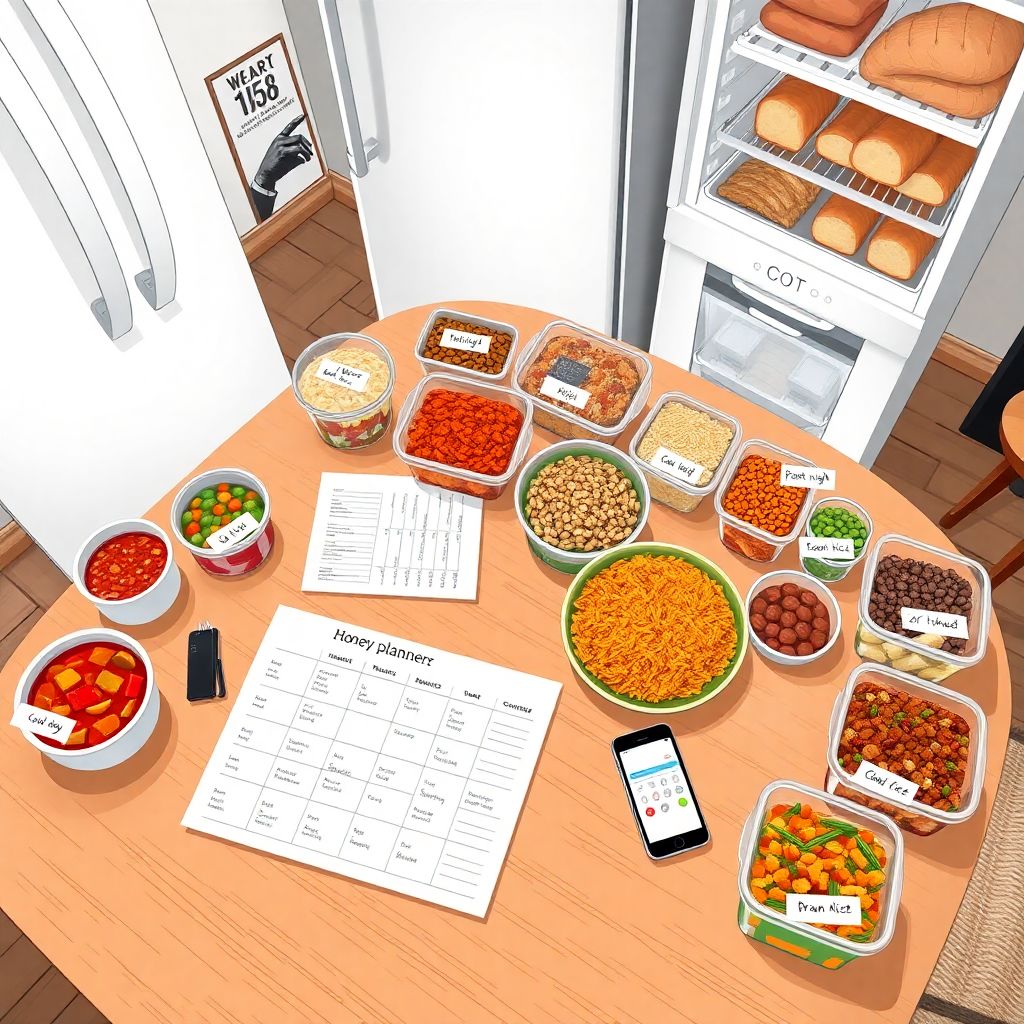
Money and food are tightly linked: every grocery run is basically a series of small financial decisions disguised as snack cravings and dinner plans. When people talk about “eating better,” they often picture fancy ingredients and huge bills, but money‑smart meal planning on a budget is much more about strategy than sacrifice. It’s about using a bit of brainpower up front so that, during the week, you can cook on autopilot, waste less, and still eat in a way that supports your health, your time, and your bank account. Think of it as building a simple system once, then letting that system quietly save you money and stress over and over again.
—
Historical background: from wartime rationing to digital meal prep

If you look back at how people ate a hundred years ago, the whole idea of cheap healthy meal planning wasn’t a lifestyle trend; it was survival. Before supermarkets and food delivery apps, families planned around seasons, local availability, and strict budgets. Leftovers were not “optional”; they were the backbone of the next meal. In the 1940s, wartime rationing in the US and Europe pushed governments to actively teach citizens how to stretch ingredients, reuse scraps, and organize meals for maximum value. Early nutrition guidelines were paired with budgeting advice, and radio shows shared practical menus that balanced calories, cost, and storage limits long before the phrase “meal prep” existed.
As convenience foods exploded after the 1950s, planning slowly shifted from necessity to choice. Canned soups, frozen dinners, and later microwave meals moved eating decisions from the kitchen table to the supermarket aisle. People planned less and reacted more, grabbing what looked tasty and quick. Strangely, this abundance made budgets harder to control: with more options and aggressive marketing, impulse buying became the norm. The modern wave of budget meal prep ideas is, in many ways, a return to those older habits—but powered now by nutrition science, price tracking apps, and a wider understanding of how food affects long‑term health and productivity.
—
Basic principles: how money‑smart planning actually works

Experts in nutrition and personal finance generally agree on one thing: a weekly meal plan on a budget works only if it is realistic for your actual life. Dr. Laura Smith, a registered dietitian who works with low‑income families, often starts with a blunt question: “What do you honestly have energy for on a Wednesday night?” Her point is simple. If your plan assumes you’ll cook elaborate recipes after a long commute, it will fail. Effective planning begins with constraints—your work hours, cooking skills, storage space, and family preferences. Within those limits, you define a small rotation of meals that use overlapping ingredients, can be batch‑cooked or prepped in stages, and tolerate substitutions when something cheaper or on sale pops up.
A second principle, highlighted by behavioral economists, is to reduce “decision fatigue.” Every unscripted food decision during the week is a chance to overspend or order takeout. The aim of low cost family meal plans is not to force strict rules, but to move 80–90% of decisions upstream: you decide once on Sunday what the backbone of the week looks like, then simply follow through. That means assigning “roles” to days—like one soup night, one pasta night, one grain‑bowl night—rather than rigid recipes. Within those roles, you swap in whatever beans, vegetables, or proteins are discounted, preserving flexibility without losing structure.
—
Strategic shopping and storage
From a financial perspective, most savings come not from extreme couponing but from preventing waste and limiting last‑minute purchases. Economist‑dietitians who study food budgets consistently find that throwing away unused produce can quietly erase the benefit of buying it on sale in the first place. A money‑smart planner reverse‑engineers the shopping list from a small set of anchor ingredients. For example, a large bag of brown rice may appear repeatedly in stir‑fries, burrito bowls, and simple soups, while a whole chicken becomes roast chicken, then tacos, then broth. The goal is to deliberately design overlaps so that ingredients are fully used before they spoil, turning your fridge into a tightly run inventory instead of a graveyard of forgotten greens.
Storage habits matter just as much as what you buy. Simple practices—like freezing half a loaf of bread immediately, cooling cooked grains before refrigerating them, or labeling containers with dates—extend how long food stays safe and appetizing. Food safety researchers frequently note that people toss food not just when it truly spoils but when they lose confidence in how long it has been there. Clear labeling, transparent containers, and a quick “fridge audit” before each small top‑up shop reinforce the planning loop and keep your budget aligned with real consumption, not wishful thinking.
—
Examples of implementation: turning theory into dinners
Consider a household of two adults and one child with limited time and a tight paycheck. Instead of starting with recipes, they first mark their “busy nights” and “lighter nights.” An honest look reveals that two weekdays are chaotic with late shifts and activities. For those evenings, they rely on reheatable batch meals such as chili or lentil curry. On calmer days, they cook more hands‑on dishes that still use the same base ingredients—onions, carrots, canned tomatoes, dry beans, rice. Across a month, they repeat a small playbook, but vary spices and formats to avoid boredom. This is where cheap healthy meal planning converges with culinary creativity: cumin, soy sauce, or garlic can all steer the same humble bean into very different directions without changing the cost structure.
Individuals focused on health goals face similar trade‑offs. Many people assume they need expensive subscriptions, yet it’s possible to mimic meal prep services for weight loss on a budget using supermarket staples, a food scale, and a clear template. Sports dietitians often suggest keeping the structure identical—half plate vegetables, a palm‑sized portion of protein, a fist‑sized portion of whole grains—while changing only flavor profiles. One week might feature chicken, brown rice, and frozen mixed vegetables flavored with teriyaki sauce; another might highlight chickpeas, quinoa, and roasted seasonal veggies. Pre‑packing these in reusable containers once or twice a week turns calorie and cost control into a mostly automated process.
—
Small experiments that build durable habits

Experts in behavior change recommend treating meal planning as a series of low‑risk experiments rather than a total life overhaul. One evidence‑based tactic is to adjust just a single meal category at a time. For instance, you could focus on building three rotating, low‑effort breakfasts that use overlapping ingredients—oats, eggs, fruit, yogurt—and track both cost and satisfaction for two weeks. Once that feels natural, move to lunches, then dinners. This incremental method reduces the sense of disruption and offers clear data: you can literally see whether a tweak saves money without sacrificing taste or convenience.
Another practical experiment is to assign a fixed, modest “test budget” for one week and document every food decision, including snacks and spontaneous coffee runs. Financial coaches often find that people underestimate these unplanned bites, which can quietly undermine even the best low cost family meal plans. By reviewing the log at the end of the week, you can spot patterns—like always caving to takeout on Thursdays—and design specific counter‑moves, such as pre‑made freezer meals targeted at that exact weak spot. The tone stays curious rather than judgmental, making it easier to adjust without feeling deprived.
—
Common misconceptions about meal planning on a budget
One popular myth is that serious meal planning is rigid and joyless, suitable only for extreme savers or fitness fanatics. In practice, the opposite is often true. Psychologists who study habits note that structure actually protects your mental bandwidth for the moments that matter, like relaxed family dinners or weekend cooking experiments. When the everyday framework is set, you’re freer to say yes to an impromptu meal with friends without wrecking the budget, because the rest of the week is already optimized. Flexibility is built in through “wildcard” meals or ingredient‑based recipes, which can absorb surprise leftovers or an unplanned discount at the store.
Another misconception is that planning is useless if your schedule is unpredictable. Emergency doctors, shift workers, and freelancers routinely manage this by shifting from day‑specific menus to portion‑based prep. Instead of deciding that you’ll eat a particular dish on Tuesday, you simply stock a mix of ready components—cooked grains, proteins, chopped vegetables—that can be combined into fast meals whenever you land at home. Financially, this approach still delivers the benefits of budget meal prep ideas because it leverages bulk buying and minimizes waste, just without insisting on a rigid calendar. The true constant is not the exact meal, but the habit of preparing ahead for the reality of your week.
—
Final thoughts: planning as a quiet financial tool
Money‑smart meal planning is less about perfection and more about direction. Every time you choose to think ahead—whether that’s jotting down a loose three‑day outline, cooking one extra portion for tomorrow, or tracking what actually gets eaten—you’re slowly aligning your food habits with your financial goals. Over months, these small, almost invisible choices compound into noticeable savings, more predictable grocery bills, and a calmer relationship with food. With a bit of experimentation and honest feedback from your own routine, you can build a system that keeps both your plate and your budget in good shape, without turning your kitchen into a full‑time job.