
Money emergencies don’t care how old you are. They hit students, parents, and grandparents the same way: suddenly and usually at the worst possible moment. A real “family” emergency fund is not just a pile of cash in one account; it’s a system that protects several generations at once and doesn’t fall apart when one person gets sick, loses a job, or passes away. Let’s break down how to actually build that kind of fund — with real stories, non-obvious tactics, and a bit of technical structure underneath the friendly tone.
—
Why a Multigenerational Emergency Fund Is Different
Most personal finance advice quietly assumes you’re only responsible for yourself, maybe a partner, and a couple of kids. In real life, many families operate in a “sandwich” model: adult children support aging parents, grandparents help with grandchildren, and money flows in both directions. That means a classic “three months of expenses” rule is often wrong for a family emergency fund. The risk profile is higher: medical shocks, caregiving gaps, cross-border costs if relatives live abroad, and legal fees if something happens to a key decision-maker. So the emergency fund must be designed like a risk buffer for a small private company, with reserves sized for multiple stakeholders and very explicit governance: who can access the funds, under what conditions, and how decisions are made when emotions are running high.
Кey nuance: a multigenerational reserve isn’t just about liquidity; it’s about operational continuity. If the adult child who manages everyone’s banking ends up in hospital, the rest of the system can’t freeze. That’s why, from day one, you should think not only about “how much money” but also “who has controlled access,” “how fast funds can be mobilized,” and “what events qualify as true emergencies” so the money doesn’t quietly leak into vacations and gadgets.
—
Step 1: Define “Emergency” for Your Specific Family
Before numbers and accounts, you need a family-level definition of “emergency.” Otherwise the fund turns into a glorified checking account. Emergencies can be split into categories: health (hospitalization, surgery, rehab), income shock (layoff, business failure), housing (urgent repairs or forced move), and care obligations (paying for a caregiver when someone becomes disabled). Sit down — ideally with core adults from two generations — and draft a simple “emergency charter”: a one-page document listing which events qualify, which don’t, and rough priority rules. Sounds bureaucratic, but it prevents passive-aggressive conflicts years later. Example: is helping a 22-year-old with moving costs an emergency? Many families say yes in the moment, then regret it when an ICU bill arrives six months later. A written charter makes it easier to say “no” without turning it into a personal rejection.
Once you’ve written this charter, store it wherever you keep key family documents: estate plans, insurance policies, powers of attorney. You’re not creating a legal contract; you’re building a decision guideline that outlives moods and temporary guilt. This single step massively reduces the biggest threat to an emergency fund across generations: slow, “harmless” erosion.
—
Step 2: Decide How Much Should Be in a Family Emergency Fund
The classic rule “3–6 months of expenses” breaks down once you add parents with chronic conditions, kids with special needs, or relatives in high-risk jobs. To estimate how much should be in a family emergency fund, collect annual expenses for each generation you’re realistically responsible for: rent or mortgage, basic utilities, food, essential transport, baseline medical costs, and any recurring caregiving like daycare or eldercare. Then, instead of just multiplying by months, assign risk weights: for example, a self-employed main earner may need 9–12 months of coverage, while a retired grandparent with stable pension may need only 3–4 months of “gap coverage” for medical copays and temporary caregivers. This risk-weighted approach is closer to how actuaries think and is far more precise than a flat rule.
A practical hack: use an emergency fund calculator online, but don’t just plug in your own expenses. Run scenarios: “What if grandma’s caregiver quits?” “What if my partner’s contract ends and job search takes six months?” Save the calculator outputs as screenshots or PDFs and discuss them at a family meeting. This turns a vague debate (“we should save more”) into something concrete: “we need an extra $12,000 over two years to cover high-risk scenarios.”
—
Step 3: Structure Accounts So Money Is Safe but Accessible

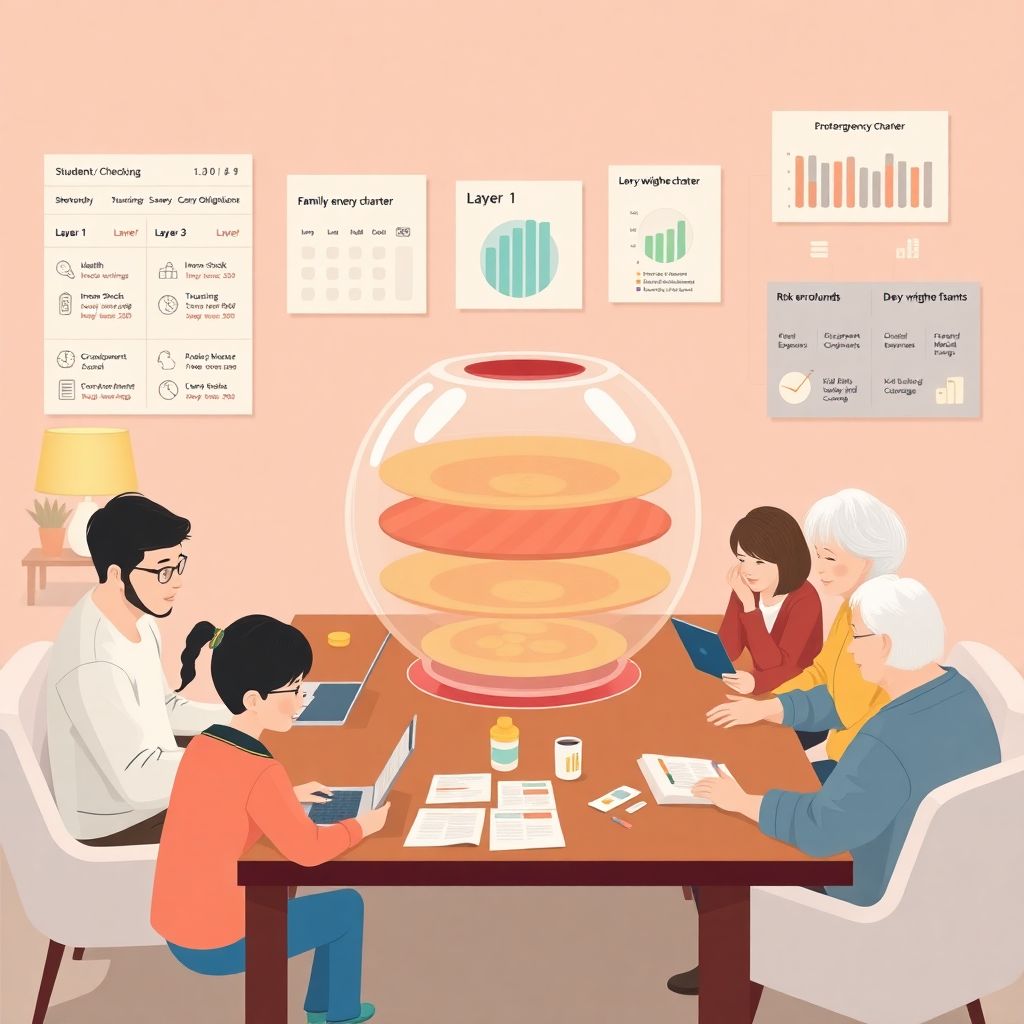
Now to the plumbing. The goal is to avoid both extremes: money buried in a single personal account that no one else can reach, and money spread so thin across relatives that no one knows the total or the rules. One robust model is a three-layer structure. Layer 1: a high-liquidity checking or current account for micro-emergencies (car breakdown, short-term medicine) with 1–2 weeks of expenses. Layer 2: a dedicated high-yield savings account that holds the bulk of the fund — 3–12 months of risk-adjusted costs. Layer 3: a secondary, slightly less liquid bucket (such as short-term Treasuries or money-market instruments) for “deep emergencies” where you’re willing to wait a few days to access funds in exchange for slightly better yield and safety.
When shopping for where to park layer 2, don’t just Google “best high yield savings account for emergency fund” and pick the top result. Check three things: FDIC/official guarantee coverage, withdrawal limits, and beneficiary setup options. Make sure you can add multiple beneficiaries or have a straightforward process for adding a co-owner if you become incapacitated. This is where a conversational meeting with your bank’s specialist can quietly morph into a risk-management workshop for your entire family.
—
Step 4: Ownership Models – Who Controls the Money?
Family politics can ruin the best-designed fund. One non-obvious but powerful tactic is to separate *legal ownership* from *decision governance*. You might open joint family savings account for emergency fund purposes between spouses or siblings for pure practicality — easier access, smoother transfers if someone is hospitalized. But you can still agree that any withdrawal over a set amount (say, one week of family expenses) requires at least two people to sign off. Informal, yes, but surprisingly effective in preventing one stressed person from emptying the fund at 3 a.m.
There’s also a case for “distributed custody” instead of one giant pot. Example: a mid-40s couple I worked with in practice manages funds for three generations. They keep a main family fund in a joint account, but also maintain small, clearly-labeled “micro-funds”: one for grandparents’ medical copays, one for car-related shocks, one for kids’ health and education emergencies. The total amount is the same, but the segmentation reduces emotional friction. When grandpa needs a sudden dental procedure, the money is drawn from “Grandparents’ Medical Emergency” rather than “the kids’ future.” Psychologically, this protects cross-generational goodwill.
—
Step 5: Real-World Case Studies (Successes and Near-Misses)
Case 1 – The engineer who quietly became the family “central bank.” A 35-year-old software engineer started a small emergency fund for his own household, planning for the usual: job loss, appliance failures. Within five years he found himself paying for his mother’s surgery deposit, his brother’s car crash deductible, and airfare for a funeral abroad. His fund was constantly depleted. When we mapped out his “true” dependents, we discovered he was functionally supporting six adults and two kids. The fix wasn’t just “save more,” but to explicitly redefine the fund as a *family* reserve, bring his brother into co-funding, and tie access to specific triggers. Over three years, the brothers built a pooled fund equal to nine months of *shared* core expenses — and their stress levels dropped sharply.
Case 2 – The retiree couple who thought they had “enough.” A retired couple believed their pension plus modest savings were sufficient. Then their daughter, a single mom, developed a chronic illness and couldn’t work full-time. They began covering daycare and medical gaps, slowly burning through their buffer. Their turning point came when they involved their adult grandson, who was just starting his career. He agreed to contribute a fixed low percentage of his income to a joint emergency fund earmarked for “health and care” only. That symbolic contribution did two things: increased capital and, more importantly, created shared responsibility across three generations.
—
Step 6: Non-Obvious Funding Strategies
If your income is already stretched, simply “saving more” is not a strategy; it’s a slogan. Non-obvious approach number one: look for *volatility reduction* instead of raw savings rate. Example: negotiate more stable work contracts, increase disability and health coverage where cost-effective, or move from variable-rate to fixed-rate loans. Each of these actions lowers the size of the emergency fund you need because fewer catastrophic scenarios can wipe you out. Insurance optimization is a boring but extremely powerful lever, especially for families supporting elders with high medical risk. Run a before/after scenario: with better insurance, your required cash buffer might shrink by several months of expenses.
Non-obvious tactic number two: embed micro-contributions into “lifecycle events.” When relatives give cash gifts for birthdays, graduations, or weddings, pre-agree that a fixed slice automatically tops up the family emergency fund rather than going entirely to consumption. Over time, these “gift skims” compound. One multiparent family I worked with saved almost $8,000 over four years just by diverting 30% of all large gifts into their shared reserve. No one felt deprived; everyone enjoyed seeing the balance grow.
—
Step 7: Alternative Methods Beyond Plain Cash
Cash is king for the first shockwave of an emergency, but beyond 6–9 months of core expenses, pure cash can be inefficient due to inflation. For longer horizons, some families adopt a layered asset strategy. The first layer remains in highly liquid accounts. The second layer sits in ultra-low-risk instruments: government bills, high-grade money market funds, or short-term CDs with laddered maturities. The third layer, rarely touched, could include conservative bond funds or even a small slice of broad-market index funds earmarked as “disaster capital” for long-duration crises like caring for a disabled relative for years.
One alternative method that works well for cross-border families: hold a thin slice of the emergency fund in a different currency or jurisdiction, but only if legal and tax rules are understood. This can hedge against local banking freezes or currency shocks. I’ve seen expat families keep 80–90% domestically and 10–20% in a very stable foreign currency account, explicitly marked as “tier-3 emergency only.” The trade-off is extra complexity, so it makes sense only when you genuinely face political or currency risk.
—
Step 8: Pro-Level Lifehacks from Practice
Lifehack 1 – Pre-approved moves. Draft in advance what you will cut or pause when you tap the emergency fund: subscriptions, non-essential lessons for kids, voluntary pension top-ups, discretionary travel. Having a “cut list” ready means you reduce outflows in the first 24–48 hours of a crisis rather than 2–3 months later when damage is already done. This is exactly how corporate contingency planning works.
Lifehack 2 – Involve a professional early. A financial advisor for family emergency planning can help you model cross-generational risks you might miss: inheritance tax friction, the cost of long-term care, or the impact of one sibling emigrating. The key is to treat the advisor as a facilitator for the whole clan, not just “grandpa’s guy.” Often, one joint session with two generations present leads to better design than five individual meetings.
Lifehack 3 – Regular “stress tests.” Once a year, run a scenario day: assume you lose the main household income for six months, a parent is hospitalized, and the car dies, all at once. Walk through: where does the money come from week by week? Which accounts, which assets, what sequence? This may sound intense, but it’s far less painful to debug your plan on a Saturday afternoon than in an actual ICU waiting room.
—
Bringing It All Together Across Generations
A real family emergency fund isn’t just an amount; it’s an ecosystem: shared definitions, clear structure, realistic targets, and honest conversations. It protects not only your bank balance, but also family relationships when stress peaks. Decide what qualifies as an emergency, calculate how much different generations realistically need, set up layered accounts with smart ownership, and use non-obvious methods to fund and protect the reserve. Over time, the fund becomes more than a safety net — it’s a quiet, practical expression of how your family takes care of each other, in this generation and the next.