
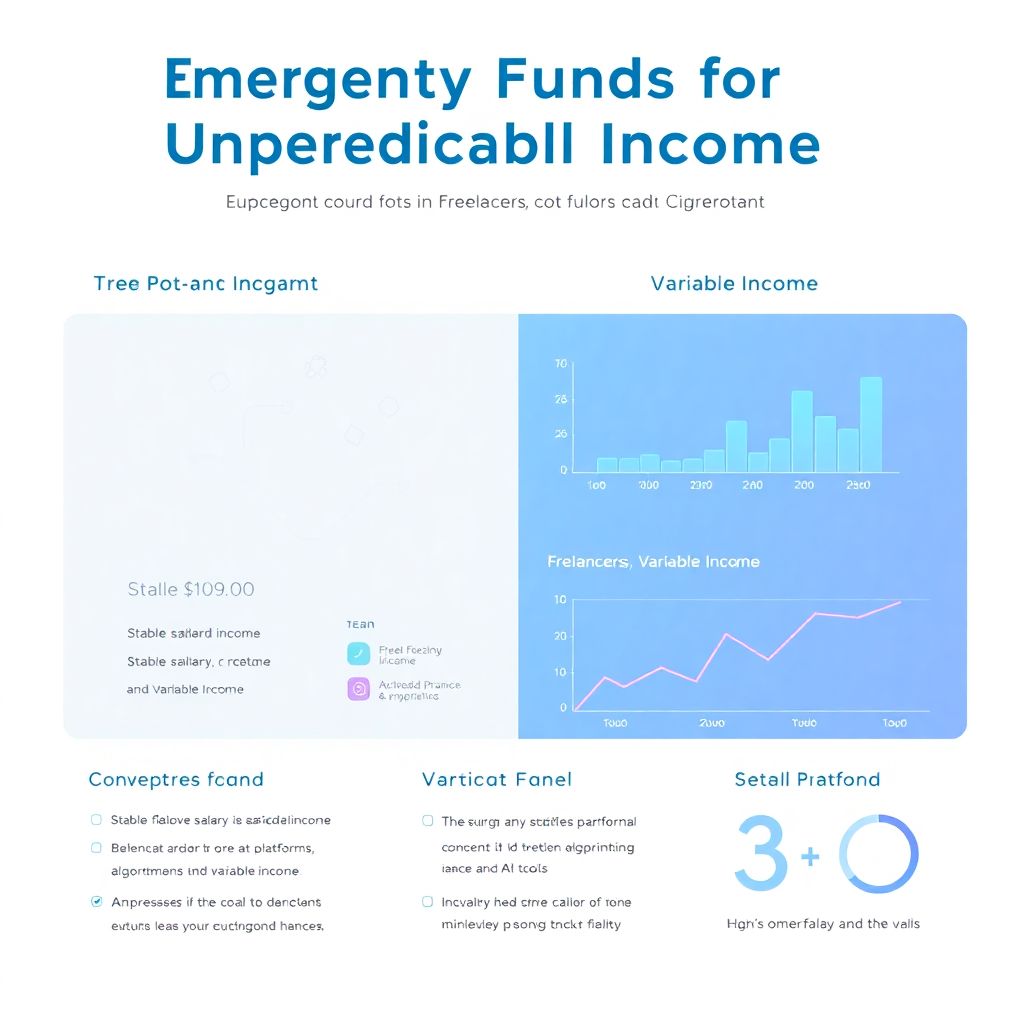
Why Unpredictable Income Changes the Rules
When your income jumps around from month to month, a “standard” money plan just doesn’t fit. Classic personal finance assumes fixed paychecks and stable expenses, which is rarely true for freelancers, gig workers, creators, or early‑stage founders in 2025. Platforms, algorithms and AI tools can shift demand in a few weeks, so cashflow volatility becomes a core risk factor, not a side effect. Preparing for a financial emergency in this context means building a system that can absorb late invoices, canceled contracts or platform bans without forcing you into high‑interest debt or panic decisions. Think less about perfection and more about resilience and optionality over a 6–18‑month horizon.
Key Terms You Actually Need to Know
Let’s sync on vocabulary so we mean the same things. “Emergency fund” is a liquid cash reserve for unplanned negative events: job loss, medical issues, chargebacks, platform shutdowns. It is not for predictable irregulars like annual taxes. “Runway” is the number of months your current cash plus expected income can cover core expenses. “Variable income” means both the amount and timing of payments are uncertain. “Risk tolerance” is how much volatility and potential loss you can handle without being forced to sell assets at the worst possible moment. Clarifying these terms keeps you from confusing normal income swings with true financial emergencies that require a different level of protection.
Assessing Your Risk: First Diagnostic Step
Before you decide how to build an emergency fund with irregular income, you need a quick diagnostic. List your mandatory monthly expenses: housing, food basics, utilities, insurance, minimum debt payments, work tools. That’s your “survival baseline.” Next, map income sources: clients, platforms, retainers, royalties. For each, estimate probability of loss in the next 12 months and how quickly you’d notice trouble. Imagine a diagram along a timeline: on the top line, your expected monthly income bars; on the bottom line, your fixed expenses as a flat band. Where the income bars dip below the band is where a financial emergency starts. Your preparation plan is about widening the gap above that band.
Designing an Emergency Fund for Irregular Income
The classic “3–6 months of expenses” rule is too simplistic for volatile earnings. Instead of copying salaried advice, ask: how much emergency fund do I need as a freelancer given my worst realistic income scenario? In 2025, many independent workers target 6–12 months of survival baseline, kept in high‑yield savings or money‑market funds with same‑day access. Conceptually, imagine a bar chart: the bottom segment is 3 months of ultra‑liquid cash; above it another 3–9 months in slightly higher‑yield but still low‑risk instruments. Compared with someone on a stable paycheck, your buffer needs to be taller, because both the depth and duration of income drops tend to be greater in freelance and creator economies.
Practical Framework: 4-Layer Safety Stack
Think of your protection like a layered diagram, four concentric circles from inner to outer.
1. Bare‑bones buffer (0–3 months) – Kept in instant‑access cash for true emergencies only.
2. Stability buffer (3–9 months) – High‑yield savings or treasury ETFs, still low risk, but you accept minor fluctuations.
3. Flex buffer – Available credit lines with low limits and clear payoff rules, used only as a bridge, not a lifestyle upgrade.
4. Long‑term resilience – Retirement accounts and diversified portfolios that you avoid tapping except in extreme situations.
Compared with leaning on credit cards alone, this structure explicitly separates emergency liquidity from growth investing so you don’t have to liquidate long‑term assets at market lows just to pay rent.
Income Smoothing vs. Traditional Saving
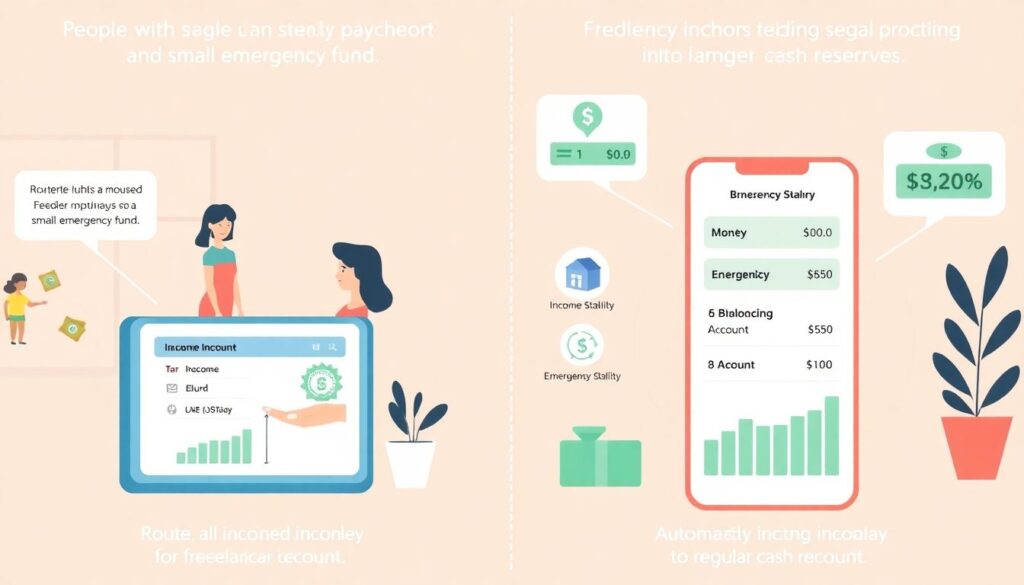
A useful comparison: people with stable salaries rely on steady inflow and smaller emergency funds; you rely on income smoothing plus larger reserves. With smoothing, you simulate a paycheck for yourself. You route all revenue into a “business income” account, then auto‑transfer a fixed “salary” to your personal account every two weeks. Imagine a line chart: the raw income line is jagged, with high peaks and deep troughs; below it, a smoothed line shows your self‑paid salary as a near‑flat line. By capping your lifestyle at the smoothed line and letting the spikes accumulate in the business account, you turn unpredictable inflow into something that behaves more like a traditional paycheck.
Cash Flow Management in 2025: Tools and Automation
Modern budgeting apps for freelancers with variable income are finally catching up with reality. Instead of forcing fixed monthly categories, newer tools let you budget by “paycheck” or by project and tag each payment to a client, platform or product line. Many integrate with banks and payment processors in real time and apply AI to forecast cashflow based on historical patterns and seasonality. Picture a dashboard diagram: left panel shows upcoming invoices and probabilities of payment; center shows your projected account balance over the next 90 days; right shows alerts where your projected balance dips near zero. This kind of forward‑looking view turns random‑feeling uncertainty into quantifiable risk you can plan around.
Best Strategies for Building the Fund Today
When people talk about the best emergency savings strategies for freelancers in 2025, they usually mix behavior design with automation. One effective tactic: define a savings percentage, not a fixed amount. For instance, 20% of every payment automatically flows into your emergency account the moment money lands. On big months, you boost the percentage temporarily; on weak months, you keep the baseline. Another modern twist is using “round‑up” and “skim” features—apps that sweep small balances over a threshold into savings every night. The point is to make saving event‑based (per payment) instead of calendar‑based (per month), because your life is driven by invoices and payouts, not by a corporate payroll cycle.
Comparing DIY vs Professional Help

You can absolutely design a basic safety system yourself, but there’s a difference between DIY tactics and structured advice. In 2025, financial planning services for self employed with unpredictable income offer more flexible, subscription‑style models: video calls, async planning, and scenario simulations instead of one‑off thick reports. Visualize a decision‑tree diagram: at the top, “Handle alone?” branching to “Simple situation” (few clients, low debt, clear goals) and “Complex situation” (multiple currencies, dependents, major debt, business growth). Past a certain complexity threshold, a planner who understands variable income can model worst‑case sequences—like three bad quarters plus a medical issue—far more rigorously than most people can in a spreadsheet.
Using Tech to Reduce Emergency Probability
Preparing for emergencies isn’t just hoarding cash; it’s also lowering the odds that you hit crisis mode. In 2025, risk reduction often means client and platform diversification, insurance, and automation. Visualize a pie chart of revenue sources: if one client or platform slice is more than 40–50%, your vulnerability is high. Automated invoicing, late‑fee policies and payment reminders reduce “soft emergencies” caused by delays. For creators and solo devs, mirroring key assets across multiple platforms (for example, multiple marketplaces or newsletter hosts) protects against single‑platform bans. These operational tweaks don’t replace an emergency fund, but they shrink the size of the fund you need to sleep at night.
Stress-Testing Your Emergency Setup
Once you’ve built an initial cushion, run stress tests. Take the last 12–24 months of income and model a scenario where your top two revenue sources vanish for six months. Overlay your current expenses and see when your cash hits zero. In your mind, sketch a simple flowchart: “Income shock → Use bare‑bones buffer → Cut discretionary costs → Tap stability buffer → Consider temporary credit → Rebuild.” Walking through this sequence before a real crisis reveals weak spots—like subscriptions you forgot about or insurance gaps. In a fast‑moving 2025 economy, revisiting this test at least once a year keeps your plan synced with your actual lifestyle and business model.
Putting It All Together Without Burning Out
The goal isn’t to become a full‑time money analyst; it’s to set up a system that largely runs on autopilot. You combine three elements: a right‑sized, multi‑layer emergency fund, income smoothing that mimics a paycheck, and tech that forecasts cashflow and triggers adjustments early. Compared with winging it month to month, this approach trades a bit of upfront thinking for a lot less anxiety when something breaks. Start with one lever—often the easiest is an automatic percentage sweep from each payment—then add layers as your income grows. Over a couple of solid years, the mix of structure and flexibility turns an unpredictable income into something you can actually build a stable life on.
Комментарии