
Why Investing on a Tight Budget Matters in 2025
If you feel “late to the game” in 2025, you’re not. A century ago, building wealth meant owning land or a business; in the 1950s — buying blue‑chip stocks through a broker in a suit; in the 1980s — watching tickers on TV and paying fat commissions. Today you can buy a slice of the global stock market from your phone with a few dollars. That’s the real shift. Learning how to build an investment portfolio for beginners now is less about being rich and more about being consistent, using tiny amounts that snowball over decades instead of chasing some magic stock tip.
Historical Context: From Wall Street to Your Smartphone
How Investing Became Accessible
For most of the 20th century, small investors were basically spectators. You needed a broker, high minimums, and patience for paper statements arriving by mail. The big change started in the 1970s with index funds: instead of guessing which company would win, you bought the whole market cheaply. In the 1990s and 2000s, online brokers cut costs, but there were still hefty fees and high trading commissions. The 2010s and early 2020s finished the revolution: commission‑free trading, fractional shares, robo‑advisors, and apps with $1 minimums. That’s the environment you’re walking into in 2025 — low barriers, but also more noise and temptation.
Why “Little Money” Is No Longer an Excuse
If you’re wondering how to start investing with little money, the key is understanding that technology solved the “minimum balance” problem. Fractional shares mean you don’t need hundreds of dollars to buy a single stock, and automatic investing lets you drip in $10 or $20 at a time. Historically, people waited to “have enough” before investing and often never began. By contrast, someone who started in 2015 with just $50 a month in a broad index fund likely saw their balance grow through multiple market swings. The lesson: time in the market beats waiting for the perfect starting amount.
Essential Tools for a Budget-Friendly Portfolio
Brokerage Accounts and Apps
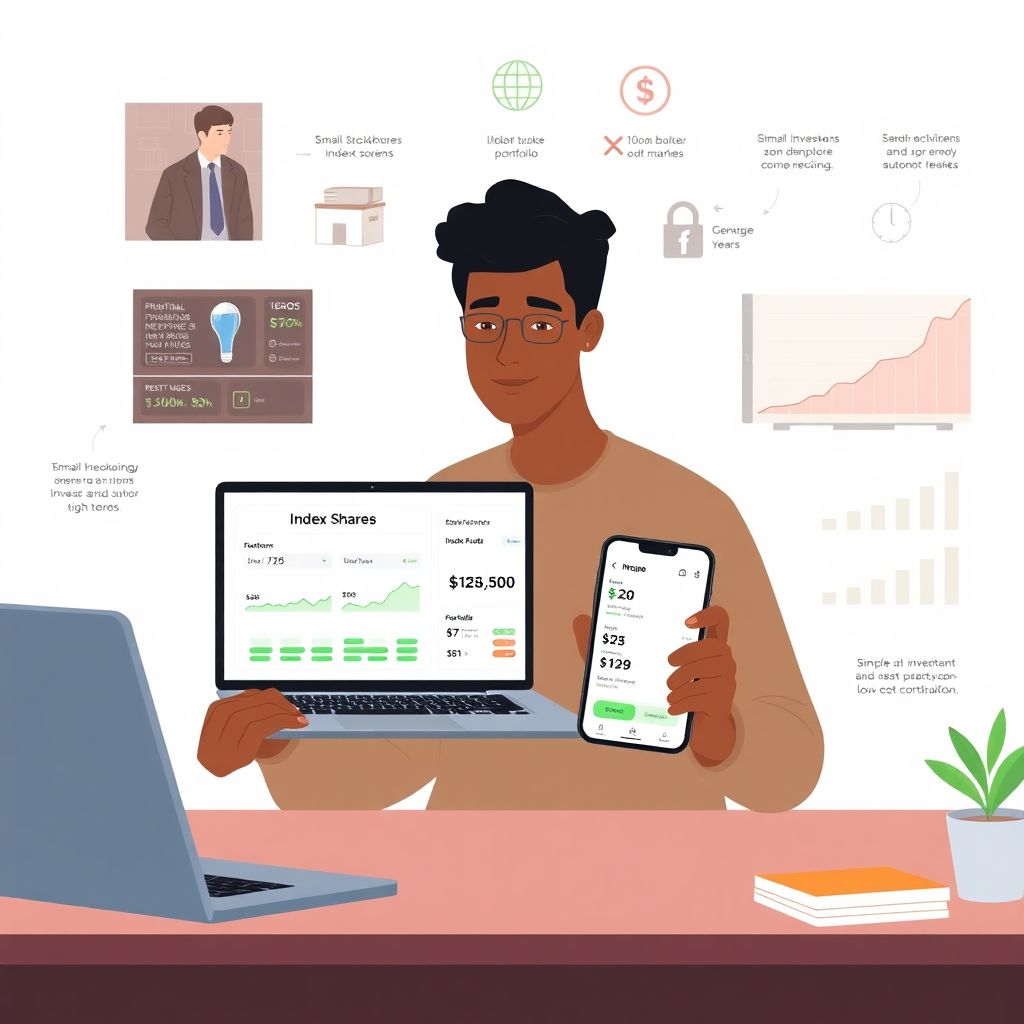
Your core tool is a brokerage account or investing app, basically a digital storefront where you buy funds and stocks. With so many options in 2025, focus on low fees, easy automation, and good support. When researching the best investment apps for beginners with low budget, look for no account minimums, fractional shares, and automatic recurring investments. Skip flashy features like daily trading prompts or complicated derivatives; they’re usually traps for beginners. A clean interface that helps you stay the course quietly beats an app trying to turn investing into a game.
Index Funds and ETFs as Your Building Blocks
For most beginners, index funds and ETFs are the “default setting.” They copy entire markets like the S&P 500 or a global stock index, instead of trying to outsmart them. The best low cost index funds for beginners usually have a tiny expense ratio, broad diversification, and a long history. Think of each fund as a basket: one purchase spreads your money across hundreds or thousands of companies. That’s a huge advantage when your budget is tight; you don’t need to pick winners, you just ride along with economic growth. Add a low‑fee bond fund later if you want to soften the ups and downs.
Budgeting and Automation Tools
Investing on a tight budget starts with knowing what cash you can actually spare. A simple budgeting app or even a spreadsheet can show where money leaks out each month — subscriptions you forgot, food delivery habits, impulse buys. Once you’ve freed up even $25 or $50, automation is your best friend. Set a recurring transfer from your bank to your brokerage right after payday, so you pay your future self before money disappears. This habit removes decision fatigue and emotional drama; you’re just following a system, not constantly asking, “Is now a good time?”
Step-by-Step: How to Build an Investment Portfolio on a Tight Budget
Step 1: Define Your Goal and Time Horizon
Before touching an app, ask: “What is this money for, and when will I need it?” If you might need cash in two years for a move or tuition, it belongs in high‑yield savings, not stocks. If your timeline is 10, 20, or 30 years, you can ride out scary downturns and aim for growth. Goals don’t have to be fancy: “Retirement at 65,” “Down payment in 12 years,” or “Financial safety cushion by 2035” are clear enough. Knowing your horizon helps decide how aggressive your portfolio should be and keeps you from panicking at the first market dip.
Step 2: Choose an Investing App or Broker
Next, open a brokerage account. In 2025, the sign‑up flow feels like opening any other app: ID check, link your bank, answer a few risk questions. When comparing platforms, ignore celebrity ads and look closely at fees and features. Does it charge trading commissions? Are there inactivity penalties? Can you buy index funds and ETFs easily? Does it offer tax‑advantaged accounts in your country (like IRAs or ISAs)? The “best” broker is the one that makes it painless to stick to your plan, not the one with the loudest marketing or most complex charting tools.
Step 3: Pick a Simple Starter Portfolio
Now build a structure that fits tiny contributions. A common beginner setup is a single broad stock index fund, or two‑fund combo: one global or U.S. stock index and one bond index for stability. This keeps decisions minimal and costs low. You don’t need sector funds, crypto experiments, or hot thematic ETFs to get started. A good mental rule: if you can’t explain in one sentence what a fund holds and why you own it, skip it for now. Complexity can come later; survival and consistency matter more in your first few years.
Step 4: Invest Your First Small Amount
If you’re unsure how to invest 100 dollars for beginners, treat it like a test run. Deposit the $100, buy your chosen index fund or ETF (using fractional shares if needed), and then… do nothing dramatic. Watch how the app works, how prices move daily, and how dividends show up. This tiny stake is about building comfort with the process, not chasing huge returns. After that, set up a recurring monthly transfer, even if it’s just $20. You’re training your brain that investing is a normal bill, like rent or utilities, not a rare event that requires perfect timing.
Step 5: Automate and Rebalance Over Time
As your balance grows, your original percentage mix can drift. Maybe stocks soar and bonds lag, so you end up more aggressive than you planned. Rebalancing means nudging things back to your target every year or so by directing new contributions or, if needed, selling a bit of what’s overweight. Many robo‑advisors do this automatically; with a manual portfolio, a calendar reminder once a year works. Rebalancing is the grown‑up version of “buy low, sell high” — you’re trimming what ran too far and topping up what’s cheaper, following rules instead of gut feelings.
Troubleshooting Common Beginner Problems
“I Don’t Have Enough Money to Make It Worthwhile”
This is the most common mental roadblock. But historically, most big portfolios started small; the difference is discipline, not income level. If you can find $25 a month, that’s your starter engine. In 2025, you don’t pay huge commissions on small trades anymore, so modest sums are fine. Focus on raising the contribution over time rather than waiting to start big. Each raise — maybe after a pay bump or cancelling a recurring expense — accelerates the compounding effect. Your first goal is not wealth; it’s forming the identity of someone who invests every month.
“The Market Is Too High / Too Scary Right Now”
Looking back at the past decades, every era had a reason to stay in cash: wars, inflation spikes, tech bubbles, pandemics, political crises. Yet long‑term charts show a jagged but rising line. Trying to guess the perfect entry point usually leads to paralysis. Dollar‑cost averaging — investing the same amount on a regular schedule regardless of headlines — is your antidote. It quietly makes you buy more shares when prices are low and fewer when they’re high, without complicated math or predictions. You’ll never hit the exact bottom, but you’ll always be in the game.
“My Portfolio Is Down — Did I Mess Up?”
Seeing your account balance shrink for the first time can feel like failure, especially when money is tight. But volatility is normal, not a bug. Historically, broad stock markets have had frequent drops of 10% or more, and still delivered positive returns over decades. The question isn’t “Did I pick the perfect moment?” but “Am I following a reasonable plan I understood when I was calm?” If your mix matches your time horizon and you used diversified funds, a downturn is usually a test of patience, not a sign your strategy is broken. Resist the urge to turn a paper loss into a permanent one by panic‑selling.
“There Are Too Many Choices — I’m Overwhelmed”
Modern platforms overflow with funds, strategies, and opinions. To cut through the noise, go back to basics: broad index funds, low fees, and a simple allocation you can explain to a friend. If you truly hate decision‑making, a robo‑advisor that builds and rebalances a portfolio for a small fee can be worth it. Think of it like autopilot: you still choose the destination, but you’re not manually steering every second. Over time, as your confidence grows, you can tweak or add components, but there’s no prize for complexity when you’re just starting out.
Putting It All Together
Your First-Year Game Plan
In your first year, measure success by habits, not account size. Open an account, pick one or two cheap index funds, invest a small lump sum plus a monthly amount, and ignore short‑term noise. Read a bit about market history so price swings feel less mysterious. Maybe review your setup twice: once after six months to see if contributions feel comfortable, and once after a year to consider a tiny rebalance. That’s it. You’re building a muscle, not auditioning for a trading floor. Boring is good — in fact, boring usually beats “exciting” over the long run.
Final Thoughts for 2025 and Beyond

In 2025, the hardest part of learning how to start investing with little money isn’t access; it’s focus. The tools are cheap and abundant, from robo‑advisors to zero‑commission brokers offering some of the best low cost index funds for beginners. What you bring to the table is consistency, a long time horizon, and a refusal to be yanked around by every headline or hot tip on social media. If you stick to a simple plan, increase contributions as your income grows, and let decades do their work, your “tight budget” origin story can turn into a surprisingly solid investment portfolio over time.
Комментарии