
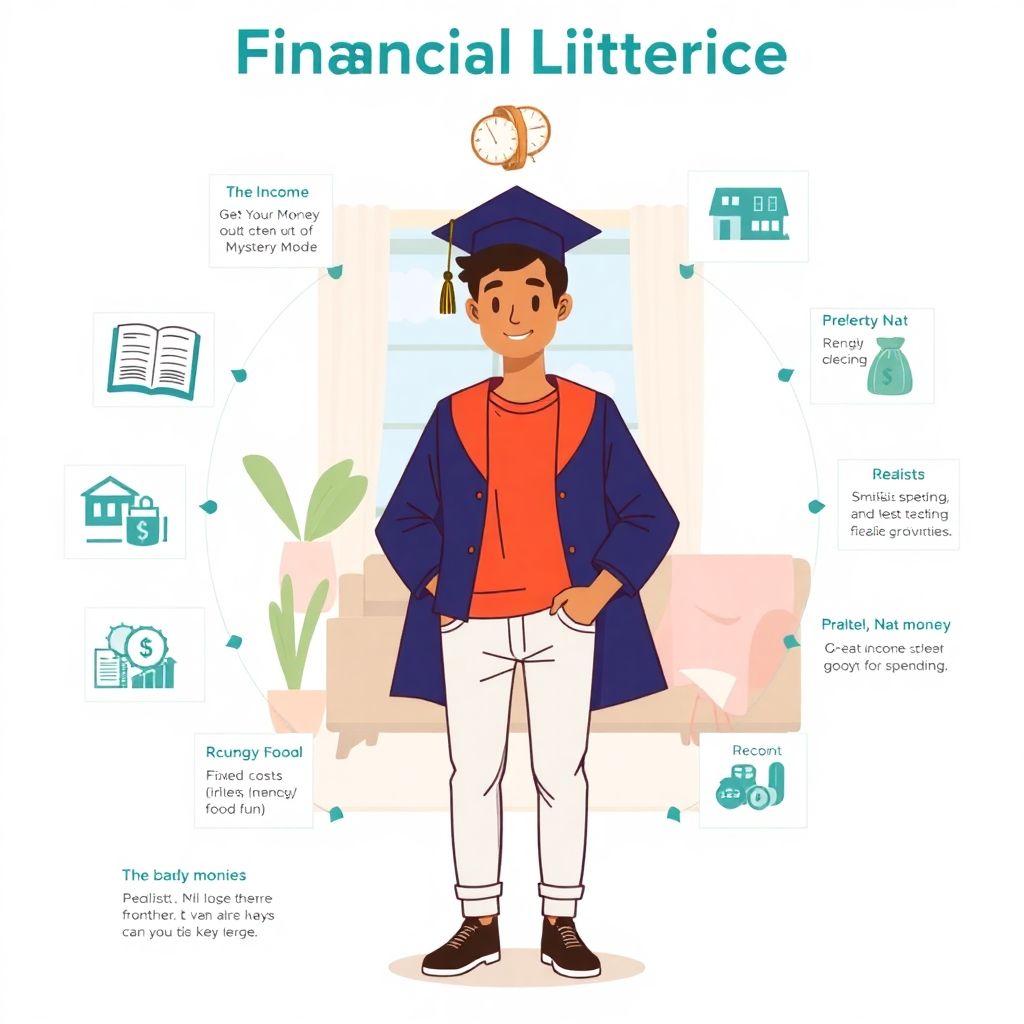
Why Financial Literacy Matters Right After College
You graduate, toss the cap, and suddenly everyone expects you to know how taxes, rent, credit scores, and retirement accounts work. Spoiler: almost nobody does at first.
Still, this stage is critical. The money choices you make in the next 3–5 years can either set you up for freedom… or keep you playing catch‑up for a decade.
Think of financial literacy as learning how your “real‑life game” works: rules, cheat codes, traps, and long-term strategies. This guide walks you step by step: from simple budgeting to real wealth, with practical, sometimes non‑standard solutions you probably didn’t hear in class.
—
Step 1. Get Your Money Out of “Mystery Mode”
Know Your Numbers (For Real, Not “In My Head”)
Most grads guess their spending. That’s how money leaks happen.
For one full month, track every cent. No optimization, no judgment. Just observe.
You need three key numbers:
– Average monthly income (after tax)
– Fixed costs (rent, utilities, insurance, minimum debt payments)
– Flexible spending (food, fun, random Amazon buys)
You can track with:
– A notes app and screenshots of your bank statements
– A simple Google Sheet
– Or the best budgeting apps for recent graduates like Mint, YNAB, or Simplifi, if you prefer automation
The goal isn’t perfection. The goal is clarity. Once you see where the money actually goes, financial planning for college graduates stops being abstract and becomes very real.
Common Trap: “I’ll Start Tracking When I Make More”
Waiting until you “earn enough” is like saying you’ll start brushing teeth when you’re rich.
Habits scale. If you’re sloppy with $2,000 a month, you’ll be sloppy with $8,000 a month—just in more expensive ways.
—
Step 2. Build a Realistic, Not Miserable, Budget
The Anti-Diet Budget
Plenty of guides push the 50/30/20 rule. It’s fine, but here’s a more flexible approach that doesn’t feel like punishment:
1. Secure the essentials (roof, food, utilities, transport).
2. Commit to a fixed “future you” percentage (debt + savings + investing).
3. Spend the rest guilt‑free—as long as you don’t go into debt.
A simple starting split if your income allows:
– 55–65% essentials
– 15–25% future you (savings, investing, extra debt payments)
– 10–25% guilt‑free fun
If you’re in a HCOL (high cost of living) city or on a low salary, your “future you” slice might be smaller at first. That’s fine. You’re building the *habit*, not competing on Instagram.
Nonstandard Trick: Budget by “Days of Freedom”
Instead of asking “Can I afford this?” ask:
“How many days of financial freedom does this cost me?”
– Take your monthly fixed costs (say $1,800).
– Divide by 30 → $60 per day.
If that $120 night out equals 2 days of freedom, you might still say yes—but you’ll say it consciously. This framework makes trade‑offs much more real than random dollar amounts.
—
Step 3. Automate Everything You Can
Set It So You Don’t Have to “Be Strong” Every Month
Willpower is terrible at managing money. Systems are better.
1. Automatic bill payments
– Set autopay for rent, utilities, phone, subscriptions (at least for minimums).
2. Automatic “pay yourself first” transfers
– Day after payday: move a set amount to savings and investments before you see the leftover.
3. Separate accounts on purpose
– One account for bills
– One account for daily spending
– One savings account you don’t touch
This way, your lazy days still look financially responsible.
Beginner Tip: Use Friction Smartly
Add a tiny bit of friction around bad habits:
– Remove stored cards from shopping sites
– Keep a “cooling-off” rule: 48 hours before any purchase above $100
– Turn off one‑click ordering where possible
But add *less* friction for good habits:
– Auto‑increase your 401(k) or IRA contributions when you get a raise
– Schedule a recurring calendar reminder for “money check‑in” once a month
—
Step 4. Attack Debt Strategically (Especially Student Loans)
Student Loan Repayment Strategies for Graduates
Ignoring your loans is emotionally understandable—and financially dangerous. Let’s turn them into a project instead of a fog.
Main approaches:
– Debt snowball: Pay off the smallest balance first for quick wins, then roll that payment into the next one. Great for motivation.
– Debt avalanche: Pay off the highest interest rate first. Mathematically best.
– Hybrid: Clear one small loan fast (a quick psychological win), then switch to avalanche.
For federal student loans, check:
– Income-driven repayment plans
– Public Service Loan Forgiveness (if you work in qualifying government or nonprofit roles)
– Temporary interest or payment pauses (when offered)
Those are powerful student loan repayment strategies for graduates who feel overwhelmed but want a path forward.
Nonstandard Move: Turn Debt into a Side‑Quest
Create a “Debt Destroyer Fund”:
– Pick any extra income source (freelance, tutoring, driving, selling stuff, overtime).
– Commit 100% of that income to one specific loan until it dies.
Psychologically, this is huge: your day job pays your life; your side‑quest kills the debt. It feels less like sacrificing your present and more like unlocking an achievement.
—
Step 5. Build Your Safety Net First
Emergency Fund: Your Drama Shield
Before aggressive investing, you need a buffer. Otherwise, every flat tire becomes a crisis.
Starter target:
– 1 month of bare‑bones expenses as fast as you can
– Eventually: 3–6 months, depending on job stability and health
Keep this in:
– A high‑yield savings account (online banks usually pay better than big traditional ones)
– Somewhere boring, not in stocks or crypto; this is not for “making money,” it’s for *not panicking*
Newbie Mistake to Avoid
Skipping an emergency fund because:
– “I have credit cards if something happens.”
This often turns a temporary problem into long-term high‑interest debt. Use credit as backup‑backup, not Plan A.
—
Step 6. How to Start Investing After College (Without Being Rich)
Start Small, Start Early, Don’t Try to Be a Genius
You don’t need a lot of money to start. You need time and consistency.
Simple starter roadmap for how to start investing after college:
1. If your job offers a 401(k) with a match, contribute at least enough to get the full match. That’s free money.
2. Open a Roth IRA (if eligible) or traditional IRA and set up automatic monthly contributions, even if it’s just $50.
3. Use low‑cost index funds or ETFs that track broad markets (like S&P 500 or total stock market funds).
You don’t have to pick “the next Tesla.” You’re not trying to be a stock picker; you’re trying to own a slice of global capitalism for decades.
Nonstandard Hack: “Investment Rent”
If you get a raise, bonus, or move to a cheaper place, “pretend” your cost of living didn’t change.
– Keep your lifestyle the same
– Send the difference straight into investments
You’re basically letting future you live in your boss’s money instead of inflating your lifestyle.
—
Step 7. Choose Tools That Fit Your Personality
App‑Heavy vs. Analog: Both Work
Some people love neatly categorized graphs; others just want not to be broke. Both types can succeed.
You might:
– Use one of the best budgeting apps for recent graduates to track everything automatically
– Or stick to a simple weekly ritual: coffee, bank app, 10‑minute overview, adjust as needed
Pick tools you’ll actually use, not the ones that look smart in screenshots.
Useful Categories to Watch
Consider keeping an eye on:
– Housing (rent + utilities)
– Transportation (car, public transit, rideshare)
– Food (groceries vs. eating out)
– Fun & lifestyle (subscriptions, nightlife, hobbies)
– Future you (savings, investments, extra debt payments)
You don’t have to micromanage every coffee. Just know where your big leaks live.
—
Step 8. Increase Your Income on Purpose
Spending Less Has Limits. Earning More Doesn’t.
Cutting costs is useful, but there’s a floor. Income, in contrast, can grow a lot if you treat your career like your main asset.
Some wealth building tips for young professionals:
– Be “annoyingly clear” with managers: Ask what *specifically* would justify a raise or promotion in 6–12 months. Get it in writing or email.
– Stack rare skills: Combine 2–3 skills (e.g., marketing + basic coding + data analysis) to become harder to replace.
– Leverage your twenties: Take roles with steep learning curves over slightly higher pay with no growth. Your future earning power matters more than your first salary.
Nonstandard Angle: Treat Your Job Like an Investor
Ask: “If I were an investor, would I put money (time) into this role or company?”
If:
– You’re learning in-demand skills
– You’re building a portfolio, network, or reputation
– You see a path to better pay or a better role
…then this job is paying you *twice*: in money now and opportunities later. If it’s not, start planning an exit, even if it takes a year.
—
Step 9. Protect Your Downside (Boring but Critical)
Insurance and Credit: The Invisible Parts of Wealth
Wealth isn’t just about what you *earn*—it’s also about what you don’t lose.
Basics to handle:
– Health insurance: Even a high‑deductible plan is better than going uninsured. One ER visit can wreck your finances.
– Renter’s insurance: Usually cheap; protects your stuff and sometimes you from liability.
– Basic disability coverage: If your employer offers it, don’t ignore it. Your ability to work is your biggest asset.
And then credit:
– Pay the full statement balance on credit cards every month, not just the minimum.
– Keep utilization under ~30% of your total limit (10% is even better).
– Set alerts for due dates so you never miss a payment.
Good credit = cheaper loans, better rental options, and sometimes even better job opportunities.
—
Step 10. Design Your Personal Money System
Your 90‑Minute Setup Plan
If you want a concrete action plan, here’s a compact sequence:
– Week 1
– Track every expense (no judgment).
– List all debts, interest rates, and minimum payments.
– Week 2
– Create a basic budget with “future you” as a non‑negotiable category.
– Set up automatic payments for bills and minimum debt.
– Week 3
– Open (or adjust) retirement accounts: 401(k)/IRA.
– Start a $25–$100 monthly automatic investment into a low‑cost index fund.
– Week 4
– Build or top up your starter emergency fund (aim for 1 month of basic expenses).
– Pick one side‑quest: either increase income or accelerate one key debt.
You don’t need to fix everything at once. You need consistent reps.
Mindset Shift: You’re Building a System, Not Chasing Perfection

You will:
– Overspend some months
– Forget a bill once
– Make a dumb purchase you regret
That doesn’t make you “bad with money.” It makes you human.
The win is that your *default* system pulls you forward even when you’re not at 100%.
—
Nonstandard (But Powerful) Money Habits to Steal
1. Monthly “Net Worth Snapshot”
Once a month, write down:
– What you own (cash, investments, etc.)
– What you owe (loans, cards, etc.)
Subtract: this is your net worth.
At first it might be negative. That’s fine. Watching it move from –$30,000 to –$28,000 to –$24,000 is wildly motivating. It turns an invisible journey into visible progress.
2. Lifestyle Experiments Instead of Permanent Sacrifices
Instead of swearing off coffee or restaurants forever, run 30‑day experiments:
– “No rideshares unless it’s raining or after midnight.”
– “Cook at home on weekdays, eat out on weekends only.”
– “Cancel all but 3 subscriptions; reevaluate next month.”
Temporary experiments feel lighter than permanent rules—but many will stick because you *feel* the benefits.
3. Money Dates (Even If You’re Single)
Once a month:
– Check accounts and net worth
– Adjust auto‑transfers if needed
– Ask: “What’s one small money move that would make next month easier?”
Treat it like a short meeting with your future self. Coffee, music, 20–30 minutes. When done consistently, this one ritual keeps your entire system from drifting.
—
From Budget to Wealth: Your First Real Advantage
Most people drift for years after college—earning, spending, stressing, but never really steering.
You’re not trying to become a finance guru. You’re building a simple, boring‑but‑powerful system:
– Clear view of your money
– A budget that doesn’t feel like a punishment
– Smart handling of debt and an emergency fund
– Automatic investing that grows quietly in the background
– Career moves and side‑quests that raise your income over time
Do this for 3–5 years, and “wealth” stops being a fuzzy idea and starts looking like options: where to live, what work to accept, what you can say no to.
That freedom is what financial literacy for college graduates is really about—and you can start building it with your very next paycheck.