
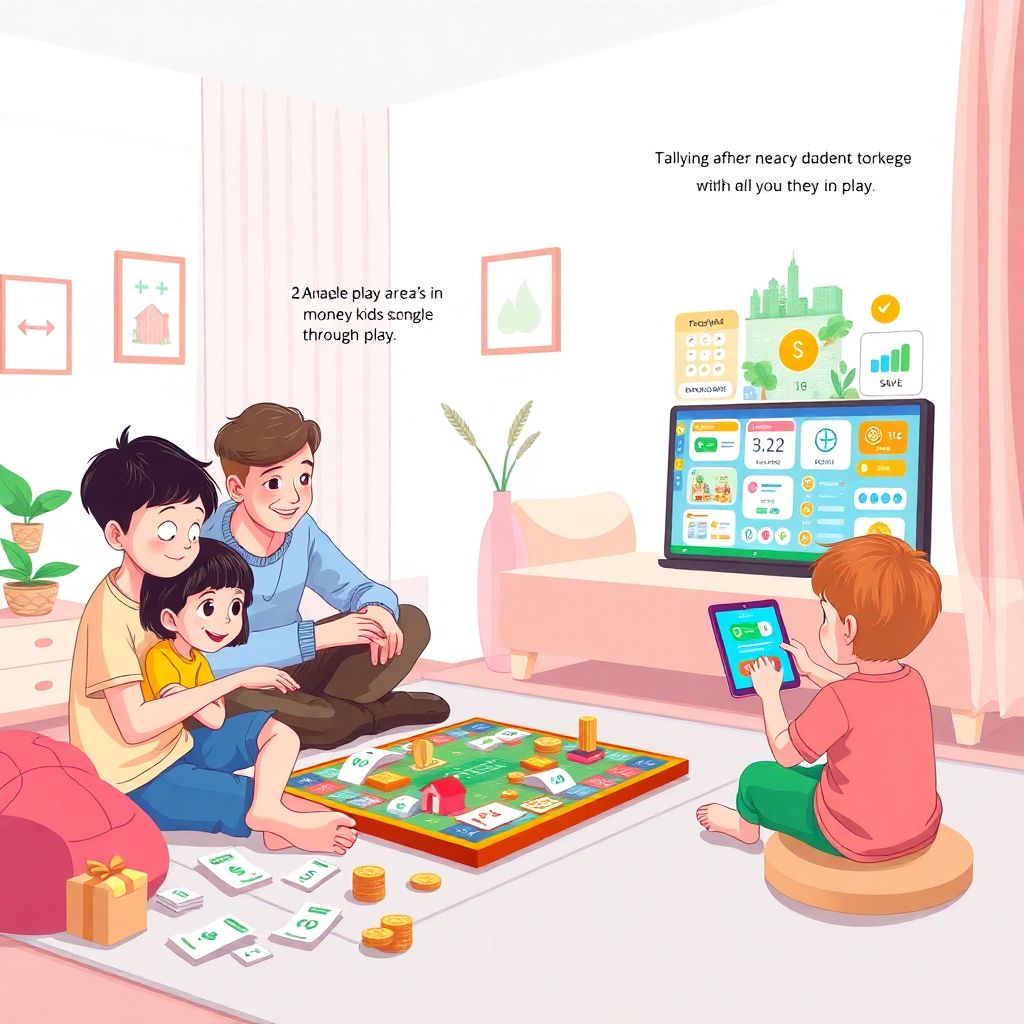
Why Money Lessons Belong in Everyday Play

Teaching kids about money sounds serious, but it works best when it feels like play. When you turn budgeting, saving and smart spending into games and activities, kids build “financial muscle memory” long before they ever see a real paycheck.
Instead of long lectures, you’re creating tiny simulations of real life: earning, choosing, waiting, trading off. That’s exactly what money games for kids are good at when you use them intentionally, not just as random entertainment.
—
Main Approaches: Analog vs Digital vs Real-Life Play
1. Classic Board Games and Card Games
Board games and card games are still some of the best board games to teach kids about money because they create a closed “economic system” that kids can experiment in safely.
Longer description:
Games like Monopoly-type titles, business simulators or store-themed card games implicitly teach:
– Counting and making change
– Basic cash-flow (income vs expenses)
– Simple investment decisions (“Do I buy this property now or save for later?”)
They’re tactile. Kids handle bills, coins and tokens, which reinforces number sense and value comparison.
Short note:
The downside? Many traditional games have oversimplified or even unrealistic economic rules (endless debt, random windfalls, no taxes, no inflation). So you’ll want to “decode” them after you play.
—
2. Digital and Online Money Simulations
Online money management games for kids live on tablets, phones and laptops. They range from simple “store simulators” to more complex financial literacy platforms with missions, levels and rewards.
In practical terms, these games can model:
– Budget allocation across multiple categories
– Dynamic prices and sales
– Time-based rewards (interest, streak bonuses)
Many modern financial literacy games for children also add narrative: kids run a café, build a city, or manage a sports team budget. This narrative context makes abstract ideas (like opportunity cost) feel concrete: “If I spend all my coins on décor, I can’t afford staff.”
Short point:
Tech is great at instant feedback. Kids see the consequences of choices in seconds, which accelerates learning—if you talk about those choices afterwards.
—
3. Real-Life “Micro-Economy” at Home
The third approach is turning your home into a low-stakes economic sandbox.
Longer view:
You create small systems where kids:
– Earn (allowance, task bonuses, one-off gigs)
– Decide (spend now, save, donate)
– Experience outcomes (running short before a goal, hitting a savings target, waiting for a sale)
This is where activities to teach kids about saving money really shine: clear goals and visible progress. You can use tools like transparent jars, simple paper “bank statements,” or a child’s account in a real or app-based bank.
Short summary:
Games and apps rehearse the skills; real-life practice locks them in.
—
Comparing Approaches: What Each Does Best
Board & Card Games vs Digital Games vs Real-Life Practice
Let’s compare them by what they’re actually training.
Board & Card Games
– Great for: arithmetic, turn-based decision-making, negotiating with siblings
– Weak at: representing ongoing subscriptions, digital payments, taxes
– Hidden benefit: social skills (bargaining, handling loss, dealing with “unfair” events)
Digital Money Games
– Great for: tracking multiple variables (budgets, goals, debts) in real time
– Weak at: sense of “real” money and physical limits (“you can’t swipe forever”)
– Hidden benefit: kids learn basic interfaces similar to online banking and e-wallets
Real-Life Practice
– Great for: emotional side of money (impatience, regret, pride in saving)
– Weak at: repetition; you can’t replay a real purchase like a game level
– Hidden benefit: kids see parents’ actual money behavior, which is the strongest teacher
Short takeaway:
Use games (analog and digital) as simulators and real life as the final exam. Rotate among all three so kids don’t think money only exists in apps or on cardboard boards.
—
Pros and Cons of Technology in Money Teaching
Advantages of Tech-Based Money Learning
Digital money games for kids and apps offer some clear strengths:
– High repetition without boredom. Kids can make hundreds of financial decisions in a weekend of playing, something that would take years in real life.
– Instant analytics. Some apps show visual breakdowns: “40% spent on snacks, 30% on upgrades, 30% saved.” That’s a built-in financial dashboard.
– Adaptive difficulty. Better tools adjust scenarios to age and skill, moving from simple earning/spending to taxes, loans and even basic investing.
Short benefit:
Tech compresses financial experience into a short, safe, engaging format. That’s powerful if you stay involved as a co-player or “financial coach.”
—
Limitations and Risks of Tech
There are also technical and psychological downsides you should factor in.
– Abstraction risk. When money is just numbers on a screen, kids may underestimate its real-world constraints.
– Reward design. Many apps emphasize streaks and badges more than genuine decision quality. Kids learn to “tap what’s rewarded,” not think critically.
– Data and privacy. Free apps often monetize via ads or data. For younger users, that’s a red flag.
– Screen balance. If “money learning” means more unsupervised screen time, the side effects may outweigh benefits.
Short guideline:
Use digital tools as instruments, not babysitters. The learning value drops fast if you’re not discussing what they’re doing and why.
—
Practical Game Ideas by Age Group
Preschool (3–5): Building Money Awareness
Focus on recognizing coins and notes, understanding “more vs less,” and waiting.
– Play “store” with fake money and real items. Make kids “pay” and give change, even if you help with counting.
– Use a clear jar labeled with a simple picture (toy, book) as a savings target. That’s your first practical implementation of activities to teach kids about saving money.
Short twist:
Occasionally introduce “sales” in your pretend store so kids see that timing can change price.
—
Early Elementary (6–9): Basic Budgeting and Trade-Offs
At this age, kids can handle simple rules and delayed rewards.
Try this mix:
– One family-friendly board game involving buying, renting, or running a business
– One simple financial literacy games for children app with missions
– One real-life savings goal with a visual tracker
Bullet list of concrete ideas:
– Give weekly allowance in small denominations so kids explicitly allocate: spend / save / share.
– After a board game, ask: “What was one good money decision you made in the game? One bad one?”
– In an app, pause when they’re stuck and say: “Explain your plan before you tap.”
Short note:
You’re wiring in the habit of thinking before spending, not just tapping because something is shiny.
—
Preteens (10–12): Planning, Goals and Simple Investing Concepts

Now you can introduce more realistic mechanics and vocabulary (budget, savings rate, interest, fixed cost, variable cost).
Practical game structure:
– Use best board games to teach kids about money that include auctions, limited resources and some kind of “return on investment.”
– Add a digital simulation that lets them run a virtual business or manage a city budget.
– Mirror the game structure with real life: set a 3–6 month savings goal where they decide what to sacrifice.
Helpful activities:
– Let them plan the budget for a pizza night or birthday party within a fixed amount, comparing 2–3 scenarios.
– Set up a simple “family bank” where you “pay interest” monthly on their saved money, so they see compounding in action.
– After playing, ask: “In the game, what would have happened if you’d saved more in the early rounds?”
Short insight:
The goal is not perfect math; it’s connecting actions now with consequences later.
—
Teens (13+): Near-Real Simulations and Digital Finance
Teens are ready for more complex, almost real systems.
Longer approach:
– Use stock-market simulators or advanced business games to show risk, volatility and portfolio thinking.
– Let them manage a prepaid card or youth account with app-based alerts. Treat this as a live version of online money management games for kids, with real stakes but clear boundaries.
– Introduce basic concepts of fixed vs variable expenses, subscriptions, and “lifestyle creep.”
Bullet list of practical drills:
– Have them “run the numbers” on a big want (e.g., a console): upfront cost, accessories, subscription services, resale value.
– Once a month, review their spending app together and ask them to classify expenses and spot patterns.
– Use game-like challenges: “Can you reduce your non-essential spending by 15% this month without feeling deprived?”
Short warning:
This is where habits can lock in for adult life. Treat their financial decisions seriously, but keep the atmosphere safe enough for mistakes.
—
How to Choose the Right Games and Activities
Step 1: Start from the Skill, Not the Game
Decide what you’re targeting:
– Recognizing value and doing change
– Waiting and saving
– Comparing options
– Long-term planning
Then pick tools (board game, app, real-life task) that force kids to use that skill repeatedly. A flashy app that doesn’t make them decide anything meaningful is entertainment, not education.
Short rule:
If you can’t answer “What exactly is this game teaching?” skip it.
—
Step 2: Check for Hidden Incentives
Analyze the game mechanics like a system designer:
– Does it reward only speed and clicking, or thoughtful planning?
– Is there a “pay-to-win” aspect that undermines the lesson?
– Are mistakes recoverable so kids experiment, or is one error catastrophic?
Short tip:
Good money games encourage experimentation and reflection, not perfection.
—
Step 3: Align with Family Rules and Real Tools
Whenever possible, connect in-game actions to real-world practices:
– Using budgets in a game? Show them your grocery budget template.
– Saving for upgrades? Link it to their real savings goal.
– Earning in a virtual job? Talk about how pay works in actual jobs (hourly vs salary, taxes).
Short bridge:
The more you map game mechanics to daily life, the more the lessons stick.
—
Trends in 2025: What’s Changing in Kids’ Money Education
1. AI-Driven Personalization
New platforms in 2025 increasingly use AI to adapt financial scenarios to each child’s behavior:
– If a kid always overspends early rounds, the system emphasizes budgeting missions.
– If they save too conservatively, it introduces low-risk “investment” stories to model growth.
Short implication:
Expect financial literacy tools that feel like personal trainers for money skills, not static worksheets.
—
2. Integration with Real Banking & Fintech
Youth debit cards and child-friendly fintech apps are blurring the line between simulation and reality:
– Gamified savings goals with progress bars and streak rewards
– Round-up features that send spare change into savings or micro-investing
– Parent dashboards that flag risky patterns
Short caution:
These tools are powerful, but they’re also products. Read terms, understand fees, and treat them as teaching tools, not just cool gadgets.
—
3. More Narrative and Collaborative Money Worlds
2025 products are moving toward multiplayer, story-rich environments:
– Cooperative quests where siblings manage a shared budget for a mission
– Storylines that incorporate giving, environmental impact, and ethical spending
– Longer arcs where financial choices affect characters’ futures, not just scores
Short benefit:
Kids see money as part of a larger system of values and relationships, not just as a way to buy stuff.
—
4. Offline “Counter-Trend” Activities
At the same time, many educators are intentionally going low-tech to balance screens:
– Maker-style projects with real budgets and materials
– Pop-up “kid markets” and fairs where children sell crafts or snacks
– Simplified household accounting charts kids fill in by hand
Short balance point:
The most robust money education in 2025 blends high-tech simulation with tangible, hands-on experiences.
—
Putting It All Together: A Simple Weekly Framework
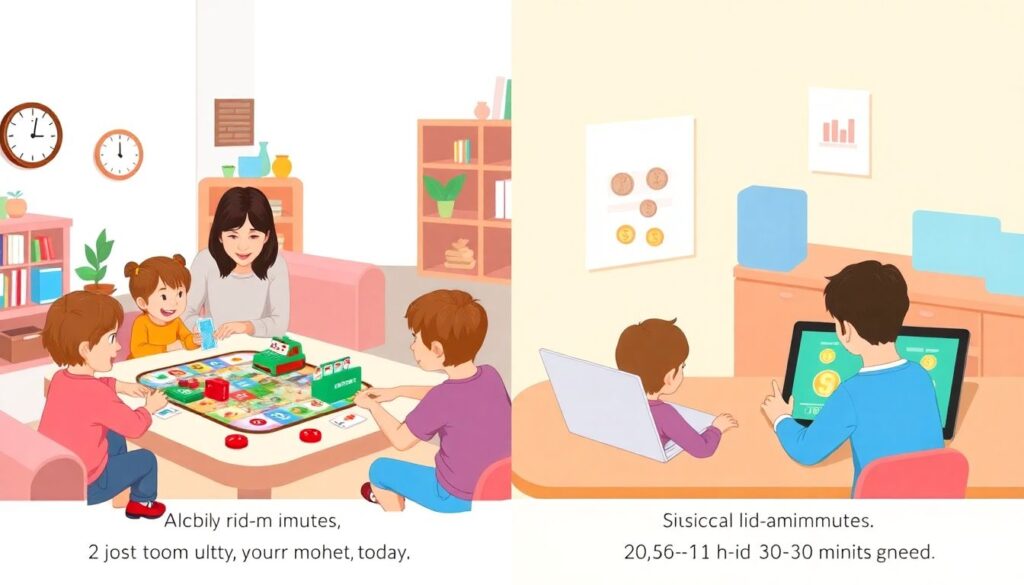
If you want something actionable rather than theoretical, here’s a minimal, repeatable structure:
– One analog session (30–60 min): board/card game or pretend store. End with 5 minutes of debrief: “What did we learn about money today?”
– One digital session (20–30 min): supervised time in a chosen app or platform, with you asking “what’s your plan?” before major decisions.
– One real-life task: let your child handle a small, real budget (snack shopping, planning a movie night, a portion of their allowance).
Short closing idea:
Consistency beats intensity. A few well-structured games and activities each week will quietly build financial habits that last decades—without ever feeling like a lecture.