

Why refinancing is back in the spotlight in 2025
In 2025, refinancing looks very different from what it did even a few years ago. Rates are no longer at historic lows, but they’re also not at the peak levels we saw in the early‑2020s. Lenders are competing hard for fewer borrowers, digital platforms are faster and more transparent, and regulators are watching fees more closely. All of this matters if you’re trying to refinance mortgage to lower payment rather than just chasing the lowest number you see in an ad.
The main shift: instead of “refi every time rates drop,” the conversation has moved to “optimize your whole mortgage strategy.” That means looking at interest rates, loan term, cash flow, home equity, and even your future plans (remote work, potential moves, side hustles) as one puzzle — and refinancing is just one of the pieces.
—
Main ways to lower your mortgage payment through refinancing
When you ask how to lower monthly mortgage payments in 2025, you’re really choosing among a few core approaches. They can be combined, but each has its own logic and trade‑offs.
1. Rate‑and‑term refinance (classic refi)
You keep roughly the same balance, change your rate, term, or both. This is the standard way to refinance and lower your mortgage payment without taking cash out. It works best if:
– Your credit has improved
– Market rates have dropped vs when you first got the loan
– You’re okay resetting or extending your loan term
2. Term extension without big rate changes
Sometimes you don’t need the absolute best mortgage refinance rates today to cut your monthly bill. Simply stretching what’s left of, say, a 21‑year remaining term back to 30 years can materially lower the payment, even if the rate is only slightly better or roughly the same. You’ll pay more interest over time, but your monthly budget gets breathing room.
3. Cash‑out refinance used strategically
The phrase cash out refinance to reduce mortgage payment sounds contradictory, but in 2025 it does make sense in specific situations:
– You refinance at a slightly lower rate
– Consolidate higher‑interest debts (cards, personal loans, some student loans)
– End up with a single, lower combined monthly obligation
You might not slash the mortgage payment alone, but your total monthly outflow can drop a lot, which is what most people actually care about.
4. Hybrid strategies with extra principal payments
A growing trend: people refinance into a lower payment for safety, then set up automatic extra principal payments as their budget allows. That way you:
– Lock in a comfortable required payment
– Still have a path to pay off the loan faster
– Can pause extra payments if life gets messy
—
How tech changed the refinance game by 2025
Refinancing used to mean paper stacks, long phone calls, and waiting. Now, much of the process is algorithm‑driven. Lenders use AI‑based underwriting, open‑banking access to your income and spending, and instant property data. This makes approvals faster, but it also changes how you should shop and compare.
You can now:
– Sync your bank and payroll data instead of uploading endless PDFs
– Get rate quotes from multiple lenders in minutes
– See closing cost breakdowns in near‑real time
The catch: the smarter the tech, the more it tries to “segment” you — meaning the system predicts how rate‑sensitive you are and may not offer its rock‑bottom deal unless it senses you’re shopping hard. Online convenience doesn’t fully replace old‑school negotiation.
—
Comparing approaches: what actually lowers the payment?
Let’s strip it down to what really moves the monthly number when you refinance and lower your mortgage payment:
– Rate reduction – Lower percentage on the same term, same balance.
– Term extension – More years to pay off the balance.
– Balance reduction – Either through bringing cash to closing or rolling less into the new loan.
– Restructuring other debts – Not traditional “mortgage math,” but it changes your monthly budget.
In practice, most 2025 refinances combine at least two of these levers. For example: slightly lower rate + fresh 30‑year term + modest cash‑out to kill a few credit cards. The monthly mortgage payment drops, the other bills vanish, and the trade‑off is a longer payoff horizon on the house unless you pay extra later.
—
Pros and cons of today’s digital refinance technologies
New platforms make it very easy to chase the best mortgage refinance rates today, but they’re not flawless. There’s a real set of trade‑offs you should weigh before clicking “Apply.”
Pros of modern refi tech (2025):
– Speed: Many borrowers get conditional approvals within hours, not weeks.
– Transparency: Fees, lender credits, and rate changes are often visualized clearly in dashboards.
– Competition: Marketplaces can pit multiple lenders against each other on your screen.
– Customization: You can experiment with different terms and see instant payment estimates.
Cons and risks:
– Personalization = price steering: Algorithms try to guess what you’ll accept, not just what’s technically possible.
– Data privacy: Connecting payroll, bank accounts, and tax data to third‑party apps carries risk.
– Fee creep: Some slick apps bury “platform fees” or third‑party charges in the closing costs.
– Over‑optimization: It’s easy to obsess over a slightly lower rate while ignoring that you’re resetting the 30‑year clock.
So while technology reduces friction, it increases the need for you to understand exactly what you’re signing up for — especially how costs stack up over the full life of the loan.
—
Using calculators the right way (not just for show)
Most people now start the process with some kind of mortgage refinance calculator to lower payment, which is smart — as long as you treat it as a planning tool, not a final answer generator.
Use calculators to:
– Compare your current loan vs different new terms (25‑year, 20‑year, 30‑year)
– See how points, fees, and lender credits change your “breakeven” time
– Test worst‑case vs realistic scenarios (like moving in 5–7 years instead of staying 30)
Where people go wrong is plugging in the teaser rate from an ad instead of the actual APR with closing costs. In 2025, with fees under more scrutiny, APR is still the closest “single number” that compares loans properly — but you should back it up by looking at cash costs and your planned time in the home.
—
Strategies for different types of borrowers in 2025
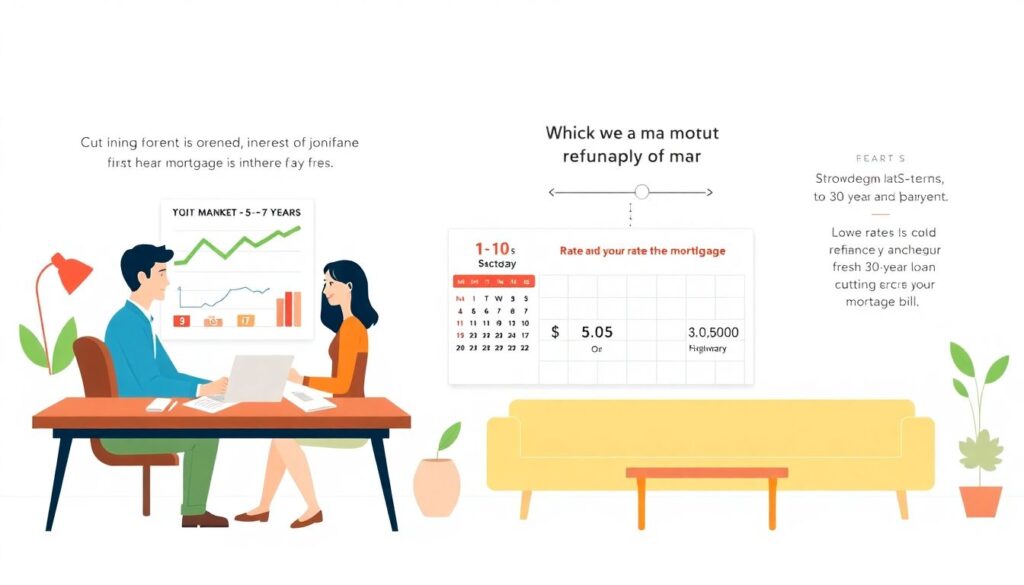
The “right” way to refinance depends a lot on where you are in life and how stable your situation is.
If you’re early in the mortgage (first 5–7 years), and rates are meaningfully lower than your original rate, a straightforward rate‑and‑term refi to a fresh 30‑year loan can meaningfully cut the bill. Here, the time left is still long, so you’re not massively extending beyond your original schedule.
If you’re mid‑cycle (10–15 years in), extending back to 30 years just to shave a small amount off the payment often means a big jump in total interest. Instead, in 2025 many homeowners:
– Refinance into a 20‑ or 25‑year term
– Keep payments manageable
– Avoid “starting the clock from zero”
If you’re cash‑flow squeezed (job transition, childcare costs, caring for parents), minimizing the mandatory payment often matters more than the lifetime interest bill. In that case, a lower rate plus an extended term gives you flexibility; you then use better years to pay extra.
If you’re planning to move or upsize within 5–8 years, chasing small rate improvements with high closing costs rarely pays off. Focus on:
– Low or zero‑cost refis, even if the rate is slightly higher
– Flexibility: no prepayment penalties, easy assumption or porting if that’s available
—
Modern trends that shape refi decisions in 2025
Several broad trends are reshaping how homeowners think about refinancing this year:
1. Stable‑but‑not‑cheap rates
Rates aren’t collapsing back to ultra‑low pandemic levels, but the volatility has cooled. Many borrowers who sat on the sidelines in 2023–2024 are now revisiting refi ideas with more realistic expectations: not a miracle drop, but a solid incremental improvement plus better structure.
2. Equity‑rich, cash‑poor homeowners
Home prices stayed high in most markets, so a lot of people have strong equity but weak monthly cash flow. That’s why targeted cash‑out refis focused on debt consolidation and payment smoothing have grown — as long as the math shows total monthly relief, not just moving the problem.
3. Rise of “payment first” thinking
Instead of asking only “what’s the rate?”, more borrowers ask “what’s my risk‑proof monthly payment?” This leads to:
– Slightly longer terms to create safety
– Fixed‑rate refis instead of variable options, even when ARMs look cheaper
– More interest in setting up automatic extra payments to self‑manage payoff speed
4. AI‑driven underwriting and niche products
In 2025, self‑employed, gig workers, and people with mixed income sources benefit from smarter underwriting that can assess cash flow from multiple streams. That opens specialized refinance offers (bank‑statement loans, DSCR loans for house hackers, etc.), though they often come at a higher rate and stricter terms.
—
How to realistically shop for the best deal
If you’re trying to find the best mortgage refinance rates today, the key is to behave like a “hard‑to‑win” customer without being a full‑time rate hunter.
A simple, grounded process:
– Get quotes from at least three sources: a major bank, an online lender, and a local credit union or broker.
– Ask each for the same scenario (same loan amount, term, and estimated closing date) so you’re not comparing apples to oranges.
– Look at the APR, fees, and lender credits together, not just the advertised rate.
– Use a calculator to check how long it takes for the savings to beat the upfront costs if you expect to move or refinance again.
Then, be willing to say: “Lender B is offering X rate and Y fees. Can you match or beat that?” In 2025’s competitive environment, you’ll be surprised how often they say yes — especially near month‑end or quarter‑end when they’re chasing volume targets.
—
Common pitfalls to avoid when refinancing in 2025
Even with better tools and more regulations, people still fall into the same traps.
Watch out for:
– Focusing only on the lower payment while ignoring total interest over the life of the loan.
– Rolling every single fee into the loan when you actually could pay some in cash; this quietly inflates the balance.
– Resetting the term repeatedly (refi every few years back to 30 years) and never making real progress on principal.
– Ignoring your timeline — refinancing for a 10‑year breakeven when you’re likely to move in 5.
The point isn’t to avoid refinancing; it’s to make sure that the structure supports your actual life plans instead of working against them.
—
Putting it all together: a practical decision framework

If you’re wondering how to lower monthly mortgage payments right now, try this quick mental checklist before you even talk to a lender:
– Has your rate gap vs today’s realistic rates (not teaser rates) reached at least about 0.5–1.0 percentage point?
– Are you okay with either resetting the term or committing to extra payments to keep your payoff timeline on track?
– Will the monthly savings after all costs genuinely help your financial stability — emergency fund, retirement, paying off other debts?
– Does the new loan keep or improve your flexibility (no harsh prepayment penalties, understandable terms, decent closing timeline)?
If the honest answer is “yes” to most of these, then a refinance can be a powerful way to tailor your mortgage to your 2025 reality — not just to the assumptions you had when you first signed the original papers.