
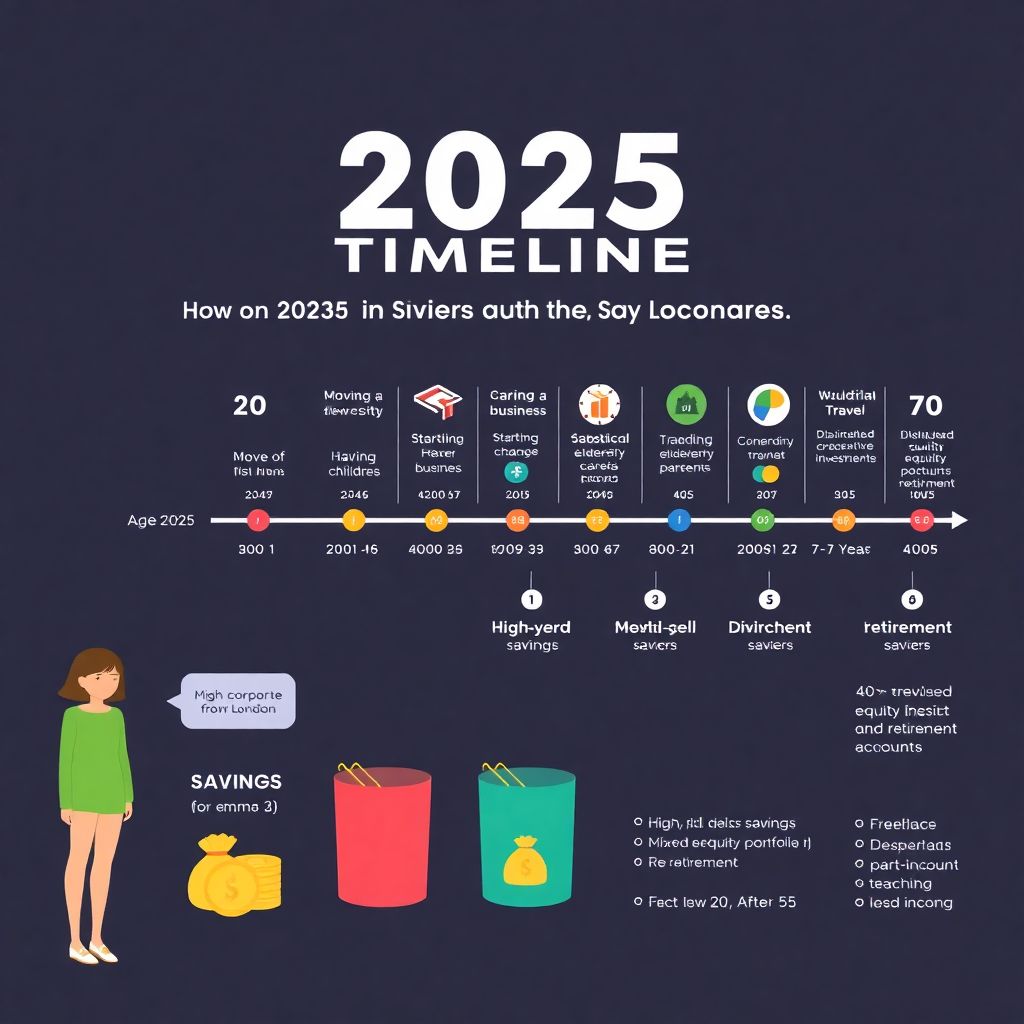
Why a Savings Timeline Matters More in 2025 Than Ever
A century ago, “major life events” meant a few predictable milestones: marriage, kids, maybe buying a modest home, and then retirement at 65 with a pension. People saved in physical cash, relied on company pensions, and rarely used formal financial planning for major life events.
Today, timelines are messier. People marry later (or not at all), switch careers multiple times, move countries, start businesses, take gap years, and live longer. Pensions are largely gone, housing is expensive, and longevity means your money has to last 20–30 years in retirement.
A savings timeline is basically a map of money across your life events: what you want to do, when you want to do it, and how much you need saved by specific dates. Without it, you end up constantly reacting to emergencies instead of calmly funding your future.
—
Step 1. Map Out Your Major Life Events (Without Overplanning Your Life)
Start with “Money Milestones,” Not Perfect Predictions
You can’t script your life, but you can outline money-sensitive events that are likely to happen. Think in doors, not corridors: events that *might* open, not a guaranteed path you must follow.
Typical examples:
– Moving out or relocating to another city/country
– Buying a home or upgrading to a larger one
– Weddings or long-term partnership transitions
– Children, adoption, or fertility treatments
– Career breaks, retraining, or grad school
– Starting a business or going freelance
– Elderly parent care
– Retirement or semi-retirement
You don’t have to know exact dates. Use time windows: “in about 3 years,” “within 5–7 years,” “sometime after 50.”
Real Case: The 3-Career Timeline
Emma, 29, from London, expected a classic route: corporate ladder → house → kids → retirement. Instead, she mapped three potential “careers” till age 60:
1. Corporate now (high income, little time)
2. Freelance in her 40s (medium income, high flexibility)
3. Part-time teaching after 55 (lower income, but still earning)
She didn’t know if it would play out exactly like that, but visualizing these phases helped her decide when she’d be able to fund big life events: house in her 30s, sabbatical with kids in her 40s, and an early semi-retirement in her 50s.
Her savings timeline followed *phases* rather than rigid dates. That flexibility is what you want too.
—
Step 2. Put Dates (or Age Ranges) Next to Each Event
Turn “Someday” Into a Year
Once you’ve listed the events, give each one:
– A target age or year
– A priority (Must / Would Be Great / Nice Extra)
Example (very rough):
– Move out of renting → by age 33 → Must
– First child → around 35 → Must
– Sabbatical for travel with family → around 40–42 → Would Be Great
– Kids’ college support → when kids are 18+ → Nice Extra, partial support
– Semi-retire → around 58 → Must
Short paragraph to keep rhythm: timelines can (and will) change. The point isn’t perfection; it’s clarity about what needs money first.
Non-Obvious Tip: Add “Exit Events”
People list weddings and houses but forget endings:
– Divorce or separation
– Selling a business
– Moving countries again
– Downsizing home in your 60s
Planning for these as potential events means you’re not blindsided. For instance, you might keep a separate “freedom fund” that makes it possible to leave a toxic job or relationship without financial panic.
—
Step 3. Put a Price Tag on Each Event
Use Ranges, Not Exact Numbers
Now estimate how much each event costs in today’s money. Don’t obsess over precision; a realistic range beats a fake-perfect number.
For example:
– Wedding: $8,000–$20,000
– House down payment: 15–25% of expected home price
– One-year career break: 1 year of living costs + insurance + buffer
– First baby: initial setup + 3–6 months of extra cushion
– Early retirement: 25–30× your *annual* spending (rough FIRE rule)
To keep up with 2025 realities (inflation, high housing, rising tuition), add a 10–20% margin to pretty much every long-term cost.
Historical Context: From Envelopes to Calculators
In the mid-20th century, people used envelope systems: “Rent,” “Groceries,” “Christmas,” “Vacation.” Simple, cash-based and surprisingly effective. Today, similar logic sits inside apps and tools like a retirement and life event savings calculator, which lets you plug in your age, target date, and event cost to see how much you need to invest or save each month.
Use the tech, but keep the envelope mindset: each event gets its own mental “bucket.”
—
Step 4. Order Events on a Timeline and Spot Conflicts
Make a Quick Visual Timeline
Take a piece of paper or a notes app and draw a horizontal line with your ages (or years). Place each event roughly where you expect it.
Then ask:
– Which events overlap?
– Will multiple big costs hit at the same time?
– When is your income likely to be highest/lowest?
This reveals conflicts like: planning a wedding, IVF, and a house purchase all in a 2-year window while one partner is in grad school. On paper, it’s painfully obvious that this will be stressful.
Real Case: The Overcrowded 5-Year Plan
Alex and Mia, both 32, wanted:
– Wedding next year
– House within 3 years
– First baby within 4 years
– MBA for Alex within 5 years
Once they mapped it, they realised all four events landed in a very short window. Instead of giving up, they re-sequenced:
– Small city-hall wedding now, bigger celebration later
– Delay house purchase by 2 years; focus on flexible renting
– Alex postpones MBA until the baby is 2, when Mia can return to work
The savings timeline didn’t just show *what* to save for—it forced them to change the story of *when* things would happen. That’s a win.
—
Step 5. Decide the Right “Bucket” for Each Event
Match Time Horizon to Savings Vehicle
This is where people often go wrong. They either invest money they’ll need soon (too risky) or leave long-term money in low-yield accounts (too conservative).
As a rule of thumb:
– 0–3 years away → cash and very safe instruments
– 3–7 years away → mix of cash and conservative investments
– 7+ years away → diversified investments (equities, index funds, etc.)
Use:
– High-yield savings or money market accounts for short-term events
– Tax-advantaged retirement accounts for far-future goals
– Brokerage or investment apps for medium/long-term goals
When you’re researching the best savings accounts for life event planning, pay attention not just to interest rates, but to:
– Fees and withdrawal restrictions
– Automatic transfer options
– Sub-accounts or “goal” features so you can label each bucket
Alternative Method: Use One Big Investment Portfolio, Not Many Little Pots
Instead of having a separate account for every goal, some advanced planners:
– Keep one diversified portfolio
– Track sub-goals in a spreadsheet or app
– Adjust their asset allocation gradually as each event gets closer
This method can be more tax- and return-efficient, but it requires discipline—not panicking during market drops and not raiding long-term money for short-term wants.
—
Step 6. Translate Each Event Into a Monthly Number
Reverse-Engineer the Savings
Now take each event and figure out how much per month you need to save.
Basic approach:
1. Take target cost (adjusted for inflation if long-term)
2. Subtract what you already have saved for it (if anything)
3. Divide by number of months until the event
Then refine: if money will be invested, account for expected returns via a calculator or an app. That’s where an online how to save money for major life events guide often stops, but you’ll go further by tying those monthly figures to your *actual* cash flow.
Example: Down Payment in 5 Years
– Target down payment: $60,000
– Already saved: $10,000
– Gap: $50,000
– Time: 5 years ≈ 60 months
– Pure cash savings: $50,000 ÷ 60 ≈ $833/month
If you plan to invest part of it and expect, say, 4–5% annual return in a conservative portfolio, that monthly number might drop slightly. A decent retirement and life event savings calculator lets you toggle return assumptions up and down to see the impact.
Short reminder: overestimate what you need; life rarely gives discounts.
—
Step 7. Prioritise Ruthlessly (Because You Can’t Fund Everything at 100%)
Rank by “Pain If Unfunded”
Two filters:
– How painful if this event isn’t fully funded?
– How reversible is the decision or timing?
For example:
– Retirement: pain is high if underfunded; timing is only somewhat flexible.
– Child’s university: painful, but there are loans, scholarships, cheaper options.
– Big wedding: emotionally important, but highly flexible in scope and timing.
When financial planning for major life events, it’s normal to underfund lower-priority goals for a while. What matters is that you’re honest about it, not pretending to be “on track” for everything.
Non-Obvious Solution: Fund “Platform” Goals First
Some goals unlock or protect many others:
– Emergency fund (3–6 months of expenses)
– Basic retirement contributions, especially if you have an employer match
– High-interest debt repayment
These “platform” goals deserve priority because they reduce future crises that wreck all your other plans.
—
Step 8. Build the Timeline Into Your Monthly Cash Flow
Connect the Timeline to Your Real Life
A timeline is only as good as your automation. Once you’ve got monthly targets:
– Set automatic transfers for each key goal right after payday
– Name accounts by goal (“Down Payment,” “Sabbatical 2029”)
– Review once per quarter, not every day
A simple monthly checklist:
– Are transfers running as planned?
– Did your income or costs change significantly?
– Does any event need to shift earlier/later?
Real Case: The “Invisible Money” Method
Jared, 38, knew that if money hit his main checking account, he’d spend it. He set up:
– Automatic transfers on payday into labelled savings and investment accounts
– A checking account with just enough for bills + a small spending buffer
He never “felt rich” on payday, but his savings timeline for a house and early semi-retirement kept moving forward.
His rule: *If I must change something, I cut lifestyle first, not the timeline contributions.* That mindset turns your timeline into the default, not the wish.
—
Step 9. Use Professional and Digital Help (Strategically)
When a Financial Advisor Makes Sense
A financial advisor for life event planning can be useful when:
– You’re juggling multiple high-value goals (e.g., stock options, business sale, early retirement, multiple properties)
– You’re dealing with complex tax decisions or multiple countries
– You and a partner can’t agree on priorities and need a neutral third party
Look for:
– Fee-only or fee-based advisors (clear pricing)
– Fiduciary duty (they must act in your best interest)
– Someone who actually talks about goals and timelines, not just selling products
Digital Tools That Actually Help
In 2025, there’s no shortage of apps claiming to automate your entire life. Focus on tools that:
– Link your accounts and show you progress per goal
– Offer scenario planning: “What if I retire at 60 vs 65?”
– Simulate trade-offs: “If I save more for a house, what happens to retirement?”
Combine old-school clarity (your handwritten or document timeline) with new-school tools that crunch the numbers for you.
—
Alternative Approaches: Not One Timeline, But Several
Scenario Planning: Plan A, B and C
Instead of “one true future,” create:
– Plan A: Everything goes roughly as hoped (steady career, no major health issues)
– Plan B: Lower income or a big expense hits (job loss, medical issue, divorce)
– Plan C: Higher-than-expected income or windfalls (business takes off, inheritance)
You don’t need full detail for all three. Just outline:
– What events get delayed under Plan B?
– What events get upgraded or pulled earlier under Plan C?
This prevents you from clinging to a single rigid script and panicking when reality disagrees.
Life-Phase Buckets Instead of Specific Events
Another alternative method: instead of separate “Wedding,” “MBA,” “Baby,” you think in phases:
– Exploration phase (20s–30s)
– Building phase (30s–50s)
– Freedom phase (50s+)
Each phase gets a rough savings capacity and list of possibilities. You accept that the exact event may change, but the money pool stays. It suits people whose lives are highly dynamic or uncertain (entrepreneurs, creatives, global nomads).
—
Pro-Level Hacks for Building and Protecting Your Timeline
1. Lock in “Minimum Viable Retirement” Early
Professionals often underestimate how big a deal this is. Define a minimum viable retirement: the lowest annual spending you’d accept in later life. Then:
– Calculate what you’d need (roughly 25–30× that spending)
– Start contributing something toward that from your 20s or 30s, even if small
This takes pressure off later. Every extra goal becomes a layer on top of a decent base, not a desperate scramble.
2. Use Windfalls to Shorten the Timeline
Instead of upgrading your lifestyle with every bonus, raise:
– Your emergency fund
– Your high-priority event buckets
A simple rule:
– 50% of any unexpected money (bonuses, tax refunds, small inheritance) goes to your top 1–2 timeline goals
– 30% to debt or investments
– 20% to guilt-free enjoyment
This approach quietly pulls expensive events closer without you feeling constantly deprived.
3. Annual “Life Calendar Review”
Once a year, sit down (alone or with a partner) and run through:
– What changed in the past 12 months?
– Are any events now more or less likely?
– Did costs or income change substantially?
– Do we need to move dates or amounts?
In the past, people relied on generic rules like “save 10% of income.” Those days are over. A yearly timeline review is your modern equivalent of tuning a machine to keep it running smoothly over a far more complex lifespan.
—
Putting It All Together
Here’s the condensed playbook to create your savings timeline for major life events:
– List your likely events and rough age ranges
– Attach price tags and priorities to each
– Map them on a simple visual timeline and spot overlaps
– Choose the right savings/investment buckets by time horizon
– Translate each goal into a realistic monthly number
– Automate contributions and adjust your lifestyle around them
– Review annually, and update as your life and the world change
The tools and terminology have evolved—from envelopes to investment apps, from pensions to self-managed retirement—but the core idea hasn’t changed since your grandparents’ time: the earlier you decide what you’re saving for and when you’ll need it, the more freedom you buy yourself later.
Your savings timeline is that decision, written down.