
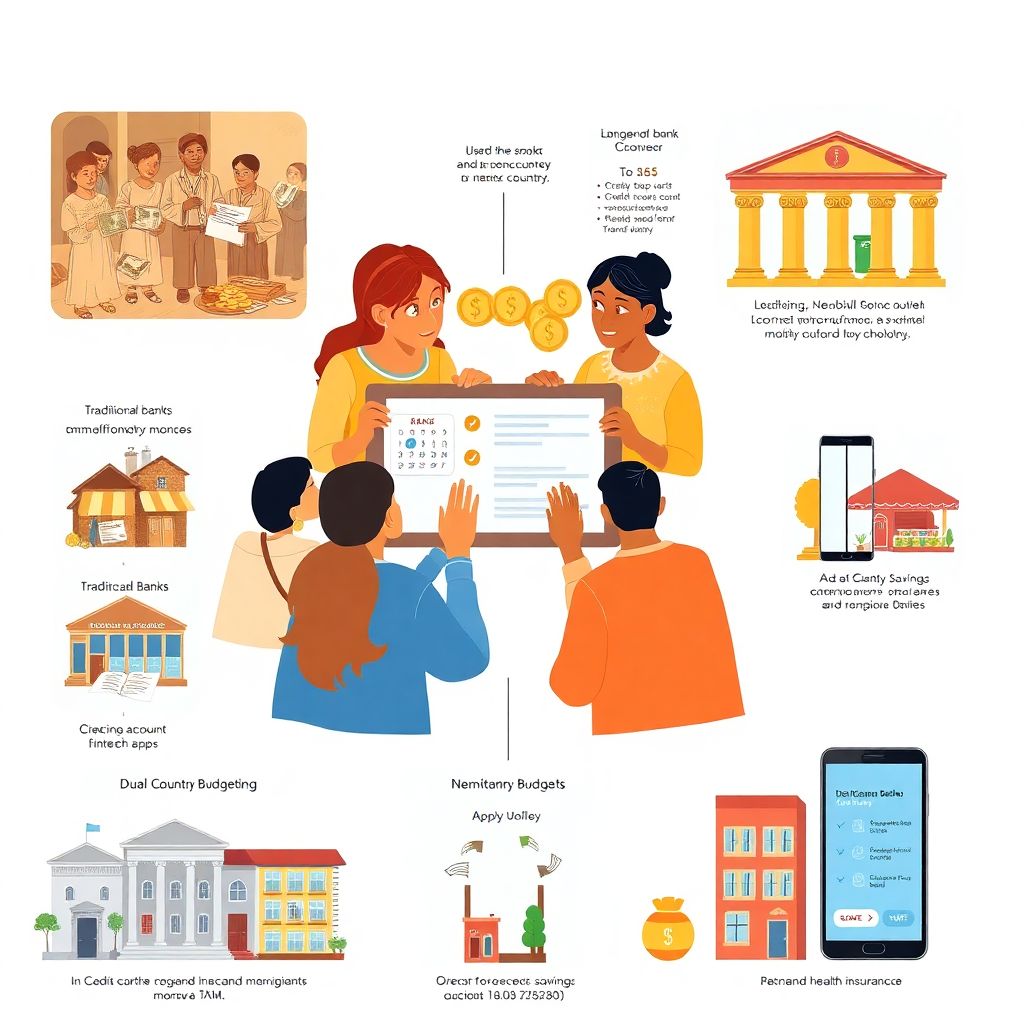
In a new country, money can feel like a different language, even if you speak English perfectly. The rules change: banks work differently, credit has new meaning, taxes look strange, and every mistake seems expensive. For immigrants, financial literacy is not a “nice to have” skill; it is a survival toolkit and a way to protect both present comfort and future opportunities, from stable housing to children’s education and long‑term residency plans.
Historical background of financial literacy for immigrants
From cash economy to digital finance
If you look back over the past hundred years, immigrant money habits have moved from almost complete dependence on cash and informal networks toward a highly formal, digital financial system. Earlier migrant waves often avoided banks due to language barriers, distrust of institutions, or legal status fears, preferring to save in cash, gold, or rotating savings groups. Over time, as regulatory frameworks changed and anti‑discrimination rules strengthened, governments realized that excluding newcomers from mainstream finance increased poverty risks, encouraged shadow markets and slowed integration. That is why since the 1990s you see more state‑backed programs, nonprofit trainings and employer initiatives focused specifically on basic banking, digital payments and safe borrowing for foreign‑born residents.
Regulation, remittances and new products
Historically, remittances were handled through expensive intermediaries and informal couriers. Gradually, tighter anti‑money‑laundering rules forced more transparency, but also pushed innovation. Growing migration flows and the sheer volume of cross‑border transfers turned migrants into a visible client segment for banks and fintechs. This is how specialized money transfer services for immigrants emerged: they compete on lower fees, faster settlement and better currency conversion, often with smartphone apps available in multiple languages. At the same time, regulators in many destination countries started promoting basic transparency standards: clear fee disclosures, easier account opening procedures and limited‑fee accounts aimed at unbanked and recently arrived customers.
Basic principles of money management in a new country
Understanding local banking and accounts
The first pillar of financial literacy for immigrants is to understand how local banks actually work, from the difference between checking and savings accounts to overdraft rules, deposit insurance and online security. When people search for bank accounts for immigrants in the US, they often assume there is a special legal category, while in reality most institutions offer standard products but adjust onboarding: they may accept foreign passports, consular IDs, or alternative proof of address. The key is to interpret the fine print: minimum balance requirements, ATM fees, international transaction charges and the policies on joint accounts, which are especially important for families who are splitting income and expenses across borders.
Budgeting in a dual‑country reality
For many newcomers, a classic budget template is not enough, because they manage obligations in two or more countries at the same time. There are rent and utilities in the host country, parallel housing or family costs back home, and the psychological pressure to send money even when margins are thin. Analytical budgeting in this context means mapping all fixed and variable expenses across borders, ranking priorities and identifying non‑negotiable safety items like emergency savings and health insurance. A realistic plan also considers volatile income, common in gig work and seasonal jobs, and tries to smooth it through buffers, side income and careful timing of remittances, rather than reacting month to month.
Credit, debt and long‑term positioning
Credit in many destination countries is not just about borrowing; it is a core identity signal that influences housing approval, insurance pricing and sometimes even employment checks. That is why understanding how to build credit score as an immigrant matters far beyond getting a loan. The basic principle is consistent, transparent use of credit products with on‑time payments and low utilization relative to available limits. Even small recurring charges paid through a starter card can help, as long as balances are cleared regularly. At the same time, immigrants must resist the temptation of easy store cards or high‑interest offers targeted at people with thin credit files, because these products can quietly trap families in expensive revolving debt.
Practical examples of financial literacy in action
Choosing banking and card products strategically
Consider a recently arrived professional who has a job offer but no local credit history. Instead of accepting the first offer at a random bank branch, she compares institutions that are accustomed to newcomers, including those partnered with large employers or universities. She checks which debit card has the lowest foreign transaction fees and whether the bank reports activity to major credit bureaus. When selecting the best credit cards for new immigrants, she focuses not on rewards marketing, but on total cost: annual fees, interest rates, and the chance to upgrade to better terms after a year of positive payment history. Over two or three years, these early choices significantly lower her banking costs and speed up her integration into the mainstream credit system.
Managing remittances and cross‑border obligations
Another example is a family that sends a stable share of income to relatives abroad. Instead of walking into a high‑fee corner shop broker every payday, they systematically compare official online channels, checking exchange rate spreads, fixed charges and delivery times. They test several providers and eventually stick to one or two digital platforms that allow scheduled transfers and transparent tracking. By using efficient money transfer services for immigrants, they may save the equivalent of a month’s rent each year, purely by cutting hidden costs. Over time, that extra money can be redirected into local savings, small business investments or education funds for their children in the host country.
Using professional advice and community support
Some immigrants leverage formal financial planning services for immigrants offered by nonprofits, community banks or city programs. A typical scenario: a couple with mixed immigration status wants to buy a home in five years but is unsure how to navigate documentation, down payment requirements and credit repair. A bilingual advisor helps them consolidate high‑interest debts, build a savings goal, and structure their tax filings in a way that supports future mortgage applications. Alongside this formal help, they learn from peers at community workshops, where people openly share mistakes and solutions. The combination of professional planning and grassroots knowledge gradually transforms money from a constant stressor into a strategic tool.
Common misconceptions and hidden risks
“Cash is safer than banks” and other myths

One persistent misconception among newcomers is that keeping large amounts of cash at home is safer than trusting unfamiliar institutions. This belief is often rooted in traumatic experiences with unstable banks or corrupt regimes in the country of origin. However, in most developed host countries, deposits up to a certain limit are insured by the state, and the risk of burglary or loss usually outweighs any hypothetical institutional danger. Another widespread myth is that opening a bank account exposes undocumented family members to immediate legal trouble, when in reality many banks are primarily concerned with anti‑fraud checks and follow standard privacy rules, though it is always important to verify policies with independent legal advice.
Misunderstanding credit, debt and “free” offers
Newcomers are frequently targeted with aggressive marketing for loans, store credit and “zero down” offers. Without deep familiarity with local consumer law, it is easy to treat every approved line of credit as a sign of financial success instead of a potential liability. Some immigrants think that using the maximum limit on every card will quickly boost their score, while the opposite happens: high utilization and late payments damage their profile for years. Others assume that informal loans from friends or unlicensed lenders are harmless, not realizing how social pressure and unclear interest agreements can create even more stress than regulated bank debt, especially when income is unstable and legal remedies are limited.
Future outlook: financial literacy for immigrants in 2025 and beyond
Digital tools, AI advisors and regulatory shifts
As of 2025, the landscape is changing fast. Neobanks and fintech apps are racing to become the default entry point for newcomers, offering multilingual interfaces, instant account opening and integrated education modules. We are likely to see more AI‑powered coaches built directly into banking apps that explain terms in plain language, simulate budget scenarios and warn users about risky behavior before it becomes a problem. At the same time, regulators in major migration destinations are discussing how to make financial products more inclusive without compromising on security, for example by encouraging alternative credit scoring models that can use rental payments or remittance histories instead of relying only on traditional bureau data.
From individual skills to structural inclusion
Over the next decade, the conversation about financial literacy for immigrants will probably move from purely individual responsibility toward a more systemic view. Teaching people how to navigate complex, often predatory systems is necessary, but not sufficient. We can expect more pressure on banks, employers and governments to design products and policies that recognize transnational lives: flexible identity verification, portable credit histories, fair remittance pricing and transparent loan terms tailored to migrant realities. If this shift happens, financial education will still matter, but it will function less as damage control and more as a way for immigrants to actively build wealth, participate in local economies and influence the financial rules that shape their own futures.