
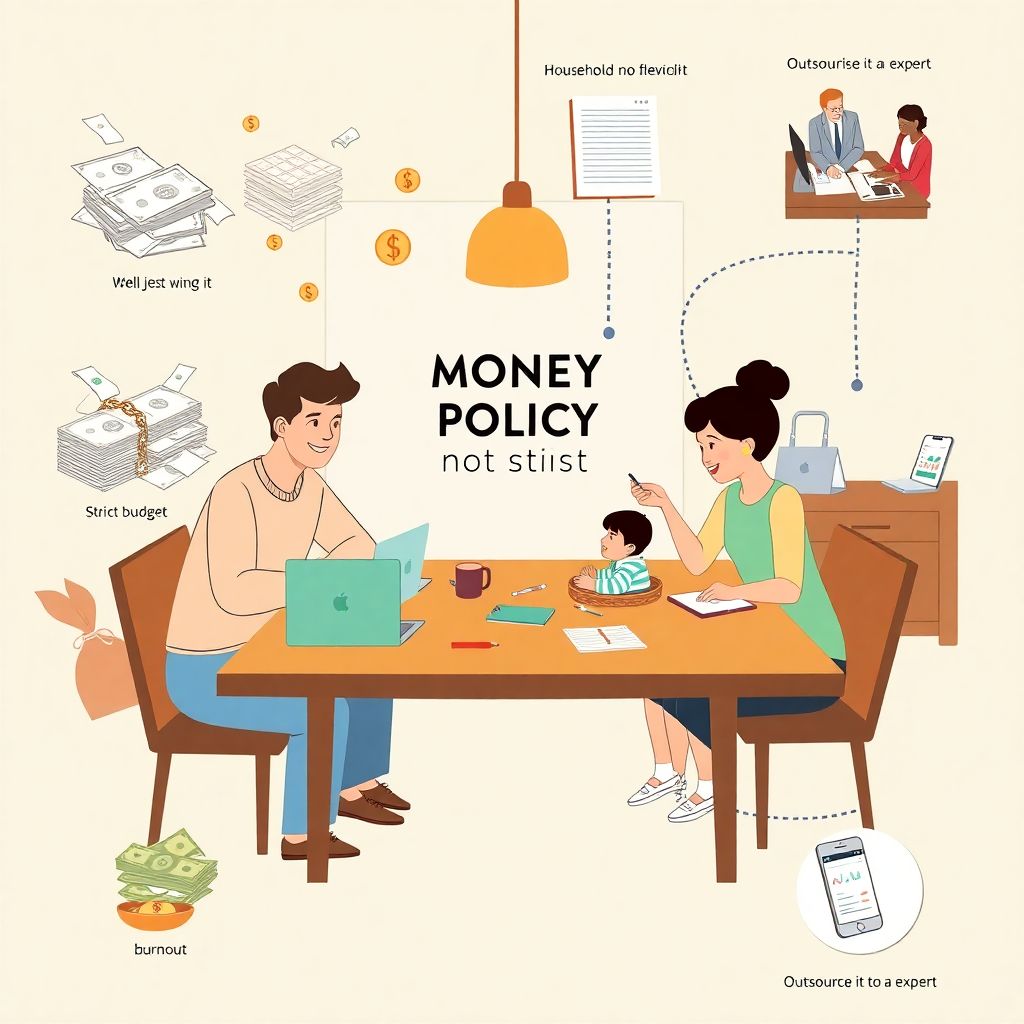
Why Your Household Needs a Personal Finance Policy (Not Just a Budget)
A lot of people think, “We just need a budget and we’re good.” But a personal finance policy is a bit bigger than a monthly budget. It’s the set of rules, agreements, and habits that guide every money decision in your home.
Think of it like “house rules for money”:
– How you earn
– How you save
– How you spend
– How you protect yourselves from risk
A simple spreadsheet can’t do all that on its own.
Before we go step by step, let’s compare three common approaches people use to “manage money” and why they often fall short on their own.
Three Typical Approaches (And Their Limitations)
1. The “We’ll Just Wing It” Approach

This is when a household doesn’t have any clear written rules.
– Money comes in, bills go out, and whatever is left… gets spent.
– No one really knows how much is saved or why.
– Arguments usually appear when something big breaks or someone wants to buy something major.
Main problem: Zero coordination. Emotion drives decisions, not a shared plan.
2. The “Strict Budget, No Flexibility” Approach
Some families go in the opposite direction: every dollar is assigned, everything’s tracked obsessively, there’s no room for surprises.
This can work for a while, especially when using a household budget planner software or spreadsheet. But:
– Life doesn’t always respect your categories.
– One unexpected bill and the whole plan collapses.
– People feel guilty if they “break the budget,” even for reasonable reasons.
Main problem: Burnout. The budget becomes a prison, not a tool.
3. The “Outsource It to an Expert” Approach
Others rely heavily on professionals:
– A financial planner sets up accounts.
– An app or online service proposes a savings plan.
– Some even look for the best financial advisor for family budgeting and let them structure everything.
This can be extremely helpful, especially if finances are complex. However:
– If you don’t understand the rules, you can’t follow them.
– A pro can’t see your daily behavior or small decisions.
– You still need agreements inside your household.
Main problem: Over-reliance. You outsource thinking instead of learning.
—
A healthy personal finance policy combines the best parts of all three:
– Clarity and structure (like a budget)
– Flexibility for real life
– Occasional professional help
– And, most important, shared rules everyone in the home understands
Let’s build that step by step.
—
Step 1. Define Your Household’s Money Values and Non‑Negotiables
Talk About What Actually Matters (Yes, Out Loud)
Before numbers, talk values. That’s what a lot of personal finance planning services for families do in their first meeting: they ask about what matters, not about spreadsheets.
Sit down with everyone who shares money decisions (partner, spouse, sometimes older kids) and answer questions like:
– What does “financial security” mean to us?
– What are we absolutely not willing to sacrifice?
– What kind of lifestyle do we actually want, not what we think we “should” want?
– What money habits from our parents do we want to copy — or avoid?
You don’t need fancy language. You just need honest answers.
Turn Values into 3–5 Simple Rules
From that conversation, create a few “money rules” that feel real for your family. For example:
– “We always have a three‑month emergency fund before big upgrades.”
– “We never carry credit card debt for consumer stuff.”
– “We spend on experiences with kids, not random gadgets.”
– “We talk about purchases over $X before buying.”
Write them down. These become the foundation of your personal finance policy.
Common mistake:
Jumping straight into cutting expenses without agreeing on your values. That’s how resentment builds — one person feels deprived, the other feels ignored.
—
Step 2. Map All Your Money Flows (Without Judging Yourself)
Collect the Facts First
You can’t create meaningful rules if you don’t know what’s actually happening with your money.
For the last 2–3 months, gather:
– Bank and credit card statements
– Any cash spending notes
– Pay stubs, freelance income, benefits
You can do this manually or use a personal finance management app for households that syncs accounts and auto-categorizes transactions. Apps aren’t magic, but they do save time.
Look for Patterns, Not Just Problems
Don’t start by beating yourself up over that food delivery bill. Look for patterns:
– Where does money naturally go? (Groceries, kids, subscriptions?)
– Which expenses feel truly essential vs. “nice to have”?
– Are there forgotten leaks — unused subscriptions, random fees, “just in case” purchases?
A quick way to spot issues:
– Highlight expenses that don’t align with the values you wrote earlier.
– Mark them; don’t fix them yet. You’re just observing.
Newbie tip:
If you feel overwhelmed, focus only on the 3 largest expense categories. Changing those will have a bigger impact than obsessing over tiny purchases.
—
Step 3. Choose Your Budgeting Style (There’s No Single “Right” Way)
Your personal finance policy should state how you’ll decide and track spending. There are several approaches; each has pros and cons.
Approach A: Traditional Category Budget
You set monthly limits for categories: housing, food, transport, entertainment, etc.
Good for you if:
– You like structure.
– Your income is stable.
– You enjoy tracking or don’t mind using software.
Pros:
– Clear visual of where money goes.
– Easy to adjust one category at a time.
– Works well with a household budget planner software that automates tracking.
Cons:
– Can feel rigid when life is unpredictable.
– Requires consistent checking and updating.
—
Approach B: Pay Yourself First (Reverse Budget)
Here you decide savings and key priorities first, then spend what’s left without heavy tracking.
Process:
1. Decide fixed savings targets (retirement, kids, emergency fund).
2. Automate those transfers on payday.
3. Pay bills.
4. Spend the remaining money as you wish, no micro‑tracking.
Good for you if:
– You hate recording every purchase.
– You’re willing to automate decisions up front.
– You want discipline without constant effort.
Pros:
– Very simple once set up.
– Focuses on long‑term goals first.
– Less guilt about everyday spending.
Cons:
– Requires accurate math on what “leftover” really is.
– Easy to ignore slow lifestyle creep (streaming, subscriptions, etc.).
—
Approach C: Envelope / Digital Envelope System
You divide money into envelopes (physical or digital “pots”):
– Groceries
– Transport
– Fun money
– Kids
When the envelope is empty, you’re done for that period.
Good for you if:
– You’re a visual, tactile person.
– You’ve had trouble staying under limits in specific categories.
– You want everyone in the household to “see” what’s left.
Pros:
– Powerful for controlling overspending.
– Makes trade‑offs obvious.
– Involves the whole family more easily.
Cons:
– Awkward with lots of online transactions if fully physical.
– Requires discipline not to “borrow” from other envelopes constantly.
—
Which Should You Pick?
You don’t have to marry just one.
A practical hybrid many households use:
– “Pay yourself first” for savings and debt payments.
– Category or envelope style for day‑to‑day spending control.
Write your choice into your personal finance policy. For example:
> “We use a pay‑yourself‑first system for savings and fixed payments, and digital envelopes for groceries, going out, and fun money.”
—
Step 4. Create Clear Rules for Saving, Debt, and Spending
Now we turn the big picture into specific rules your future self can actually follow.
1. Rules for Saving
Decide:
– Minimum monthly savings rate (e.g., “At least 15% of net income.”)
– Order of priorities (emergency fund → high‑interest debt → long‑term goals, etc.)
– Where the money physically goes (which accounts).
You might state in your policy:
– “We maintain an emergency fund of 3–6 months of essential expenses.”
– “Until we reach that, we save at least X per month to the emergency fund.”
Warning:
Don’t put all your savings into long‑term accounts that are hard or costly to access (like some investment accounts) before you’ve built a short‑term safety net.
—
2. Rules for Debt
Debt rules should be stingy and clear, because this is where households quietly sink.
Consider rules like:
– “We never carry a balance on high‑interest credit cards.”
– “We prioritize paying off any debt above X% interest before investing aggressively.”
– “We only take new loans for [education / home / car] under [specific conditions].”
If you use family financial planning services near me or a remote advisor, this is a great topic to clarify with them: which debts to attack first, and how aggressively.
Common mistake:
Paying extra on a mortgage or low‑interest loan while carrying high‑interest credit card debt. Emotionally it feels good; mathematically it’s expensive.
—
3. Rules for Everyday Spending
This is where arguments usually live: groceries, going out, impulse buys.
Helpful rules:
– Personal “no‑questions‑asked” allowance for each adult.
– A limit for unplanned purchases (“Anything over $X, we discuss first.”).
– A maximum ratio of fun/optional spending to income.
A simple structure your policy can express:
– Essentials: 50–60% of income
– Financial goals (savings, debt): 20–30%
– Lifestyle/fun: 10–30%
Not perfect, but a reasonable starting point.
—
Step 5. Decide Who Does What (And How Often You Review)
Assign Roles, Not Blame
In many homes, one person ends up doing everything by default. That’s risky: if something happens to them, the other person is lost.
Your policy should answer:
– Who pays which bills?
– Who tracks accounts and savings progress?
– Who handles contact with banks, insurers, and any advisor?
You can split by strengths:
– The detail‑oriented person manages day‑to‑day tracking.
– The big‑picture thinker leads the quarterly review.
– Older teens might track their own category (e.g., school lunch money) under supervision.
—
Schedule Regular Money Check‑Ins
A “money date” or family finance meeting doesn’t need to be long or dramatic.
Frequency:
– Weekly or bi‑weekly: quick check‑ins (upcoming bills, any surprises).
– Monthly: review of spending vs. plan.
– Quarterly: bigger review of goals, savings, and any life changes.
A basic agenda:
– What changed since last time? (Income, expenses, life plans.)
– Are we following our written policy?
– Does any rule feel unrealistic and need updating?
Newbie tip:
Use a personal finance management app for households to generate simple overviews before your meeting so you’re discussing decisions, not digging for data.
—
Step 6. Decide on Tools: Apps, Spreadsheets, or Professionals?
DIY Tools: Apps and Software
You don’t have to be a tech genius. Just pick tools that reduce friction.
Common combinations:
– Spreadsheet + bank app
– Household budget planner software that links to all accounts
– A simple note‑taking app for quick cash tracking
Look for tools that:
– Sync automatically (less manual entry = more consistency)
– Allow shared access if you manage money with a partner
– Offer clear visuals (graphs, category breakdowns)
—
Professional Help: When to Consider It
If your finances are complex, or emotions constantly derail your plans, getting help is not a failure — it’s efficiency.
Options:
– Hourly financial planner
– Ongoing personal finance planning services for families
– Local or virtual advisor for specific issues (college planning, retirement optimization)
You might start by searching “family financial planning services near me” to find someone who understands local laws and taxes. Then compare that with online-only options, which may be cheaper but less personal.
When comparing professionals:
– Ask how they’re paid (fee‑only vs. commissions).
– Ask if they’ll help you build a workable household policy, not just sell products.
– Ask for sample plans or processes, even anonymized.
—
Step 7. Build the Actual Written Policy Document
Now you’re ready to combine everything into a clear, readable document. It doesn’t need to be formal or legal. It just needs to be understood.
Include sections like:
– Our Money Values
– What matters most to us (security, flexibility, giving, etc.).
– Income Sources
– Who earns what, how often, and where it lands (which accounts).
– Spending System
– Which budgeting style you use.
– Category guidelines or envelope rules.
– Personal allowance amounts.
– Savings and Debt Strategy
– Emergency fund target.
– Order of debt repayment.
– Savings rate and accounts used.
– Decision Rules
– Purchase approval thresholds.
– How you evaluate big expenses (cars, vacations, renovations).
– How to handle financial emergencies.
– Roles and Review Schedule
– Who tracks, who pays, who leads reviews.
– Meeting frequency and rough agenda.
Keep the language simple enough that a teenager could understand it. That’s a good test that you’re not hiding behind jargon.
—
Step 8. Start Small, Then Iterate
Launch Light, Not Perfect
You don’t need every detail locked in before you start.
Pick:
– 1–2 new rules for spending.
– A clear savings target.
– A simple tool (app or spreadsheet).
– A date for your first review meeting.
Then live with it for one month.
—
What to Watch for in the First 2–3 Months
– Are your rules realistic, or too strict?
– Do you keep forgetting certain expenses (school fees, gifts, car maintenance)?
– Is one person silently doing all the work?
– Do you feel more or less stressed about money?
Adjust the policy based on what you learn. That’s not failure; that’s the whole point.
Common errors to avoid in the first months:
– Changing tools constantly instead of fixing habits.
– Setting unrealistically low food or transport budgets “to be good.”
– Ignoring your policy whenever something inconvenient happens.
—
Comparing Approaches: Policy‑Based vs. App‑Only vs. Advisor‑Led
To wrap the ideas together, consider these three broad setups:
1. App‑Only Approach
You rely heavily on an app or software, maybe a sophisticated household budget planner software, to dictate rules based on your data.
Works well when:
– You’re highly self‑motivated.
– Your finances are simple.
– You’re comfortable reading and acting on reports.
Weak spots:
– No shared household agreements.
– The app can’t resolve emotional conflicts or conflicting goals.
– Easy to ignore notifications and drift.
—
2. Advisor‑Led Approach
You find the best financial advisor for family budgeting that you can afford and follow their plan.
Works well when:
– You have high income, complex situations, or business assets.
– You know you won’t stick to a self‑designed plan.
– You want optimized tax and investment strategies.
Weak spots:
– If the plan doesn’t match your actual behavior, it won’t stick.
– Temptation to blame the advisor instead of adjusting habits.
– Costs can be high relative to your income if not chosen carefully.
—
3. Policy‑First Approach (with Tools and Help Supporting It)

You start with your own written household policy, then use tools and, if needed, professionals to support it.
Works well when:
– You want everyone in the household on the same page.
– You’d like flexibility and control, but also structure.
– You want to build financial skills, not just follow orders.
Weak spots:
– Requires some upfront thinking and uncomfortable conversations.
– Needs consistency in reviews to stay alive.
Among these, the policy‑first method usually creates the most durable change because it links values, behavior, and tools instead of hoping an app or advisor will magically fix things.
—
Final Thoughts: Make Your Policy a Living Document
A good personal finance policy for your household isn’t a one‑time project. It should evolve when:
– Jobs change
– Kids arrive (or leave home)
– Health situations shift
– Big goals are reached
The goal isn’t perfection; it’s predictability and peace. You want a system where:
– Everyone knows the rules
– You can handle surprises without panic
– You move toward long‑term goals almost automatically
Start small. Write something imperfect. Talk about it. Test it for a month.
Then update it.
That’s how a “policy” turns into a habit — and how money stops being a constant argument and becomes just one more part of a life you’re building on purpose.