

Why Financial Statements Matter More Than Listing Photos
If you invest in property, your real profit is hidden in the numbers, not in the glossy brochure. Understanding real estate investor financial statements is what separates people who “own a few rentals” from those who systematically build wealth. Lenders, partners and savvy buyers all read these documents to decide whether a deal is solid or shaky. Once you can glance at a few pages of numbers and see the story behind a property – who really gets paid, when, and how much risk sits under the surface – you stop guessing and start making deliberate, calculated decisions.
Tools You Actually Need (Nothing Crazy)

You do not need Wall Street software to make sense of property numbers. A simple toolkit is enough, as long as you use it consistently. At a minimum, you want a way to store and sort numbers, a clear document archive and a calculator you trust. That can be as basic as a spreadsheet on your laptop and a folder system in the cloud. The goal is not fancy charts; the goal is being able to quickly answer questions like, “What was the average repair cost per unit over the last 12 months?”
Here is a straightforward setup that works for most investors:
– Spreadsheet tool (Excel, Google Sheets, LibreOffice) with templates for each property
– Cloud storage (Google Drive, Dropbox, etc.) with folders for leases, invoices, and statements
– Simple calculator app and a note‑taking tool for quick what‑if scenarios
As your portfolio grows, you might add bookkeeping software or a property‑management platform, but the core habit is the same: keep data clean, updated and in one place. The more disciplined you are about feeding accurate information into your system, the easier it becomes later to do real estate investment cash flow statement analysis and spot trends before they turn into problems.
The Three Big Financial Statements You Must Recognize
When people talk about how to read real estate financial statements, they usually mean three core reports: income statement, cash flow statement and balance sheet. Together they show whether the property makes money, how cash moves in and out, and what the asset is actually worth after debts. You may see slightly different formats depending on the accountant or property‑management software, but the logic behind them is remarkably consistent and becomes intuitive once you walk through a few real examples.
Income Statement: The Profit Snapshot
The income statement (also called P&L or profit and loss) shows income minus expenses over a certain period, often monthly or yearly. For a rental, it starts with gross scheduled rent, then subtracts vacancy and concessions to get effective rental income. Next come operating expenses: property taxes, insurance, repairs, management fees, utilities you pay, and so on. Importantly, this report usually stops at net operating income (NOI) before debt service. For an investor, NOI is like a property’s “engine power” before you factor in how you financed it, and it is central for valuation methods such as the capitalization rate approach.
Cash Flow Statement: Following the Money
The cash flow statement tracks the actual movement of cash in and out of your account, which may differ from “paper profit.” Real estate investment cash flow statement analysis is where many investors wake up to reality. It starts with cash from operations (rent in, bills out), then adds or subtracts cash from investing activities (renovations, capital improvements, buying or selling assets) and financing activities (loan draws, principal repayments, investor distributions). A property can look profitable on the income statement yet be bleeding cash because of big loan payments or ongoing upgrades. That is why staring only at NOI can be dangerously misleading.
Balance Sheet: What You Own vs. What You Owe
The balance sheet shows a property’s financial position at a specific moment – assets on one side, liabilities and equity on the other. A real estate balance sheet for investors lists the property value (often at cost plus capital improvements), cash reserves, prepaid expenses and maybe receivables. On the liability side you see the mortgage balance, credit lines and other obligations. The difference is your equity. Watching how equity changes over time tells you whether your strategy is actually building wealth or just creating busywork. High leverage is not automatically bad, but it should be visible, deliberate and aligned with your risk tolerance.
Step‑by‑Step: How to Read Real Estate Financial Statements
Let’s turn this from theory into a repeatable routine you can run every time you look at a deal or review your own portfolio. The idea is to start broad, then zoom into the parts that matter for your decision. Once you adopt a simple workflow, reviewing real estate investor financial statements becomes less about decoding jargon and more about asking the right questions in the right order, so no crucial red flags slip through just because you were distracted by a high advertised cap rate.
Try this process whenever you receive a new set of documents:
– Step 1: Skim all three statements to get a rough impression of income, expenses, debt and cash position
– Step 2: Focus on income line items and vacancy to test whether revenue numbers are believable
– Step 3: Work through operating expenses and compare them to realistic local benchmarks
– Step 4: Trace the loan payments and other financing cash flows to understand true cash yield
– Step 5: Check the balance sheet for leverage, reserves and any odd liabilities or related‑party items
As you practice how to read real estate financial statements this way, your brain starts to notice patterns automatically: suspiciously low repair budgets, optimistic rent assumptions, or balance sheets that hide personal loans from the seller. Over time, the routine takes minutes rather than hours, but you catch more issues precisely because you are not rushing in blind or relying on the seller’s marketing packet.
Income: Testing the Story Behind the Rents
Whenever someone pitches you a property with “incredible upside,” start by asking, “What is the current, documented income?” Then open the income statement and rent roll. Check that the total rent on the statement matches the leases and the bank deposits shown in bank statements or management reports. If gross potential rent looks too high, verify how many units are vacant, how long they have been empty and whether concessions or discounts are quietly eroding the top line. If the property relies on other income streams like parking, laundry or storage, confirm they are stable, recurring cash sources, not one‑off events dressed up as ongoing revenue.
Expenses: Where Profit Quietly Disappears

Expense lines are often where deals go from attractive to average. Look at major categories: taxes, insurance, utilities, repairs and maintenance, management fees, landscaping, and any on‑site staff costs. Compare each to what similar properties in your area typically spend. If the seller claims unbelievably low maintenance costs, ask whether they deferred repairs or capitalized expenses in a way that makes operations appear cheaper. Also watch for missing categories, like snow removal in cold climates or pest control in older buildings. Healthy properties still need money to stay healthy; if the expense picture looks artificially skinny, expect a catch after you take over.
Debt and Cash Flow: From NOI to Money in Your Pocket
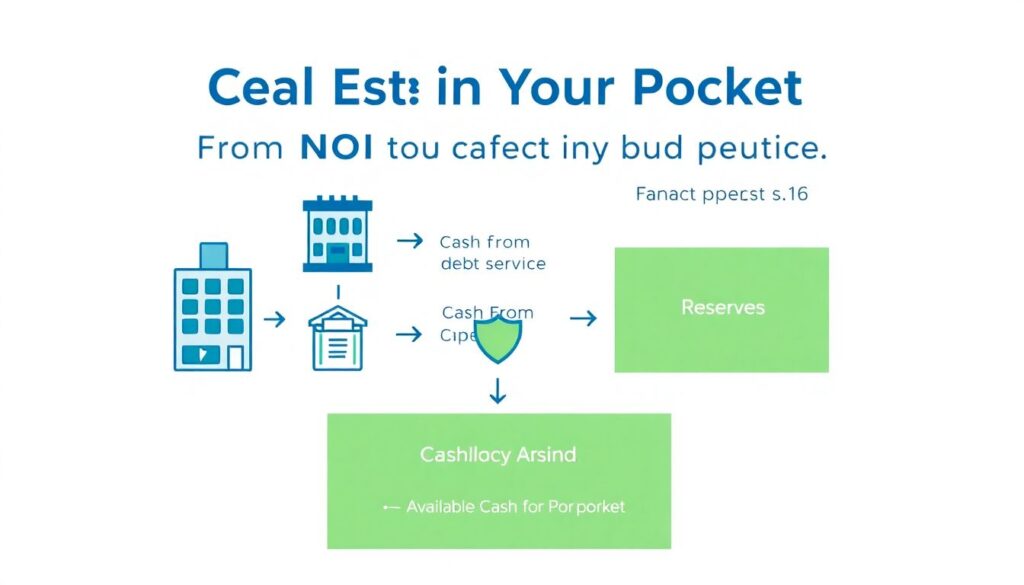
The jump from NOI to actual cash in your pocket is where financing terms come into play. Turn to the cash flow statement and locate principal and interest payments. Add up all debt service, then subtract it from cash from operations. That number, after reserves for capital expenses, is your available cash flow. In practice, this is where you sanity‑check whether “8% cap rate” means anything for you personally. If the loan is expensive or amortizes fast, your equity might grow while your short‑term cash yield stays thin. Evaluating this trade‑off is a big part of real estate investment cash flow statement analysis, and you will quickly see why the same property can look attractive to a long‑term wealth builder and unattractive to someone focused on immediate income.
Balance Sheet Reality Check: Strength, Weakness, Liquidity
Next, revisit the balance sheet with three questions in mind: Is there enough equity cushion? Are there adequate reserves? And are any hidden liabilities waiting to surprise you? Start with the loan‑to‑value ratio: outstanding debt divided by property value. Very high leverage means small shifts in value or income can wipe out your equity. Then, look at cash and reserve accounts. If the property has aging roofs, boilers or elevators, but almost no reserves, you should treat that as a looming obligation, even if it is not yet on the liability side. Finally, read any notes that explain unusual items – for example, loans from related parties or balloon payments that arrive in a few years.
Putting It Together: A Quick Practical Walkthrough
Imagine a small 10‑unit building. The income statement shows annual effective rental income of $120,000 and operating expenses of $60,000, leaving an NOI of $60,000. At first glance, this 50% expense ratio seems reasonable. But when you dig into the details, you notice repairs are only $3,000 for the year and there is no line item for professional management. After requesting more documents, you learn the seller did all repairs himself and ignored several non‑urgent issues. You adjust expenses upward to account for a normal maintenance budget and third‑party management. Suddenly NOI drops, your projected cash‑on‑cash return shrinks and the “great deal” looks merely decent – a perfectly acceptable outcome if the price adjusts accordingly.
Common Problems and How to Troubleshoot Them
Even with a solid process, you will run into financial statements that seem messy, incomplete or simply confusing. Instead of giving up, treat them as puzzles to solve. Start by asking whether the reporting period is consistent across documents; mismatched months or fiscal years are a frequent source of weird numbers. If cash flow looks negative despite positive NOI, trace large, irregular payments in the real estate investor financial statements – maybe there was a one‑off roof replacement or a lump‑sum insurance payment. When line items are too aggregated, ask for a more detailed general ledger to see what is hiding under broad labels like “miscellaneous” or “administrative.”
Here are a few recurring red flags worth double‑checking:
– Big swings in income or expenses from year to year without a clear explanation
– Negative cash flow while the seller insists the property is “very profitable”
– Unusually high owner distributions despite thin or inconsistent profits
– Large “due to owner” balances on the balance sheet that hint at hidden support
Effective troubleshooting is less about accounting brilliance and more about persistence and pattern recognition. Once you have worked through a handful of messy files, you will get faster at spotting which issues are harmless quirks and which signal structural problems with the asset or the way it has been managed.
Learning by Doing (and When Courses Make Sense)
The most reliable way to get comfortable with these documents is to handle them regularly: break down one property per week, even if it is a hypothetical deal from an online listing. Over time, the language of real estate investor financial statements will feel less foreign, and you will start building your own mental library of what “normal” looks like
for different asset types and markets. If you find that self‑study is too slow or you want more structured practice, a focused real estate investment financial statement analysis course can speed things up by giving you curated examples, typical pitfalls and feedback on your reasoning, not just on your math. Whatever path you choose, keep it practical: tie every concept back to a real decision about buying, holding, refinancing or selling.
Turning Numbers into Better Decisions
Understanding how to read real estate financial statements is not about becoming an accountant; it is about protecting your capital and increasing your odds of hitting your goals. Each income line, expense category and debt payment tells you something about risk, resilience and opportunity. When you can read those signals confidently, you negotiate better, you pass on bad deals faster, and you manage existing assets with more intention. With a simple toolkit, a repeatable process and a bit of practice, the numbers stop being intimidating and start becoming your most reliable business partner.