
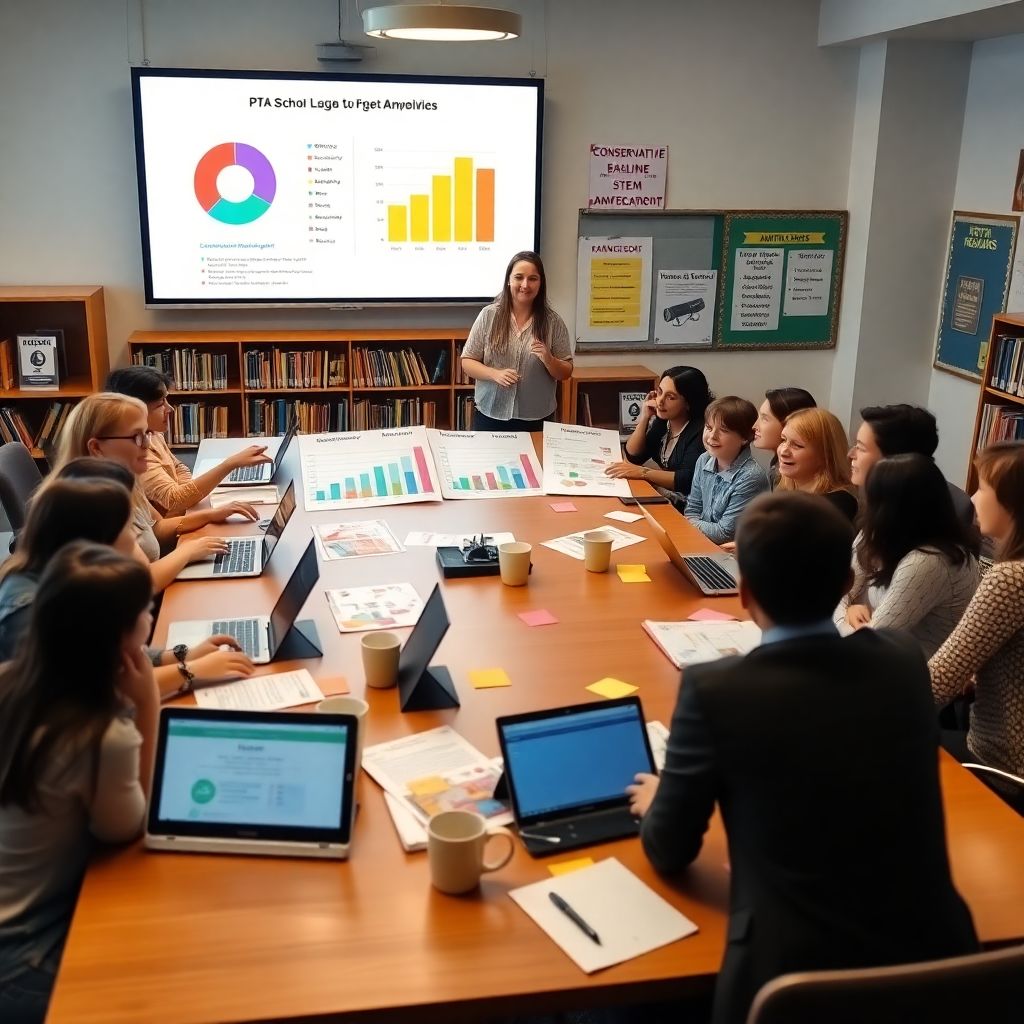
Why a Parent-Teacher Budget Plan Matters More Than You Think
If you’ve ever sat in a PTA or parent council meeting wondering where the money went — or why there’s never quite enough — you’re not alone. A parent-teacher budget plan is basically the operating system of your school community projects: if it’s clear, realistic, and shared, everything runs smoother; if it’s vague, everything feels like guesswork.
A solid plan does three things at once: it aligns priorities, reduces stress for volunteers, and makes fundraising feel purposeful instead of chaotic.
Different Approaches to PTA Budget Planning: Big Picture vs. Detail Freaks
Let’s compare how groups usually start. Some PTAs use a “big picture” method: they pick a few strategic goals (e.g., literacy support, playground upgrade, teacher appreciation) and assign rough budget envelopes to each. Others go full “detail freak”: they itemize every line — down to coffee for meetings and colored paper for flyers — before even discussing goals.
Both models have pros and cons:
1. Goal-Driven (Top-Down) Approach
You start with core objectives and then allocate funds to support them. This approach is closer to strategic planning: define what impact you want, then put money behind it. It works great if your PTA wants to shift from “we just fundraise” to “we invest in specific outcomes”.
2. Line-Item (Bottom-Up) Approach
You list all possible expenses based on last year’s history: events, supplies, subscriptions, grants, mini-projects. Then you adjust up or down depending on expected income. This is easier for new treasurers, because they can rely on concrete numbers.
In reality, the healthiest PTAs use a hybrid: they keep historical line items for control and accountability but group them under a few strategic goals so people see the big picture, not just numbers on a spreadsheet.
Step-by-Step: How to Prepare a Parent-Teacher Budget Plan
Step 1: Collect Data Before You Argue About Numbers
A surprisingly common mistake: people start debating amounts without any data. Instead, treat your budget like a small-scale financial analysis project.
Here’s a minimal workflow:
1. Export last year’s income and expenses (even if it’s messy).
2. Tag each transaction: fundraising, operations, student support, staff support, infrastructure, outreach.
3. Identify one-off items (e.g., a special anniversary project) so they don’t distort this year’s plan.
4. Estimate predictable changes: enrollment growth, new district policies, inflation on printing and food.
This “forensic” look at the old budget is basically your informal pta budget planning guide. Once people see where money actually went, the conversation becomes more grounded and less emotional.
Step 2: Use a Template, But Don’t Become Its Prisoner
Ready-made formats save time. A good parent teacher association budget template usually includes standard income streams (membership dues, fundraisers, grants, donations) and expense categories (events, teacher grants, admin costs, reserves).
The trap? Treating the template as a rulebook instead of a starting point.
Short version: customize it. Remove categories that don’t fit your school. Add line items that reflect your culture — for example, translation services for multilingual families, or a dedicated line for social-emotional learning projects.
Step 3: Compare Two Decision Models — Conservative vs. Ambitious
When you decide how to create a PTA annual budget, you’ll feel a tug-of-war between two financial mindsets:
1. Conservative / Risk-Averse Model
– Income projections are based only on proven fundraisers.
– Big new projects launch only after money is already secured.
– A larger reserve fund is kept for emergencies.
This works best for unstable communities, high turnover PTAs, or when trust needs rebuilding. It’s easier to deliver on promises — fewer surprises.
2. Ambitious / Growth Model
– Income projections assume at least one new fundraising channel.
– The PTA invests early in community-building events that may not break even but build long-term engagement.
– A smaller but clearly defined reserve is kept, and the rest is put to work.
Neither is “right”. A practical hack is to run two scenarios: a conservative baseline and an ambitious stretch version. Present both to the board and principal, then negotiate a realistic middle path.
Inspiring Examples of Budget Plans That Changed a School
Case 1: Turning a Chaotic Budget Into a Literacy Strategy
One suburban PTA realized their spending was scattered: small amounts on random events, with no clear theme. They restructured the budget around three strategic outcomes: reading, community connection, and teacher retention.
They didn’t raise more money that year. But by redirecting funds — cutting low-impact expenses and increasing teacher mini-grants for classroom libraries — they financed a monthly “Family Reading Night” and book vouchers for low-income families. Teachers reported higher engagement, and the principal started co-presenting at PTA meetings, because the budget showed a sharp, intentional focus.
The lesson: even with the same total, a focused budget plan multiplies impact.
Case 2: From “Bake Sales Forever” to Sustainable Funding
Another school was stuck in “event churn”: constant bake sales, car washes, raffles. Volunteers were burned out, and the budget still felt fragile.
The treasurer ran a quick scenario analysis: What if they cut small fundraisers by half and built a corporate sponsorship and recurring-donation model instead? They built a hybrid budget: predictable income from monthly donors and sponsors, plus just a few high-yield events.
Within two years, they replaced five low-yield fundraisers with one well-organized community fair and a network of recurring donors. Their budget became less volatile, and planning went from reactive to proactive.
This is where tools matter: they adopted school pta finance management software to track donor trends and event ROI. Once they could see which activities actually produced stable income, the budget conversations changed from “we need to do more” to “we need to do what works”.
Practical Recommendations for Budget Development
Build Transparency In From Day One
In a school community, perception is half the battle. A clear parent-teacher budget plan is not only a financial tool, it’s a trust-building mechanism.
Post simplified reports: pie charts, short summaries, and a one-page overview. Avoid financial jargon in public communication, but keep technical detail in the internal documents. This dual-layer approach respects both lay parents and those who want full transparency.
Use a Simple, Repeatable Annual Cycle
To move from improvisation to an actual system, think of the year in discrete phases:
1. Review (End of School Year) – Analyze last year’s numbers and outcomes.
2. Prioritize (Early Summer) – Define 3–5 primary goals for the next year.
3. Draft (Late Summer) – Build a draft budget aligned with those goals.
4. Approve (Start of School Year) – Present to the PTA board and general members, get formal approval.
5. Monitor (Monthly) – Compare actuals to budget; adjust if necessary.
6. Report (End of Year) – Close the books, summarize impact, archive data.
Once this cycle is described and documented, you no longer “reinvent budgeting” each year — new officers can just follow the procedure.
Comparing Tools and Tech: Spreadsheets vs. Software
Approach 1: Classic Spreadsheets
Spreadsheets (Excel, Google Sheets) are flexible and free, so most PTAs start here. They’re perfect for:
– Custom categories tailored to your school
– Quick scenario modeling (what if we add a new fundraiser?)
– Sharing drafts with committee chairs
But they depend heavily on the treasurer’s personal skill. Version control, formula errors, and access issues can easily creep in. When leadership changes, the learning curve starts all over again.
Approach 2: Dedicated PTA Finance Tools
Cloud-based systems designed for associations standardize a lot of the messy parts: income tracking, expense approvals, reporting, and even online payments. With the right school pta finance management software, you get built-in reporting formats, permission settings, and sometimes even integrated fundraising tools.
The trade-off: subscription fees and the initial setup effort. For a very small PTA with minimal transactions, a spreadsheet might be enough. For a mid-to-large PTA or one with complex projects, specialized software can dramatically reduce risk and treasurer burnout.
A balanced approach: start with a robust spreadsheet model and migrate to software once your annual turnover, number of events, or volunteer base crosses a certain threshold you define in advance.
Motivating the Team: Culture Around the Budget
Make the Budget About Students, Not Just Numbers
Volunteers don’t get excited about line items; they get excited about outcomes. Every time you present the budget, tie numbers to real scenarios:
– This line finances translation at family nights, so more parents can participate.
– This reserve allows us to support a student emergency fund without scrambling.
– This event fund pays for STEM night, where kids and parents build projects together.
When the conversation shifts from “we need $2,000” to “we want every child to have access to books in their home language”, motivation rises naturally.
Use Storytelling in Your Reports
Instead of just “we spent $500 on teacher grants”, share a quick micro-story: a teacher who used a grant to buy lab materials for a hands-on experiment day. Numbers plus stories create buy-in. Over time, this storytelling habit makes budget approvals almost frictionless.
Learning and Growth: Training for PTA Leaders
Why Training Your Treasurer Is an Investment, Not a Formality
Many PTAs treat the treasurer role as “whoever is good with spreadsheets”. That’s a start, but it’s not enough. When you invest in a pta treasurer training and budgeting course, you’re not just teaching one person to handle money — you’re protecting the entire organization from errors, misunderstandings, and potential compliance issues.
Formal training often covers:
– Basic non-profit accounting principles
– Budget forecasting and variance analysis
– Internal controls (who approves what, when, and how)
– Legal and tax considerations in your region
Even a short, affordable online course can dramatically raise the professionalism of your budget planning process.
Useful Resources for Ongoing Learning

To keep evolving your parent-teacher budget plan, it helps to build a small “knowledge library” for new officers. Include:
1. Links to your national or regional PTA’s official pta budget planning guide or financial handbook.
2. A curated list of webinars and workshops on budgeting, fundraising strategy, and governance.
3. Your own internal “PTA Finance FAQ” — a simple document with answers to recurring questions about reimbursements, approvals, and timelines.
4. A sample completed budget from a previous year, annotated with notes on what worked and what didn’t.
With these resources in place, each new board doesn’t start from zero. They inherit both tools and wisdom.
Final Thoughts: Treat the Budget as a Shared Roadmap
At its core, a parent-teacher budget plan is not an accounting exercise; it’s a shared roadmap for how your community wants to support its students and staff over the next year. Whether you lean toward conservative or ambitious planning, spreadsheets or specialized software, the key is the same: clarity, transparency, and alignment.
When your budget clearly answers the question “What kind of school experience are we building together?”, numbers stop being a source of conflict and become a lever for real change.