
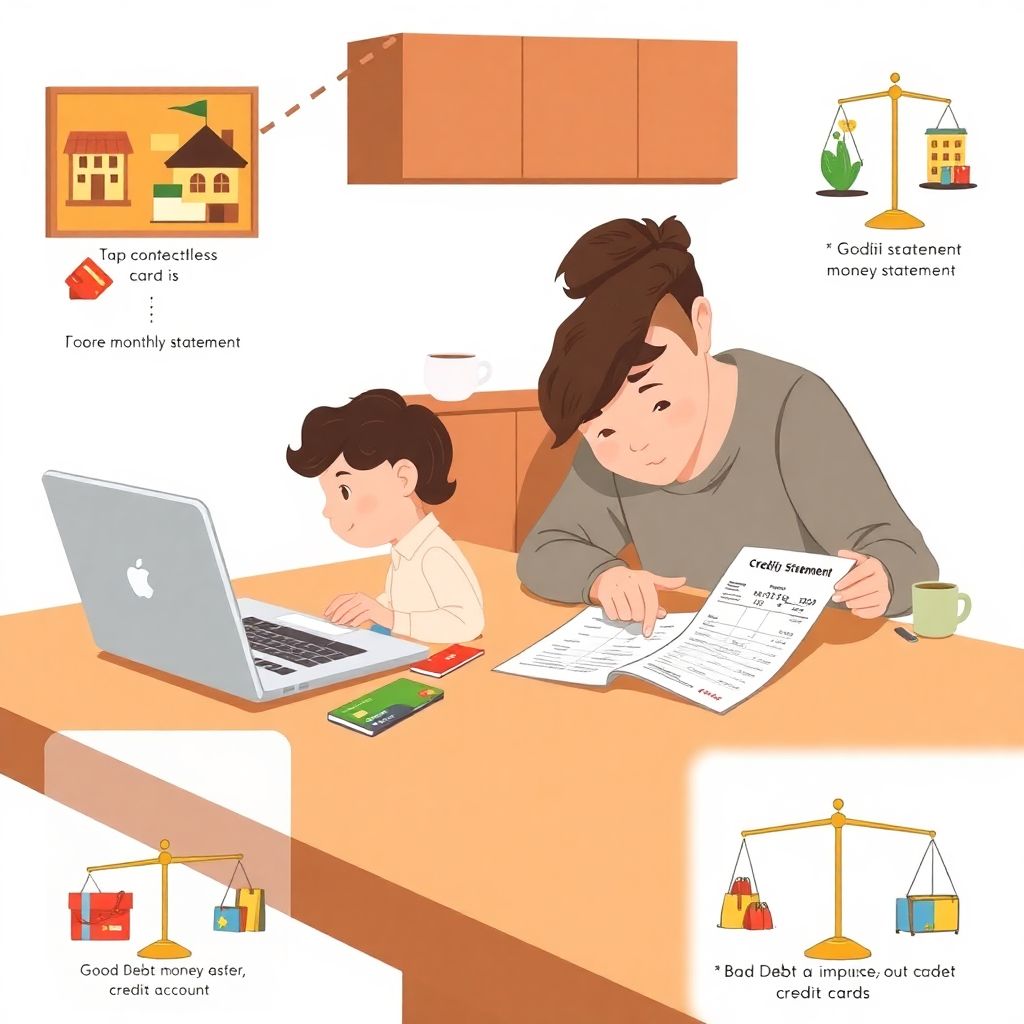
Why These Money Talks Matter More Than Ever
Money is no longer an “adult-only” topic. Kids see contactless payments, online shopping, and buy-now-pay-later offers long before they ever earn their first paycheck. If you skip conversations about credit cards, loans, and debt, the world will educate them instead—through ads, social media, and sometimes painful mistakes. Understanding how to teach kids about credit cards and the difference between helpful and harmful borrowing is less about turning them into mini-investors and more about keeping them from feeling lost, ashamed, or trapped when they start managing money on their own. A calm, open approach today can prevent panic later, when a real bill with real interest shows up in their inbox.
Step 1: Start With “What Is Credit?” (Before You Mention Cards)
Most parents jump straight to, “Credit cards are dangerous, don’t use them.” That sounds protective, but it leaves kids with a cartoon version of reality: credit is bad, cash is good, end of story. Instead, slow down and start with the basics: credit is simply “borrowing money now and promising to pay it back later.” Explain that banks and lenders are like stores that rent money; you pay extra (interest) for the convenience of using their money today. When kids understand this core idea, it becomes much easier to talk about credit cards, car loans, and even student loans as different versions of the same basic tool, instead of mysterious traps.
Common beginner mistake: Treating credit like magic money
One classic beginner mistake is letting kids think credit is separate from their real money. They see you tap a card, walk away with groceries, and nothing visibly leaves your wallet. If you never connect that tap to actual work and income, they internalize the idea that plastic equals instant satisfaction with no clear cost. Counter this by literally walking them through a statement: “Here’s the grocery store. Here’s the amount. Here’s how it comes out of my bank next month.” When kids witness the full cycle—spend, bill, payment—the illusion of “free money” disappears, but without guilt or fear attached.
Step 2: Explain How Credit Cards Actually Work
Once the concept of credit is clear, you can move into how credit cards operate in the real world. Keep it simple and concrete: a credit card lets you borrow from a bank up to a certain limit; at the end of the month, you get a list of everything you bought; if you pay it all, you avoid interest, but if you only pay part, the bank starts charging you extra on what’s left. This is where financial literacy for kids credit cards and loans should feel like a story, not a lecture—follow one pretend purchase from the swipe, to the bill, to the impact on next month’s budget, so they see cause and effect.
Beginner mistake: Only warning, never explaining
A lot of parents share one-liners: “Never carry a balance,” “Credit cards ruin lives,” or “Cut them up.” While these warnings come from a good place, kids walk away scared but not smarter. Fear alone doesn’t teach them how to use a card responsibly when they eventually get one at college or with their first job. Instead of only saying what not to do, show them the safe way: using a card like a short-term tool, always planning to pay in full, and checking the statement regularly. This “how” is what sticks when you’re not there to supervise every tap.
How to teach kids about credit cards using real-life moments
You don’t need a formal “lesson” with a whiteboard. Everyday shopping offers perfect micro-teaching moments. At the checkout, say: “I’m using a credit card, but this is still my money. I’ll see this on my bill and pay it from my bank next month.” At home, open the statement and point out a few familiar purchases so your child recognizes them. That’s the best way to teach kids about loans and debt in context—short, repeated explanations attached to actions, instead of one big serious talk they’ll quickly forget.
Step 3: Decode “Good” vs. “Bad” Debt Without Sugar-Coating
Kids hear adults throw around phrases like “good debt” for mortgages or “bad debt” for maxed-out cards, but rarely get the logic behind those labels. To avoid creating confusion, explain that debt is not morally good or evil by itself; it is a tool. It becomes “good” when it helps you build something valuable over time—a home, an education, a business—and you have a realistic plan to repay it. It becomes “bad” when it funds things that disappear quickly, like impulse purchases or lifestyle upgrades, especially if the debt grows faster than you can pay it down, trapping you in never-ending payments.
How to explain good and bad debt to children in plain language
Skip complicated financial jargon and reach for examples they already know. Ask: “If you borrow money to buy a toy that you’ll forget about in a week, but you’re still paying for it months later, does that feel smart or stressful?” Then contrast it with: “If you borrow to get an education that lets you earn more for the rest of your life, that can be worth the cost, as long as you don’t borrow more than you can realistically pay.” When you frame it this way, how to explain good and bad debt to children becomes much easier, because they can tie the idea to time, usefulness, and long-term value instead of abstract labels.
Beginner mistake: Calling all debt “bad” to scare them straight
It’s tempting to say, “Debt is always bad, avoid it forever.” This feels protective now, but it can backfire later. Your child might feel like a failure if they ever need a car loan to get to work or a modest student loan to go to school. They may sign contracts without reading them, just to hide the “shame” of borrowing. A better strategy is balanced honesty: acknowledge that some debt is often necessary in modern life, emphasize that the problem is borrowing blindly or more than you can handle, and show them how thoughtful planning keeps debt from turning into chains.
Step 4: Introduce Loans Through Goals They Actually Care About
Kids don’t care about abstract student loan charts, but they definitely care about a new bike, a gaming console, or a trip with friends. Use those real desires to explain loans in a concrete way. Say your child wants something big. You can offer a “parent loan”: you’ll pay for it now, they repay you over several months from allowance or small earnings. Agree on the total amount, the repayment plan, and even a tiny bit of “interest” to show that borrowing has a cost. Suddenly, loans stop being theoretical; they become choices with visible trade-offs.
Best way to teach kids about loans and debt through experience
The best way to teach kids about loans and debt is to let them feel, in a low-risk environment, what it’s like to owe money. When a chunk of their next few allowances goes toward repaying you instead of fun stuff, they grasp the weight of debt more quickly than any lecture could accomplish. Just be careful to stay supportive, not punitive: if they’re late on a “payment,” use it as a chance to talk about consequences and planning, not to shame them. The goal is learning, not recreating a collection agency at the dinner table.
Beginner mistake: Turning loans into emotional leverage
Parents sometimes use these mini-loans as a power move: “I bought that for you, so you owe me.” This attaches guilt and emotional pressure to money, which can turn into secrecy or avoidance later. Instead, treat it like a neutral financial agreement between partners. You can say, “We made a plan together, and sticking to it is part of being responsible. If the plan is too hard, let’s adjust, but we won’t pretend the debt doesn’t exist.” This calm tone helps kids associate loans with clear agreements and communication, not with fear of disappointing you.
Step 5: Use Tools, Not Just Talk—Cards, Apps, and Practice
At some point, theory runs out of steam and kids need tools in their own hands. This is where kids debit and credit card teaching tools and simple budgeting apps come in. Many banks and fintech services now offer supervised accounts where you can transfer allowance, set limits, and see transactions in real time. A debit card connects directly to a balance, so when the money is gone, it’s gone; that’s an excellent starting point, because it enforces the idea that there is a finite amount to spend, and swiping is just another way to move real money.
How to safely introduce credit-like behavior

Before your teen ever gets an actual credit card, you can simulate the experience. One option is adding them as an authorized user on your card with a strict limit and a clear rule: anything they buy must be repaid from their own money by a certain date. Walk through statements together and let them explain each purchase. Tie it directly to their budget: if they blow half of next month’s money on impulse buys, don’t bail them out—let the frustration teach them more than nagging ever could. Your role is to keep the environment safe while they stumble on small stakes.
Beginner mistake: Giving tools without oversight
Handing a teen a card and saying, “Be careful,” is like handing them the car keys without driving lessons. Another beginner mistake is never checking statements or transactions with them, under the assumption that “no news is good news.” If you want them to develop strong habits, schedule quick, regular check-ins: five or ten minutes where you review what they spent, what surprised them, and what they would do differently next month. These short debriefs build financial literacy for kids credit cards and loans in a practical, low-stress way.
Step 6: Talk About Interest, Minimum Payments, and Traps
Interest is often the invisible part of debt that trips people up. Kids see a price tag; they don’t see that carrying a balance can double or triple the actual cost of what they bought. Explain interest as the “rent” you pay for using the bank’s money over time. If you only make the minimum payment, most of what you send goes to this rent, not to shrinking what you owe. Using a simple example—like a $100 purchase stretched out over many months—can show how a small monthly bill can hide a huge final cost, quietly draining future income they haven’t earned yet.
Beginner mistake: Ignoring the small print and the “minimum due”
Even adults fall into the trap of only looking at the bright, bold “minimum payment” on a statement, treating that number as a suggestion of what’s safe. Kids who absorb this behavior assume that as long as they hit that smaller amount, everything is under control. To counter this, emphasize that the minimum due is designed to maximize the bank’s profit, not to protect them. Show them the “total owed” line and how little it shrinks if you only pay the minimum. This single insight can prevent a lot of future heartache.
Step 7: Model the Behavior You Want Them to Copy
No script, book, or app can compete with what kids observe at home. If they hear you constantly say, “I’m broke,” yet see packages arriving every day, the hidden message is that money is chaotic and credit fills the gap. Modeling doesn’t mean being perfect; it means being honest about your choices. When you decide not to buy something because it would mean more debt, say so. When you use a credit card strategically—for points or convenience—but pay it off in full, explain that too. These small comments over years quietly shape their attitude more deeply than any one-off lecture.
Beginner mistake: Hiding financial stress completely

Many parents think shielding kids from all money worries is kind, but total secrecy can make adult life later feel like a sudden storm of bills and jargon. That doesn’t mean unloading your stress onto them; instead, offer age-appropriate transparency. You might say, “We’re paying off a loan for the car we use to get to work, so we’re skipping some extras this month.” This shows debt as a planned, manageable tool rather than a terrifying unknown. When they eventually face their own bills, the situation will feel familiar instead of shocking.
Step 8: Create a Judgment-Free Zone for Questions and Mistakes
Kids will occasionally make choices you don’t like: spending too fast, forgetting what they bought, or asking for loans they can’t reasonably repay. Treat those moments as data, not disasters. Ask them to walk you through what happened and how they felt afterward. Help them notice patterns—impulse buying when they’re bored, falling for “limited time” offers, or comparing themselves to friends. The aim is not perfection but awareness. When your child knows they can admit a money mistake without being mocked or yelled at, they’re much more likely to seek your help before problems spiral.
Beginner mistake: Using shame as a teaching method
Comments like “How could you be so careless?” or “You’re just like [relative] who’s bad with money” might slip out in frustration, but they shut down learning instantly. Shame makes kids hide their errors, which is the exact opposite of what you want when it comes to debt. Instead, separate their decision from their identity: “That wasn’t a great choice, but everyone makes money mistakes. Let’s figure out how to fix this and avoid it next time.” This stance prepares them to handle real-world credit issues with problem-solving instead of avoidance.
Putting It All Together
Talking to your kids about credit cards, loans, and “good vs. bad” debt is not a single, dramatic sit-down; it’s an ongoing series of short, honest conversations and small experiments with real money. By starting with the basics of what credit is, using relatable examples, and gradually layering in tools like supervised cards and simple loans, you give them space to learn while the stakes are still low. When you avoid common beginner mistakes—scaring instead of explaining, hiding everything, or handing over tools with no guidance—you raise kids who see borrowing neither as a magic solution nor as a permanent curse, but as a powerful tool that requires respect, planning, and clear thinking.