
Why Bank Statements Matter More in 2025 Than They Did for Your Parents
Paper statements used to arrive once a month, land in a drawer, and quietly collect dust. In 2025, your “statement” is a live data stream in your banking app, full of instant payments, subscriptions, micro‑transactions, and maybe even a bit of crypto on the side.
And that stream is moving faster than ever.
Today, a typical teen might have:
– a debit card linked to a parent‑controlled account,
– a couple of subscription services,
– in‑game purchases, and
– peer‑to‑peer transfers like “I’ll send you my half on the app.”
Without learning how to read a bank statement early, it’s incredibly easy to lose track, pay duplicate charges, or miss a fraudulent transaction hidden between Netflix and a food‑delivery order.
The New Basics: how to read a bank statement Without Falling Asleep
Let’s strip it down. Whether it’s paper or app-based, the core elements are the same. If you’ve ever thought “I’ll check this later” and never did, this is for you.
1. The Summary at the Top: Your Financial Snapshot
This is the dashboard. It usually includes:
1. Previous balance – what you had at the start of the period.
2. Total deposits/credits – money in.
3. Total withdrawals/debits – money out.
4. Fees and interest – what the bank took and what it gave back.
5. Ending balance – where you stand now.
This is the part you and your kid should be able to understand in under 30 seconds. It’s effectively the “bank account statement explained in one glance.” If the ending balance feels off, that’s the signal to dig into the details below.
2. The Transaction List: Where the Truth Lives
Every row tells a story:
– Date – when the bank processed it (not always the same day you paid).
– Description – the merchant or source of the money.
– Amount – what moved in or out.
– Balance after – not always shown, but common in digital statements.
This is where you catch:
– duplicate charges,
– trial subscriptions that quietly converted to paid,
– small fraud transactions (often under $10) used to “test” a stolen card.
In a world of tap‑to‑pay and one‑click purchases, this section is less boring accounting and more personal security.
3. Fees and Interest: The Hidden Cost of Not Paying Attention
Overdraft fees, ATM fees, “maintenance” fees, foreign transaction fees — they add up. In many countries, surveys before 2024 showed young adults losing tens or hundreds of dollars a year to bank fees simply because they didn’t know what to look for or how to contest them.
If you’re teaching a teen, this section is gold:
– Show them each fee.
– Explain what caused it.
– Discuss how to avoid a repeat (alerts, minimum balance, using in‑network ATMs, etc.).
Learning this at 14 instead of 24 can easily save them thousands over a decade.
What Has Changed by 2025: From Monthly Paper to Real‑Time Feed
The biggest shift isn’t *what* a statement shows, it’s *how often* and *how fast* it updates.
Instant payments, same‑day employer deposits, and real‑time notifications have turned the old “once a month” statement into something closer to a financial social media feed.
Three important trends:
– Always‑on visibility: Many banks now let you see pending transactions, categorized spending, and projected balances based on upcoming bills.
– Subscription chaos: Streaming, apps, games, AI tools — the average household juggles dozens of recurring charges. That makes statement literacy critical just to know what you’re actually paying for.
– Shared and junior accounts: Parent‑teen shared accounts and child cards tied to a parent’s wallet are now mainstream, which makes understanding statements a family project, not just an adult chore.
In other words, if you only glance at your statements monthly in 2025, you’re driving a race car using last month’s dashboard.
Stats: How Comfortable Are People With Their Statements, Really?
Various financial literacy surveys up to 2024 paint a consistent picture:
– Many adults can *check* their balance but struggle to *explain* the fees or interest on their account.
– A large share of teens and young adults say they feel confident with payment apps, but not with traditional banking terms like “available balance” vs “current balance.”
Projecting these trends into 2025, nothing suggests this gap magically closed. In fact, as financial products get more complex and more “gamified,” the risk is that people feel *more* confident while understanding *less*. That’s a dangerous combo.
This is why “bank account statement explained in plain language” should be a standard part of every school curriculum — but until that happens, it falls to parents, guardians, and mentors.
Teaching Kids About Money and Banking in the Age of Apps
You’re not just explaining words on a page. You’re building your kid’s personal firewall against scams, debt traps, and pure confusion.
Start With What They Already See
Most kids meet money through:
– in‑game purchases,
– app store subscriptions,
– streaming services,
– school lunch accounts or prepaid cards.
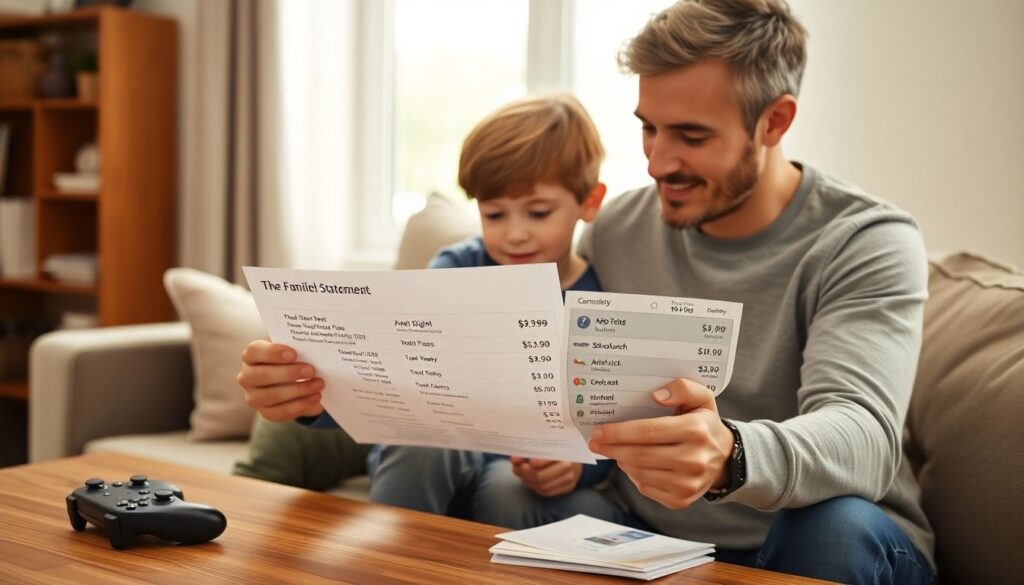
Sit down with their statement (or the shared family account) and literally connect the dots:
“See this $9.99? That’s the game pass you bought last week.”
“Those three $4.99 charges? That’s the same app on different accounts.”
This turns the abstract idea of “a statement” into something real and immediate, and makes teaching kids about money and banking feel less like a lecture and more like solving a puzzle together.
Use Digital Tools, But Don’t Outsource Thinking to Them
A lot of banks now offer online banking for kids, with:
– real‑time alerts to both parent and child,
– spending categories (“food,” “gaming,” “transport”),
– simple visuals and graphs.
These are fantastic on‑ramps. Just resist the temptation to let the app “teach everything.”
You still want them to read the actual transaction list, not just glance at a pretty pie chart.
Ask them:
– “Can you find the biggest expense last week?”
– “Which charges are subscriptions?”
– “Which ones were surprises?”
Make them use their brain, not just their thumb.
Step‑by‑Step: How to Walk Through a Statement With Your Kid
You don’t need a finance degree. You just need 15 quiet minutes and a bit of patience.
A Simple 5‑Step Routine
1. Open the latest statement together
Paper, PDF, or in‑app — doesn’t matter. The key is reading it *side by side*.
2. Scan the summary
Ask: “What was the starting balance? What’s the ending balance? Did money go up or down this month?”
3. Find three “expected” transactions
Let them point out things they remember (pocket money, a specific purchase). This builds confidence.
4. Hunt for surprises or questions
Any unknown merchant? Duplicate charge? Random fee? Pause there. Look it up together if needed.
5. End with one concrete takeaway
Maybe it’s “We’re canceling this old subscription,” or “Let’s turn on alerts for transactions over $20.” Tiny wins add up.
Do this 10–12 times over a year and your child will be more financially literate than many adults.
Economic Angle: Why This Matters Beyond Your Household
On a personal level, understanding statements helps avoid:
– overdraft fees,
– unnecessary subscriptions,
– accidental debt.
Zoom out, and the effects scale. When millions of people:
– track spending more accurately,
– contest fraudulent charges faster,
– choose lower‑fee products,
you get:
– lower default rates for banks,
– fewer “junk fees” tolerated in the market,
– more pressure on financial institutions to simplify products.
Regulators in many regions have been pushing for clearer disclosures and more transparent fees. Consumers who understand statements are the backbone of that pressure. Banks can’t rely on “confusion” as a quiet revenue stream if a generation of teens grows up fluent in their own data.
Industry Impact: How Banks Are Adapting (and Competing for Your Kid)
Financial institutions have figured out something big: loyalty is often formed young.
That’s why you now see a race to offer the best bank accounts for kids and teens:
– zero or very low fees,
– built‑in budgeting tools,
– parental controls and shared visibility,
– gamified savings goals.
This isn’t just a feel‑good trend. It’s strategic. If a bank earns your teen’s trust at 15, the odds are higher they’ll still be there for the first job, first credit card, first car, and maybe first mortgage.
On the flip side, fintech apps and neobanks have made it easy to switch. If a bank’s statement is confusing or fee‑heavy, parents can now jump to a competitor in a few taps. That competitive pressure is one reason statements in 2025 look cleaner, more visual, and much more like a modern app than an old ledger.
Future Forecasts: What Reading a Statement Might Look Like by 2030
Looking ahead, several trends are very likely:
– AI‑assisted statements
Your app will flag, in plain language: “This subscription increased in price by 25%” or “You paid more bank fees this month than last month.” Some apps already do bits of this; by 2030 it’ll be standard.
– Automatic negotiation and cancellation
Instead of *you* hunting through the statement, your banking app may proactively say: “You haven’t used this service in 5 months. Want to cancel?” or “We found a cheaper utility plan; tap to switch.”
– Hyper‑personalized financial education for kids
Imagine a statement that says, “You spent $35 on snacks this week. If you cut that in half and saved the rest, you’d have $910 in a year.” That kind of immediate, personalized cause‑and‑effect is a powerful teaching tool.
All of this will make statements easier to read — but also easier to ignore if you just trust the automation. That’s exactly why teaching statement basics now is so important: it prepares kids to *understand* what the AI is telling them, instead of blindly accepting it.
Bringing It All Together
In 2025, “how to read a bank statement” is no longer a dusty adult skill; it’s a core digital life skill, right up there with managing passwords and recognizing phishing attempts.
If you want a practical starting point:
– open the latest statement,
– walk through the summary,
– pick a few transactions to decode together,
– spot one thing to change for next month.
Keep it short, keep it conversational, and keep repeating it.
Your kid doesn’t need to become a mini‑accountant. They just need to confidently say:
“I know what’s happening with my money, and I can prove it by reading my statement.”
Комментарии