
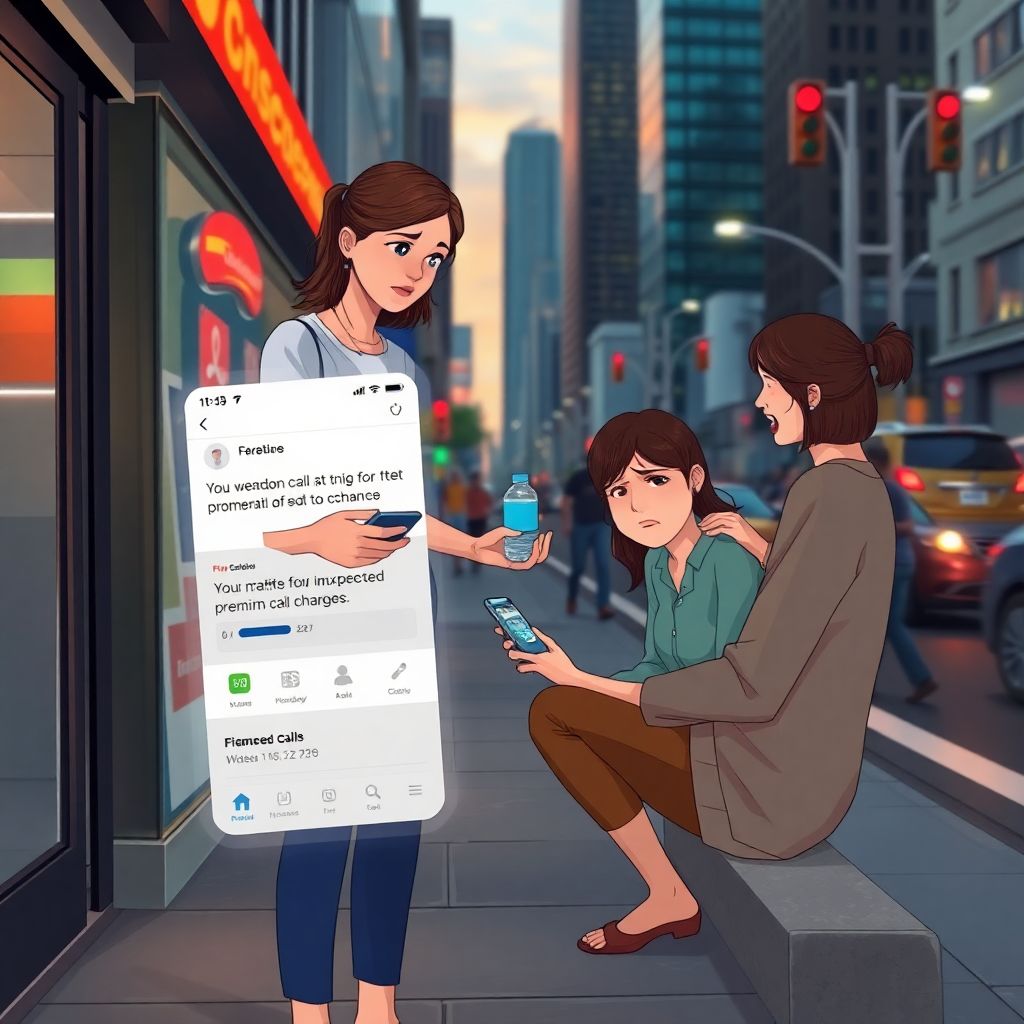
Helped a stranger and ended up with surprise phone fees – what now?
I’m a 27‑year‑old woman living in a big, fast‑paced city. I make a conscious effort not to ignore people who clearly look distressed or in need of help. I don’t want to be the person who just walks by and pretends not to see.
A few days ago, on my way home, I noticed a woman on the sidewalk who looked completely overwhelmed. She seemed confused, was crying, and didn’t look steady on her feet. I stopped, asked if she was okay, and helped her sit down somewhere safe. I stayed with her and called for help so she wouldn’t be alone.
While we were waiting, she told me her phone battery had died and she couldn’t remember any numbers off the top of her head. She gave me what she thought was her roommate’s number and asked if I could try calling from my phone. I dialed it, no one answered, and that was that. A bit later she said she was thirsty, so I ran into a nearby corner shop and bought her a bottle of water.
I didn’t think much of it afterward – it just felt like the basic, decent thing to do. But that evening, when I checked my phone account, I saw several unexpected charges. The number I’d dialed apparently routed through some kind of premium or paid calling service. Because of that, I was hit with extra fees.
It’s not an astronomical amount of money, but it’s enough to sting. I’m actively trying to pay off my credit card balance and slowly build an emergency fund, so even “small” surprise expenses feel like a step backward. It also left me feeling conflicted: I tried to help, and somehow it turned into a little financial trap.
The situation raised a few questions for me:
– Is there any realistic way to contest or reverse these phone charges, or do I just have to accept them as an expensive reminder to be more careful?
– How can I safely and practically help someone in public without opening myself up to financial risk or potential scams?
– Should I change anything about how my phone or cards are set up so I’m better protected the next time I try to help someone?
I’m not interested in punishing anyone or making this a bigger drama. I just want to be more informed and prepared so that I can still do the right thing without accidentally hurting my own finances.
—
Can you dispute or reverse the phone charges?
In many cases, you can at least try to get those charges reduced or removed:
1. Contact your phone provider immediately
Call customer support, explain exactly what happened, and emphasize that:
– This was a one‑time, accidental call.
– You were assisting someone in distress.
– You were unaware the number went through a premium service.
Politely but firmly ask whether they can:
– Remove the charges as a one‑time courtesy, or
– Offer a partial adjustment or credit.
Providers often have the ability to reverse first‑time premium charges, especially if you have a decent payment history and it’s clearly not a recurring pattern.
2. Ask for a detailed breakdown
Request a clear itemization of:
– Which number was called,
– How the charges were calculated,
– What kind of service it was (premium, international, etc.).
Sometimes seeing exactly what happened gives you leverage to argue that you were not properly informed or that it was misleading.
3. Check for premium call blocking options
While you’re on the line with them, ask:
– If they can block premium-rate numbers on your account going forward.
– Whether any “spend caps” or alerts can be enabled so you’re warned before unusual charges go through.
Even if they don’t reverse this incident, you can use it to put better protections in place.
If the amount is small, there is always the chance your provider says no and expects you to pay. In that case, it may not be worth escalating further. But it’s very much worth at least one call – many people are surprised by how often companies remove fees when you ask clearly and calmly.
—
How to help someone in public without exposing yourself financially
You shouldn’t have to choose between being kind and being safe. You can absolutely do both with a few boundaries:
1. Use official emergency channels first
If someone seems disoriented, in danger, or unable to care for themselves:
– Call emergency services or a local non‑emergency help line.
– Describe the situation and follow their instructions.
That way, you’re not personally responsible for sorting out their logistics, and professionals can assess what kind of help they actually need.
2. Avoid dialing unfamiliar numbers directly
If a stranger asks you to call a specific number:
– Ask who you’re calling (friend, roommate, doctor, etc.).
– Consider using speakerphone so you control the call.
– If something about the number looks odd (strange country code, lots of digits, premium-style prefix), pause.
If you’re unsure:
– Offer to call emergency services instead.
– Say you’re not comfortable calling a private number on your phone, but can help them find a safer option (for example, approaching a nearby business to use their phone, if possible).
3. Set a spending boundary in your mind
Decide in advance what you’re willing and able to spend to help someone:
– Maybe you’re okay with buying a small bottle of water or bus fare.
– Maybe you’re not okay with covering taxis, hotel rooms, or large purchases.
Having a personal limit means you aren’t making a pressured decision in the moment when emotions run high.
4. Keep your payment info private
Never:
– Hand over your unlocked phone with apps and payment methods open.
– Read out your card number or allow someone to “type it in for you.”
– Allow a stranger to walk away with your phone, even “just for a second.”
You can stand next to them and dial, maintain physical control of your devices, and still be polite and supportive.
5. Help in non‑financial ways
You can still be incredibly kind without spending much (or any) money:
– Sit with the person and talk to them calmly.
– Offer to call emergency services or a crisis hotline.
– Ask nearby staff (in a store, café, etc.) if they can assist with water or a seat.
– Help them find a safe place to wait, like a bench in a busier, well-lit area.
Emotional support and helping coordinate safe assistance are often more valuable than money.
—
How to adjust your phone settings to avoid surprise charges
You can do a lot on the technical side to protect yourself from accidental fees:
1. Ask your provider to block premium services
Many carriers have:
– Premium-rate number blocks.
– International call restrictions.
– Spending caps or alerts for unusual usage.
You can request to:
– Disable calls to all premium-rate numbers,
– Require your consent (like a text confirmation) before such calls are allowed,
– Get alerts when your bill surpasses a certain threshold.
2. Use call confirmation or dialer apps
Some phones and apps allow you to:
– Show a warning when dialing certain prefixes (common for premium or international numbers).
– Require an extra tap to confirm the call if it’s outside your usual calling region.
Even a simple “Are you sure you want to call this number?” pop‑up can make you pause long enough to reconsider.
3. Protect your phone’s lock screen
Make sure:
– Your phone is locked if you ever hand it to someone, and
– They can only access the dialer (if you choose to allow that), not your full home screen or financial apps.
That way, even in a stressful situation, they can’t quickly open payment apps or access your personal information.
4. Review your plan’s small-print regularly
It’s tedious, but helpful to:
– Check whether your plan has specific rules for international or premium numbers.
– Confirm how you’re notified of new or unusual charges.
Knowing this in advance can help you argue more effectively with customer service if something goes wrong.
—
Balancing compassion with self‑protection
Feeling frustrated after something like this is completely valid. You tried to help, and it left you with a bill instead of a good feeling. It’s easy to start thinking, “Next time I’ll just walk past,” but that doesn’t have to be the takeaway.
A more balanced mindset might be:
– You’re still allowed to care, but
– You’re also allowed to set boundaries and decline requests that feel unsafe or financially risky.
If someone pressures you to use your phone for an unusual call, you can say:
– “I’m not comfortable dialing that number on my phone, but I can call emergency services for you.”
– “I can’t spend more money right now, but I’ll stay with you until help arrives.”
You don’t owe strangers unlimited access to your resources in order to be a good person.
—
What to do next, step by step
1. Call your phone provider
– Explain the situation clearly and politely.
– Ask for the charges to be reversed as a one‑time exception.
– Request blocks on premium or international numbers if possible.
2. Update your safety rules for helping
– Decide what you are and are not willing to do financially.
– Commit to using emergency services as your first serious form of help.
– Practice a few phrases so it’s easier to say no to risky requests in the moment.
3. Adjust your phone settings
– Enable any available blocks or alerts.
– Tighten up lock-screen access and app permissions.
4. Give yourself credit
You acted with empathy and concern for another human being. That’s something to be proud of. The financial annoyance is real, but it doesn’t erase the fact that you did the right thing based on what you knew at the time.
—
Final thought
Treat this less as a reason to stop helping and more as a prompt to upgrade your personal “helping safely” toolkit. You can still be the person who doesn’t walk past someone in distress – just with a few extra safeguards in place so kindness doesn’t come with surprise charges attached.