
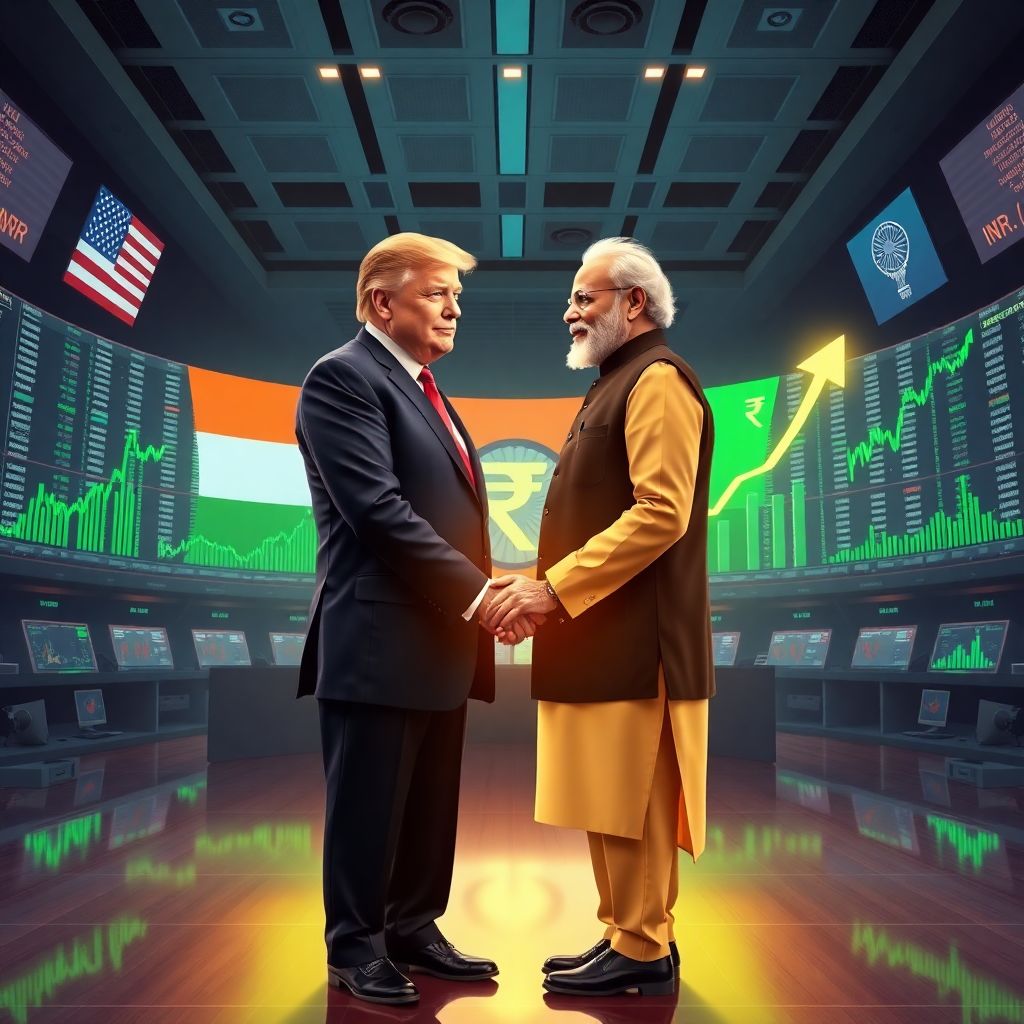
Financial markets are on a strong upward swing today, and the main catalyst is a newly announced trade agreement between U.S. President Donald Trump and Indian Prime Minister Narendra Modi. Under this deal, the United States has agreed to sharply reduce reciprocal tariffs on Indian goods, cutting them from around 50% to approximately 18%.
This drastic tariff reduction is being interpreted by investors as a powerful boost to India’s export potential. Lower barriers mean Indian products can enter the U.S. market at more competitive prices, making them more attractive to American buyers. As a result, traders are pricing in a significant expansion in India’s export volumes to the United States over the coming months and years.
Stock indices are reacting accordingly. Sectors that rely heavily on exports to the U.S.—such as pharmaceuticals, textiles, information technology services, automotive components, and certain categories of consumer goods—are seeing particularly strong gains. Companies that previously struggled to remain competitive due to high U.S. import duties are now expected to enjoy wider profit margins and higher sales volumes, which is fueling the current market rally.
Beyond equities, the currency market is also responding. The Indian rupee (INR) has strengthened notably, reflecting heightened demand. When exports rise, foreign buyers must convert more U.S. dollars into rupees to pay for Indian goods and services. This growing demand for INR naturally supports its value. Market participants anticipate that as the trade deal takes effect and export contracts are signed, this demand dynamic will intensify, giving the rupee additional upward momentum.
The macroeconomic implications are significant. A surge in exports generally supports economic growth by increasing industrial production, boosting employment, and improving corporate earnings. Higher export revenues can also help narrow the current account deficit, reinforcing confidence in the country’s external position. For policymakers, a stronger and more stable currency, alongside robust export performance, provides more room to maneuver when it comes to inflation control and interest rate decisions.
Investors are also betting on second-order effects. Increased export activity tends to spur investment in logistics, infrastructure, and manufacturing capacity. Companies anticipating higher orders from the U.S. may ramp up capital expenditure on new plants, technology upgrades, and workforce expansion. This investment cycle can create a positive feedback loop: as capacity grows, the country is better positioned to seize further international opportunities.
At the same time, the rally is not purely driven by optimism; it is also a reassessment of risk. Previously, high tariffs made revenue streams from the U.S. market vulnerable to policy shifts and sudden cost spikes. By locking in a much lower tariff regime, the new agreement provides greater predictability for long-term business planning. That reduction in perceived policy risk supports higher valuations for export-oriented companies and, by extension, for the broader market.
The strengthening rupee has its own set of winners and losers. While exporters typically prefer a weaker currency to maintain price competitiveness, the current situation is somewhat different. The magnitude of the tariff cut is so large that it can more than compensate for the currency’s appreciation. Meanwhile, a stronger INR reduces the cost of imported inputs such as crude oil, machinery, and certain raw materials, which can improve corporate margins and ease inflationary pressures for consumers.
For individual and institutional investors, today’s movement offers several key takeaways:
1. Export-heavy sectors gain prominence. Portfolios with significant exposure to companies that have substantial U.S. revenue streams are likely to outperform in the short to medium term. This includes not only goods exporters but also service providers that benefit from stronger bilateral economic ties.
2. Currency-aware strategies become more important. With the rupee appreciating, investors need to factor in potential currency translation effects on multinational companies and on foreign investors’ returns. Those holding assets denominated in INR could see improved value in dollar terms if the trend continues.
3. Domestic-oriented firms might see delayed benefits. While the immediate winners are exporters, domestically focused businesses can also profit indirectly. As export-driven sectors expand, they create demand for banking services, transportation, warehousing, construction, and domestic suppliers, which may translate into broader market strength over time.
4. Potential for policy follow-through. Markets are also speculating that this agreement might be a stepping stone toward deeper economic cooperation between the two countries. If additional measures—such as streamlined regulations, expanded market access, or sector-specific pacts—are announced, they could extend the current rally.
However, it is important to acknowledge the potential risks and uncertainties. Trade agreements can be politically sensitive, and their implementation often faces bureaucratic and legal hurdles. There is also the possibility that some sectors in both countries will push back against increased competition, seeking exemptions or revisions that could dilute the benefits. Markets are currently pricing in a relatively smooth rollout, which means any major setback might trigger volatility.
Moreover, while the rupee’s appreciation reflects strength, an excessively rapid rise could eventually pressure some exporters’ margins if they fail to improve productivity or move up the value chain. Policymakers and corporate leaders will need to focus on enhancing competitiveness through innovation, quality improvements, and efficient supply chain management to sustain the gains from the tariff reduction.
From a broader perspective, this trade deal signals a shift toward deeper integration between two large economies. For India, easier access to a massive consumer market like the United States can be a decisive factor in accelerating its growth trajectory. For the U.S., lower tariffs on Indian goods may lead to lower prices for consumers and more diversified supply chains, potentially reducing reliance on any single foreign supplier.
In the long term, the success of this agreement will be measured not only by short-term market rallies but also by structural changes: the creation of high-quality jobs, the development of new export industries, and the strengthening of India’s position in global trade networks. If businesses capitalize on the new opportunities, the current surge in market indices and the appreciation of the rupee could mark the beginning of a more sustained period of economic expansion.
For now, markets are celebrating. Equity benchmarks are climbing, the rupee is firm, and sentiment is decidedly risk-on. Behind the numbers, the core narrative is clear: by slashing tariffs from 50% to 18%, the new U.S.–India trade arrangement has reshaped expectations about future export growth, currency dynamics, and the overall outlook for the Indian economy. This recalibration of expectations is what is driving today’s powerful rally across financial markets.