
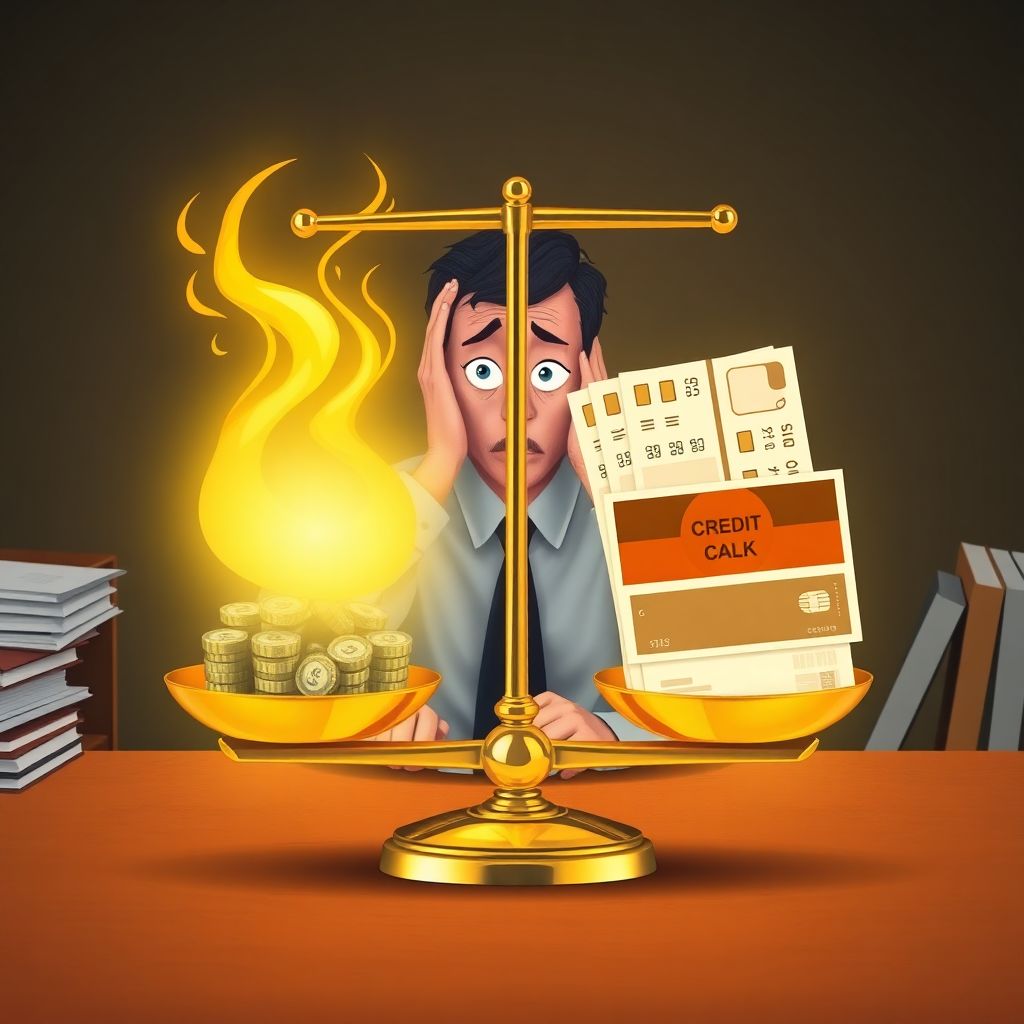
Savings vs. Debt: How to Decide What Comes First
You’re in a situation many people eventually face: you’ve built up a solid savings cushion, but you’re also carrying high-interest credit card debt. On one side, you value the security of your savings. On the other, you’re watching interest charges eat away at your money every month. Deciding what to prioritize can feel like you’re choosing between safety and progress.
Here’s the snapshot of your numbers:
– Credit card balances: about $6,000 total (on two cards: $2,500 and $3,500)
– Interest rate on cards: about 26.5%
– Total savings: about $11,000 in a high-yield savings account
– Emergency fund: $4,500 (goal: $15,000 for 4 months of expenses)
– Home fund: $5,700 (for a house purchase in about 2 years)
– Sinking fund: the remaining amount, likely for irregular or upcoming expenses
Even if you paid off both cards completely, you’d still have about $5,000 left in savings. So the core question is: should you aggressively wipe out the credit card debt now, or keep more of that cash untouched for security and your home goal?
Below is a structured way to think it through and a strategy that balances both risk and peace of mind.
—
The Math: Why High-Interest Debt Is So Dangerous
At 26.5% interest, your credit card debt is extremely expensive. That interest rate is almost certainly much higher than the return you’re earning in your high-yield savings account.
– If your HYSA pays, for example, 4-5% annually, you’re earning maybe 4-5% on your savings.
– Meanwhile, you’re paying 26.5% annually on the credit card balances.
Every dollar you keep in savings instead of using it to pay down the cards is effectively costing you the difference between those rates. Roughly:
– 26.5% (card interest) – 4-5% (HYSA interest) ≈ over 20% “net loss” on that money.
From a purely mathematical standpoint, it’s almost always better to pay off credit card debt with rates above 20% rather than keep a large cash pile that’s only earning a few percent. In other words, paying down that debt is a guaranteed, risk-free return roughly equal to your interest rate.
—
The Emotional Side: Why Keeping Savings Still Matters
That said, money decisions aren’t just math. They’re also about mental health, stress reduction, and being able to sleep at night.
Things your savings is doing for you right now:
– Giving you an emergency buffer if you lose your job or have an unexpected big bill.
– Keeping your home-buying dreams alive by building a future down payment fund.
– Helping you avoid new debt when irregular expenses come up (your sinking fund).
If you wiped out almost all your savings, you’d eliminate the credit card balances, but you’d also be leaving yourself far more vulnerable. A single medical bill, car repair, or job interruption could send you right back into new debt at 26.5% interest. That can be demoralizing and financially damaging.
So the goal isn’t “all-or-nothing.” The goal is to maximize your financial progress while still protecting yourself from emergencies.
—
A Balanced Strategy: Keep a Core Emergency Fund, Attack the Debt
Given your numbers, one strong approach is a hybrid:
1. Decide on a minimum emergency cushion you’re comfortable with.
For many people, that’s at least 1-2 months of bare-bones expenses. Since your long-term target is 4 months ($15,000), your current $4,500 is already a meaningful start. You might choose to keep something like $3,000-$4,500 untouched as a “do not cross” safety line.
2. Use everything above that safety line to crush the debt immediately.
– You have $11,000 in savings.
– Suppose you decide to keep $4,000 as a non-negotiable emergency buffer.
– That leaves around $7,000 you could use toward the $6,000 of credit card balances.
– You’d clear all the credit card debt in one shot and still have about $5,000 left if you follow your original idea, or possibly adjust to your preferred buffer.
3. Rebuild savings quickly once the debt is gone.
With no credit card payments and no massive interest charges, you can redirect what you were sending to the cards straight into your emergency fund and home fund. Your net worth will grow faster because you’ve removed that 26.5% drag.
This approach lets you:
– Eliminate a major financial risk (high-interest debt).
– Keep a meaningful emergency cushion.
– Continue working toward your home goal, even if that timeline shifts slightly.
—
What If You’re Still Nervous About Using So Much Savings?
If clearing the entire balance at once feels scary, consider a more conservative version:
– Keep a slightly larger emergency fund, say $5,000-$6,000, if that’s what you need to feel secure.
– Use the rest (about $5,000-$6,000) to pay down the cards as aggressively as possible right now.
– Then commit to paying off the remaining small balance in just a month or two using your income.
Even paying down most of the balance in a lump sum will drastically reduce interest charges. You’ll feel the psychological relief of seeing the balance plummet, while still keeping a safety net.
—
Consider the Timeline for Buying a Home
You mentioned wanting to buy a home in about two years and having a dedicated home fund of $5,700. It’s worth asking:
– What matters more over the next 24 months: slightly more cash in a home fund, or a much cleaner, lower-risk financial profile?
A few key points:
– Lenders look at your debt and how you manage it. High credit card balances and missed or late payments can hurt your credit score and reduce how much you qualify for.
– Freeing yourself from high-interest debt can improve your credit utilization, potentially boosting your credit score over time.
– The interest you’re paying on those cards now could instead be money you put toward your future down payment once the debt is gone.
Allowing your home timeline to shift by a few months (if it even needs to) in order to eliminate your 26.5% debt can make your future home purchase more sustainable and less stressful.
—
Structuring Your Savings After the Payoff
Once the credit cards are gone, you’ll want a clear plan for how to rebuild and manage your savings:
1. Emergency fund first
– Prioritize bringing your emergency fund closer to your 4-month goal ($15,000).
– Decide on a milestone (e.g., “I won’t add more to the home fund until the emergency fund hits $8,000 or $10,000”).
2. Then the home fund
– After your emergency fund reaches that milestone, direct extra money into your home savings.
– With no credit card payments and less interest draining you, your home fund can grow much faster than before.
3. Maintain a small ongoing sinking fund
– Keep a dedicated sinking fund for things like car repairs, medical bills, annual bills, or known upcoming expenses.
– This prevents you from needing to reopen the credit card debt to cover life’s normal surprises.
—
Practical Steps You Can Take Right Now
To turn this into concrete action:
1. Decide your “comfort minimum” for the emergency fund.
Ask: “What amount would let me sleep at night if my credit cards were zero but something went wrong tomorrow?” Maybe that’s $4,000, maybe $5,000. That’s your floor.
2. Make a one-time lump payment on your credit cards.
– Put every dollar above that floor toward the credit cards immediately.
– If that pays them off entirely, great. If not, you’ve at least cut the balance dramatically.
3. Choose a payoff method for any remaining debt.
– If there’s a balance left, decide whether you’ll:
– Focus on the card with the highest interest rate first (debt avalanche), or
– Focus on the card with the smallest balance first for a quick win (debt snowball).
– In your case, with both at 26.5%, the difference is mostly psychological, so pick whichever method will keep you most motivated.
4. Lock in new habits once the cards are paid.
– Use the freed-up money (what you were paying in minimums and extra payments) to contribute automatically to your emergency and home funds.
– Consider setting automatic transfers right after each paycheck.
—
How This Affects Your Overall Risk Level
Think of your financial life as risk management:
– Carrying 26.5% credit card debt is a huge risk. If something goes wrong, that debt can snowball fast.
– Having zero credit card debt but a modest emergency fund is still somewhat risky, but less so, and you’re losing far less money each month.
– Having no high-interest debt and a growing emergency fund is where you want to be: stable, flexible, and capable of handling surprises.
By using part of your savings to wipe out the cards now, you’re trading some short-term comfort (a bigger savings balance on paper) for a major long-term reduction in risk and stress.
—
Adjusting Your Mindset: Net Worth vs. Account Balances
It’s easy to get attached to the number you see in your savings account and feel like you’re “going backward” by spending it down. But what really matters is your net worth:
– Net worth = what you own (savings, investments, assets) minus what you owe (debt).
Right now, your net worth is smaller because part of your savings is effectively offset by high-interest credit card balances. When you transfer money from savings to pay off debt, your total net worth can actually increase, even if your savings account balance falls. You’re removing a liability that was costing you 26.5% per year.
If you focus on growing net worth rather than just one account’s balance, using savings to kill debt makes much more emotional sense.
—
A Sample Plan Based on Your Numbers
Here’s one specific scenario using your figures:
– Keep $5,000 in savings as a firm emergency buffer.
– Use $6,000 from savings to pay off both credit cards completely.
– You end up with:
– $0 credit card debt at 26.5%
– $5,000 in your high-yield savings (which you can later re-divide into emergency, home, and sinking funds as needed)
Then:
– Take the money you were paying on the credit cards each month and direct it into:
– Emergency fund until it reaches a number you feel truly secure with (closer to the 4-month goal).
– Then to your home fund, to rebuild and grow that amount before your 2-year timeline.
You’ve preserved a meaningful cash cushion and stopped the bleeding from extremely high interest.
—
Bottom Line
Given:
– The very high interest rate on your credit cards (26.5%),
– The fact that you’d still have around $5,000 in savings even after paying them off,
– And your long-term goals of security and homeownership,
Paying off the credit card debt using a significant portion of your savings, while keeping a reasonable emergency buffer, is likely the most financially efficient and safest path forward.
You don’t have to choose between “all savings” or “all debt payoff.” You can protect yourself with a solid emergency base, erase that high-interest burden, and then rebuild your savings from a much stronger position.