
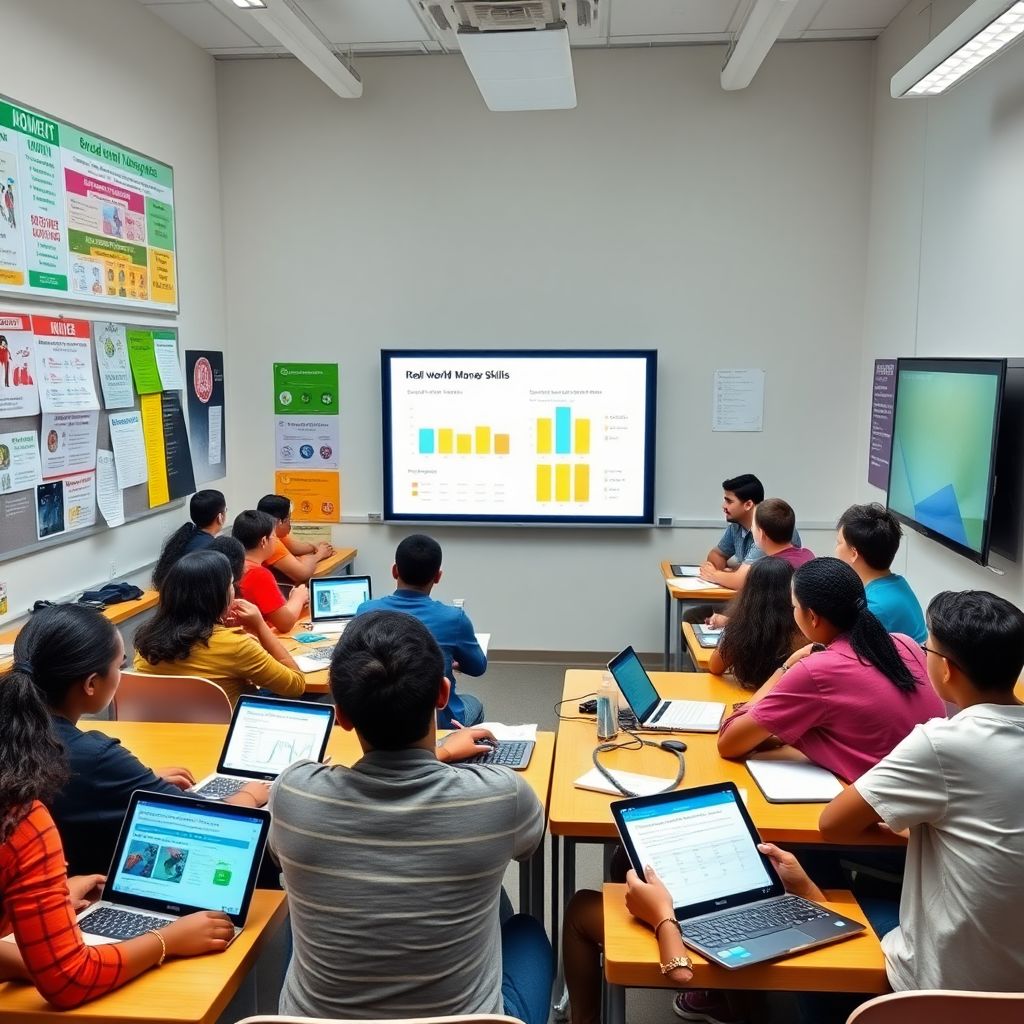
Why Money Basics in High School Suddenly Matter So Much
Financial literacy for high school students is no longer a “nice extra.” It’s turning into a survival skill.
By 2024, more than 25 U.S. states either require or are phasing in a standalone personal finance class for graduation. Yet, according to multiple surveys, a majority of teens still feel unprepared to handle a budget, read a paycheck, or avoid basic debt traps. The gap between what teens need to know and what schools actually teach is still wide.
And that gap has real economic consequences: for households, for future tax revenues, and even for industries that profit from financial confusion.
The Numbers Behind Teen Money Confusion
Let’s ground this in data instead of vague worries.
– Roughly 60–70% of U.S. high school students say they learn about money mostly from parents or social media, not from school.
– Young adults (18–29) consistently rank lowest on standardized financial literacy tests—yet they’re the ones making early decisions about student loans, credit cards and buy-now-pay-later services.
– Average credit card debt for 18–25-year-olds has climbed in recent years, while emergency savings for the same group often hover under $1,000.
When you run the math at a population level, even tiny improvements in skills add up. If a financial literacy course for high school students helps just 10% of a graduating class avoid high‑interest credit card debt for one year, the savings in interest payments can reach millions of dollars when scaled nationally.
Those savings don’t just stay in bank accounts. They shift spending patterns, housing decisions, family formation, even long‑term health outcomes. That’s why money basics are not a “soft” topic; they are economic infrastructure.
From “Don’t Be Dumb With Money” to Real‑World Decision Skills
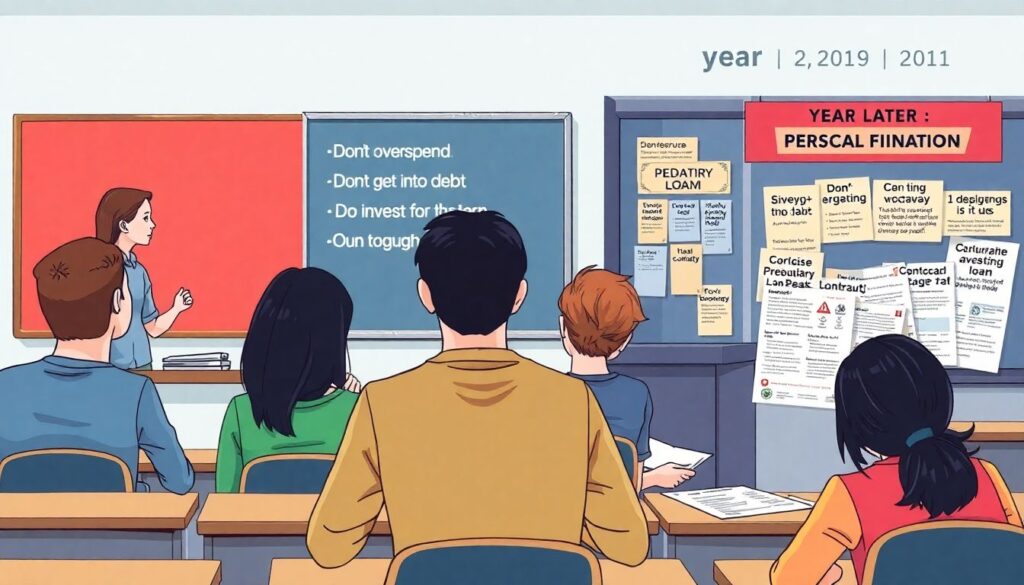
Many schools still treat personal finance as a list of do’s and don’ts:
– Don’t overspend.
– Don’t get into debt.
– Do save.
– Do invest “for the long term.”
The result? Students memorize vocabulary, ace a quiz, and still sign a predatory loan a year later because the decision context feels totally different.
A stronger personal finance curriculum for high school should focus less on memorizing rules and more on training three decision muscles:
1. Trade‑off thinking – “If I spend here, what am I giving up later?”
2. Risk perception – “What’s the worst realistic outcome, and can I survive it?”
3. Delayed feedback – “I won’t feel this mistake right away; how do I evaluate it now?”
Money basics are really about scenario thinking. When teens compare “go to a lower‑cost college and work part‑time” vs “take out large loans and hope for a high salary,” they’re doing applied economics, not just budgeting.
Short-Term Pain, Long-Term Economic Upside
In the short run, better financial literacy can be uncomfortable—for some industries.
When teens learn about compound interest in both directions, they:
– Become more skeptical of high‑fee products.
– Question aggressive “instant approval” offers.
– Delay or downsize major purchases.
This can temporarily slow consumption in sectors dependent on easy credit: store cards, buy‑now-pay-later apps, certain auto lenders. From a macroeconomic view, that looks like a drag on growth.
Over a 10–20 year horizon, though, the picture flips. Households with less toxic debt and better savings habits are more resilient in downturns, default less, and invest more in education, health, and small businesses. That stability feeds into stronger local economies and more predictable tax revenues.
Forecasts from central banks and think tanks consistently show that financially literate populations correlate with:
– Higher household net worth over the life cycle.
– Lower default rates.
– More participation in formal financial markets.
So while some business models suffer, the broader economic ecosystem becomes healthier.
Why Industry Quietly Cares About Teen Money Skills
You might assume banks, credit card companies, and fintechs want people to stay confused. Some do benefit from complexity, but there’s a counter‑trend.
Industries are discovering that chronically over‑indebted customers are expensive:
– Higher collection costs.
– Higher default risk.
– More regulatory scrutiny.
This is why you’re seeing a growing wave of online financial education programs for high schoolers sponsored by banks, credit unions, and fintech startups. They’re betting that smarter future customers will:
– Use more products over a lifetime.
– Stay loyal if they feel educated, not tricked.
– Attract regulators’ favor by demonstrating “responsible” practices.
Ironically, teaching teens to be financially savvy is becoming a competitive advantage.
What Traditional Money Classes Miss
Typical money management classes for teens often focus on:
– How to write a check (fading relevance).
– How to balance a static monthly budget (ignores irregular income).
– A simple savings plan (10% rule, etc.).
That’s better than nothing, but it fails to reflect how teens *actually* handle money today:
– Gig income from tutoring, gaming, delivery, or content creation.
– Digital wallets, micro‑transactions, subscriptions, and in‑app purchases.
– Social pressure driven by Instagram, TikTok and gaming ecosystems.
Teaching a teen to track bills on paper while they’re losing money in twelve forgotten subscriptions is missing the forest for the trees.
Nonstandard Ideas for Teaching Money Basics That Actually Stick
Here are some less obvious approaches that line up with how teens think and live.
1. Turn Class into a “Personal Profit Lab”
Instead of a generic budgeting unit, each student runs a semester‑long experiment: “Increase my personal monthly surplus by 15–20%.”
They:
1. Map incoming cash (allowance, part‑time work, gifts, side gigs).
2. Identify three “leak points” (delivery food, skins in games, impulse buys, etc.).
3. Set up one friction tool per leak (unsubscribe, spending cap, or “24‑hour rule”).
4. Track results weekly like a mini P&L (profit and loss) statement.
The point is not deprivation. It’s teaching that money is a *system* you can tweak—and measure.
2. Draft “Money User Manuals” Instead of Essays

Have students write a one‑page *Money User Manual* about themselves:
– “My biggest money triggers are…”
– “When I’m stressed, I tend to buy…”
– “What I value enough to spend more on is…”
– “My non‑negotiable saving rule is…”
This shifts financial literacy from abstract rules to self‑knowledge. Teens learn that budgeting is partly psychology, not just math.
3. Use Live Market Data, but Skip the Stock‑Picking Game
Stock‑picking competitions send a subtle but harmful message: “Success = beating others in a few weeks.” That nudges short‑term gambling, not long‑term investing.
A better twist:
– Have students build a boring long‑term portfolio (index funds, bonds, cash).
– Then compare it over the semester to meme stocks or random picks.
– Discuss volatility, risk, and the emotional side of watching values swing.
They see why most adults should automate investing instead of trying to “outsmart the market.”
4. Reality‑Check College and Career Choices With Cash‑Flow Simulations
Instead of just “dream job vision boards,” students:
1. Pick a target job (graphic designer, nurse, mechanic, software engineer).
2. Look up credible median starting salaries and likely taxes.
3. Add realistic local costs (rent or room/board, transport, food, loan payments).
4. Run the numbers over 5–10 years with different levels of debt.
When teens see a projected monthly cash flow that’s negative for the first five years, suddenly “cheap community college + transfer later” looks less boring and more strategic.
5. Teach Micro-Savings and Micro-Risks, Not Just Big Goals
Traditional advice: “Save for retirement. Save for a house.” That’s too abstract for a 16‑year‑old.
More concrete:
– Micro‑savings: “Build a $300–$500 ‘oh no’ fund in three months.”
– Micro‑risks: “What’s a small investment in yourself that might fail but could boost your income? (Online course, better tools, portfolio website.)”
This trains the sense that money is a tool to reduce stress *and* to buy options—small experiments that can compound into big opportunities.
Blending Online and Offline: How to Make It Actually Happen
Digital tools can radically change access. A well‑designed financial literacy course for high school students no longer has to depend on one teacher who “kinda likes economics.”
Schools can combine:
– Online modules for core concepts (interest, credit, inflation, taxes).
– In‑class debates and simulations for messy decisions (loans, car purchases).
– Local guest speakers (small business owners, young professionals, even recent grads) for reality checks.
Many districts are experimenting with online financial education programs for high schoolers that use interactive scenarios: choose a car, pick an apartment, decide whether to take a side gig. The key is to avoid turning them into click‑through quizzes and instead tie every module to a discussion about trade‑offs and values.
Why Workshops Still Matter in a Digital World
Despite all the apps, something powerful happens in live budgeting and saving workshops for teenagers:
– They see that others share the same money stress.
– They hear how different families handle similar constraints.
– They can ask “stupid” questions without an algorithm judging them.
In-person sessions are ideal for gritty topics: negotiating pay at a part‑time job, saying no to friends who pressure you to spend, or setting boundaries with family when you start earning.
A Simple Roadmap Schools Can Actually Implement
To move from theory to practice, a school could structure a one‑semester money program like this:
1. Foundations (Weeks 1–3)
Basic vocabulary, but always tied to decisions: what happens if you misread a paycheck, underestimate tax, or ignore interest on debt?
2. Everyday Systems (Weeks 4–6)
Build a realistic budget based on irregular teen income. Plug in digital payments, subscriptions, and surprise expenses.
3. Big Choices (Weeks 7–10)
Run simulations on college vs vocational paths, housing options, transportation, and early investing.
4. Behavior and Psychology (Weeks 11–13)
Money triggers, marketing tactics, social media pressure, how to set rules for yourself that survive “in the moment” decisions.
5. Personal Plan (Weeks 14–16)
Each student leaves with:
– A simple saving rule.
– A debt‑avoidance rule (e.g., when they *would* allow themselves to borrow).
– A first‑job checklist (what to ask, what to read on a pay stub).
– A list of online tools and apps they’ve tested and actually liked.
This doesn’t require a team of Wall Street veterans. It requires structure, honest conversation, and some basic data literacy.
The Industry Impact: Who Wins When Teens Get Smarter About Money?
Improved financial literacy reshapes the landscape.
– Banks and fintechs that offer transparent products and low‑cost tools for saving and investing will likely win customer trust and long‑term relationships.
– High‑fee lenders and opaque subscription models will face growing resistance and possibly tighter regulation as the next generation votes with both wallets and ballots.
– Education and edtech companies can build sustainable businesses around a robust personal finance curriculum for high school, integrating real data, AI‑driven personalization, and local context.
– Labor markets gain from young workers who understand total compensation, benefits, and the trade‑offs between cash now and security later.
Over time, as more cohorts graduate with strong money basics, things we consider “normal” today—like widespread paycheck‑to‑paycheck living among full‑time workers—start to look like design failures, not personal failures.
The Real Goal: Teens Who Feel in Control, Not Just Informed
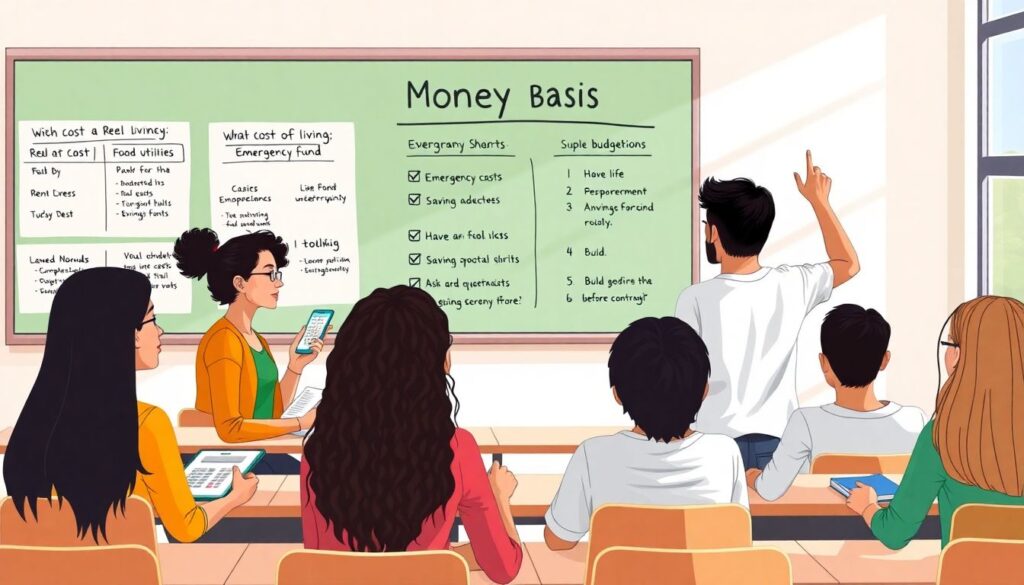
Ultimately, the point of teaching money basics to high school students isn’t to turn them into mini‑accountants or day traders. It’s to give them:
– A realistic sense of what life actually costs.
– A toolkit for dealing with uncertainty.
– Enough confidence to ask hard questions before signing anything.
If we do this right—mixing data, honest trade‑offs, nonstandard teaching methods, and modern tools—the next generation won’t just know more about money. They’ll make fewer expensive mistakes early on, giving them a head start that compounds for decades.
That’s not only good for them; it’s good for the entire economy they’re about to inherit.