

Why Financial Literacy Matters So Much When You’re Coming Back to Work
Coming back to work after a break – whether it was for childcare, illness, burnout, relocation, or a career pivot – is a double restart. You’re rebuilding your professional life and, often, your money habits at the same time. That’s why financial literacy for people returning to work isn’t just “nice to have”; it’s a risk‑management tool, a confidence booster, and, frankly, a way to buy back options in your life over the next 5–10 years.
Globally, surveys by the World Bank and OECD show that only about one‑third of adults can correctly answer basic questions on interest, inflation, and risk diversification. Among those who’ve been out of the workforce for more than two years, the gap is usually even larger: US and UK studies suggest that returning workers are 10–20 percentage points less likely to feel “confident” in their financial decisions than continuously employed peers. That confidence gap turns into a real money gap when people hesitate to negotiate salaries, underuse employer benefits, or overuse high‑cost credit during the first 12–18 months back on the job.
—
What’s Different About Money When You Return to Work

The money problems of someone rejoining the workforce look different from those of a recent grad. You may be juggling legacy debt, kids, elderly parents, or skills re‑training costs – all while trying to rebuild savings that were used to survive during your career break. Cash flow is often unstable for the first few months, and expenses tend to ramp up faster than income.
Another twist: many people returning to work underestimate “friction costs” – commuting again, work clothes, childcare, higher food spending, and sometimes relocation. These hidden costs can eat 15–30% of the new paycheck if they’re not budgeted for from day one.
—
Case Study #1: The Mid‑Career Parent Who Felt “Behind”
Consider Maya, 38, who took a four‑year break to raise two children. When she returned to work in marketing, her salary was good on paper, but she felt permanently “behind” her peers. She carried a mix of credit‑card debt from the childcare years and had cashed out most of her retirement account to cover expenses. Her first reaction was to “catch up fast” by putting almost everything extra into investments she didn’t fully understand, while keeping minimum payments on high‑interest debt.
Her employer offered a financial literacy course for adults returning to work as part of a broader diversity initiative. During that course, she discovered that prioritizing debt pay‑down over aggressive, poorly diversified investing would produce a better risk‑adjusted outcome. By restructuring her budget, refinancing some debt, and taking full advantage of her employer’s retirement match, she went from negative net worth to positive within three years – without working crazy overtime or taking extreme risks.
—
The Economic Stakes: Micro Decisions, Macro Impact
At first glance, it might seem like Maya’s story is strictly personal. But multiply her situation by millions of people re‑entering the labor market after breaks due to pandemic disruptions, caregiving, or reskilling, and the macro picture changes. In the US alone, workforce participation among women with children rebounded sharply after 2021. McKinsey and other analysts estimate that better integration and upskilling of these returning workers could add hundreds of billions of dollars to GDP over a decade.
Financial literacy acts as a productivity amplifier. Employees who can manage money calmly are less likely to suffer from financial stress, which multiple studies have linked to lower productivity, higher absenteeism, and increased turnover. For employers, every worker who sticks around an extra year because they feel stable financially keeps recruiting and training costs down and preserves institutional knowledge.
—
How the Market for Financial Education Is Shifting
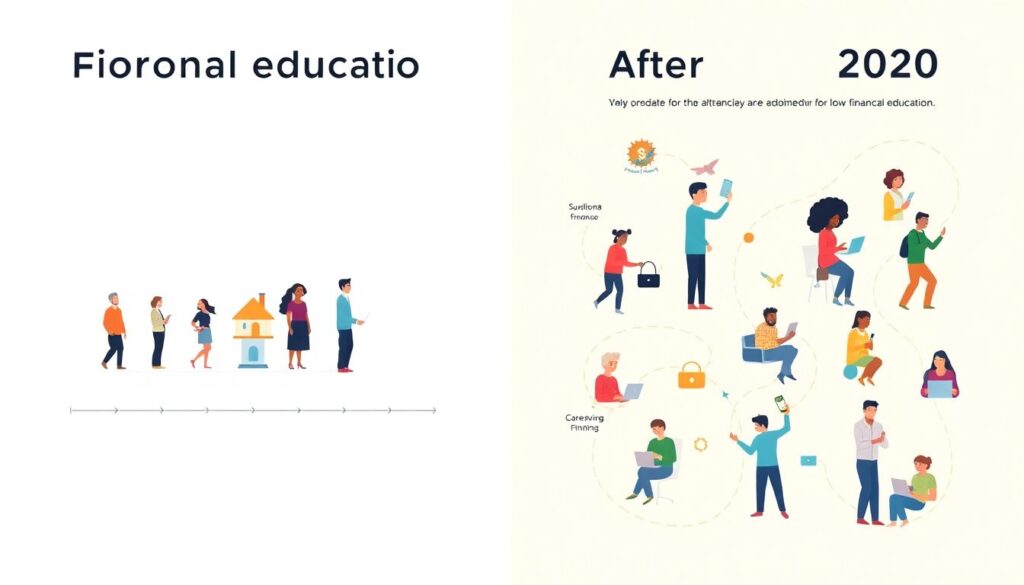
Before 2020, many financial education offers were framed around traditional “life stages”: college, first job, first home, retirement preparation. The pandemic and the rise of career breaks for mental health, gig work, or caregiving forced a shift. Providers began designing the best personal finance programs for employees who don’t fit a linear career path and might rejoin at 30, 40, or 55.
This has created a small but fast‑growing sub‑industry: programs tailored to career re‑entry. Analysts expect corporate spending on workplace financial wellness programs for employees to grow in the high single digits annually over the next few years. As more firms compete for experienced talent, they’re realizing that supporting returning workers is both a branding asset and a retention strategy.
—
What Good Financial Literacy Actually Looks Like for Returners
For someone re‑entering the workforce, generic tips like “make a budget” or “save 10%” rarely go far enough. Effective financial literacy for this group has to cover five overlapping layers:
1. Stabilize cash flow.
Understand your new pay structure, benefits, and taxes; map baseline fixed costs; make sure the “return to work” doesn’t produce a surprise cash crunch due to new expenses.
2. Repair the damage from the career break.
That might mean consolidating or refinancing debt, negotiating with creditors, and building a minimal emergency buffer so one small shock doesn’t send you back to square one.
3. Optimize employer benefits.
Health insurance, retirement match, stock purchase plans, and childcare benefits can add 10–30% to the value of your compensation. Not knowing how to use them is equivalent to a pay cut.
4. Rebuild long‑term plans.
Retirement, kids’ education, or home ownership plans may need to be reset to realistic timelines and contribution levels that work with your new salary and age.
5. Protect against future interruptions.
Disability insurance, appropriate life insurance, and a more resilient savings strategy help make the next break (voluntary or not) less financially brutal.
When a financial literacy program is built on these layers rather than abstract theory, people re‑entering the workforce tend to internalize skills much faster and make fewer high‑cost mistakes.
—
Case Study #2: The Tech Professional After a Burnout Break
Alex, 32, left a high‑pressure tech job after severe burnout. During his two‑year break, he lived off savings and some freelance work but ignored taxes, assuming they would somehow “sort themselves out.” When he joined a new company at a slightly lower salary, he discovered a sizable back‑tax bill plus penalties. The stress almost pushed him to decline the job offer and return to gig work.
His new employer ran money management classes for working professionals as part of an onboarding wellness package. In those small‑group sessions, he learned to prioritize paying the tax debt through a structured plan, use the company’s stock purchase and retirement match sensibly, and switch from a purely growth‑oriented investing style to one with a proper emergency fund. Within 18 months he had cleared the tax issue and built five months of living expenses in cash. The key wasn’t advanced investing tricks; it was basic literacy tailored to the messy reality of rejoining the system after living “off the grid” financially.
—
Digital Tools and the Rise of Flexible Learning
The demand for flexible, self‑paced learning has pushed many institutions and fintech startups to build an online budgeting and financial planning course specifically aimed at adults with jobs and families. These courses often integrate with banking apps, payroll systems, or HR platforms, pulling real data (with consent) to make the lessons concrete instead of theoretical.
For returning workers, this approach matters because time and mental energy are scarce commodities. Short video modules, scenario‑based exercises, and calculators embedded into day‑to‑day tools turn abstract concepts like “savings rate” or “debt‑to‑income ratio” into practical knobs you can actually adjust. Over the next 3–5 years, expect more AI‑driven personalization, where learning modules adapt not just to income and age, but also to patterns in spending and saving behavior.
—
Why Employers Are Suddenly Paying Attention
From an employer’s perspective, offering a financial literacy course for adults returning to work isn’t pure charity. It’s a retention and productivity strategy anchored in hard numbers. Surveys by large HR consultancies show that employees who rate themselves as “financially secure” are markedly more engaged at work and less likely to look for another job within the next 12 months.
The economics are straightforward: replacing a mid‑career professional can cost 1–2 times their annual salary when you factor in hiring, training, and ramp‑up time. If a relatively low‑cost education initiative keeps even a small fraction of returners from leaving due to money stress, the program pays for itself. That’s why more HR departments are bundling financial coaching alongside mental health support, flexible schedules, and re‑entry training.
—
Case Study #3: Corporate Upskilling as a Strategic Move

A European manufacturing company noticed that employees returning from long medical leave or parental leave were twice as likely to quit within two years. Exit interviews repeatedly mentioned “financial strain” and “feeling lost about money” as part of the decision. In response, the firm launched a pilot with external experts to create one of the best personal finance programs for employees who were coming back after at least six months away.
The program combined group workshops, one‑on‑one financial coaching, and follow‑up webinars over a six‑month period after return. Within three years, the company saw a drop of more than 25% in turnover among this group. Unexpectedly, they also saw fewer requests for salary advances and hardship loans from the corporate welfare fund. Shareholders appreciated the improved stability of the skilled workforce, and management expanded the program across regions.
—
Short‑Form Learning vs. Deep Behavior Change
Not all financial education is equally useful. Many people binge short videos about investing, but their real‑world behavior doesn’t change. The gap often lies between “information” and “implementation.” For people back at work after a break, the implementation step is critical because their financial baseline has just shifted.
Programs and courses that work well for this group tend to include at least three elements: clear actions (e.g., “schedule a benefits review by X date”), feedback loops (checking progress a month or two later), and social accountability (small groups, coaching, or peer discussions). Without these, the knowledge remains abstract and gets drowned out by daily life and job demands.
—
What to Look For in a Course or Program When You’re Returning
If you’re re‑entering the workforce and trying to choose between options, use a simple filter. You’re not looking for entertainment; you’re looking for something that will change how money flows through your life over the next few years. This means you need coverage of taxes, benefits, debt, savings, and risk protection – not only investing or “getting rich quick.”
Many community colleges, nonprofits, and employers now offer structured money management classes for working professionals. When evaluating them, ask whether they include real‑life scenarios (career breaks, variable income, caregiving responsibilities), whether they integrate your local tax and benefits rules, and whether there’s at least some personalized component – even light‑touch email feedback can make a difference.
—
Five Practical Moves for People Coming Back to Work
To anchor all this analysis into concrete behavior, here is a focused sequence of steps that works well for many returners:
1. Audit your “new normal” budget in detail.
Include commuting, childcare, meal costs, work clothing, and any extra services you now rely on to save time. Compare this with your net paycheck, not your gross salary.
2. Prioritize high‑interest debt and essential protections.
Pay down expensive consumer debt systematically, but keep minimum health insurance and basic emergency savings in place to avoid new high‑cost shocks.
3. Capture every employer benefit you reasonably can.
At least hit the retirement match if available; review health plans, disability coverage, and any learning subsidies or childcare assistance.
4. Rebuild a simple, realistic long‑term plan.
Adjust retirement and big‑ticket goals to your current age and income. It’s better to plan with honest numbers than chase an unrealistic “catch‑up” fantasy.
5. Invest in your own literacy and skills.
Whether through a workplace financial wellness initiative, a community class, or a reputable online course, treat financial literacy as part of your professional toolkit, not an optional hobby.
Following this order helps reduce the noise: you deal with immediate risks first and only then move into longer‑term optimization.
—
Industry Outlook: From Optional Perk to Standard Practice
Forecasts from HR and benefits consultants suggest that workplace financial wellness programs for employees will move from “innovative perk” to standard practice, especially in large organizations, over the next decade. As labor markets stay relatively tight and mid‑career hiring becomes more competitive, employers will look for low‑cost ways to differentiate themselves. Helping returning workers stabilize their finances is a clear candidate.
On the provider side, expect more specialized offerings: not just generic “financial literacy,” but targeted modules for caregivers returning to work, people transitioning out of gig work, older workers delaying retirement, and individuals recovering from health‑related breaks. Fintechs will keep partnering with companies to deliver these at scale, while regulators and policymakers may nudge or incentivize employers to adopt minimum standards for financial education, much like they previously did with retirement plan disclosures.
—
Putting It All Together
A career break doesn’t have to translate into a lifetime financial penalty, but without deliberate financial literacy, it often does. The combination of changed expenses, disrupted savings, and emotional pressure to “catch up” creates a fragile setup just as you’re trying to rebuild your work identity. Structured support – whether through an online budgeting and financial planning course, employer‑sponsored education, or community programs – can compress years of trial‑and‑error into a few focused months.
For individuals returning to work, the most important shift is mindset: you’re not just earning again; you’re redesigning how money works in your life after a major transition. For employers and the broader economy, supporting that redesign is more than goodwill. It’s a pragmatic investment in a more stable, productive, and engaged workforce – one financially literate returning worker at a time.