
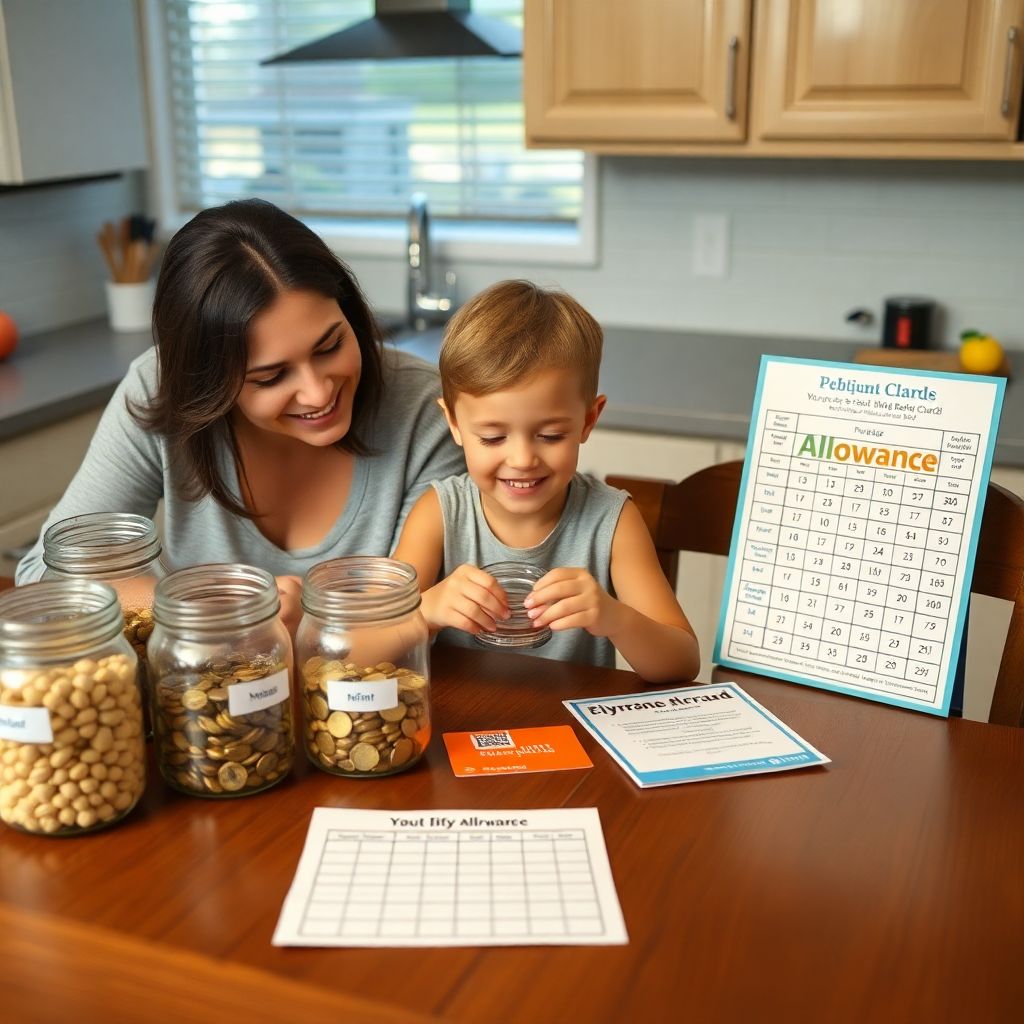
Set up an allowance as a structured training system, not loose pocket money: define purpose (learning, not reward), pick a weekly amount and date, split into spend/save/give, track it visibly, and review choices together. Start small, stay consistent, and gradually expand tools from jars to apps and youth debit cards.
Core Principles for Allowance-Based Financial Learning
- Link allowance to learning goals (budgeting, saving, giving), not to basic family cooperation like brushing teeth or being polite.
- Keep the kids allowance system simple at first: fixed day, fixed amount, clear rules on what parents pay for vs. what kids cover.
- Always separate money into at least two containers or categories (spend and save); add give and goals as they mature.
- Talk through every spend decision briefly; the conversation is more important than the amount.
- Increase allowance only when kids demonstrate responsibility: tracking, delayed gratification, and honest reporting of mistakes.
- Use age-appropriate parental money management tools for children, from envelopes to apps and supervised debit cards.
Why an Allowance Is a Teaching Tool, Not Just Pocket Money
- Use allowance as practice money to learn how to teach kids financial responsibility: budgeting, trade‑offs, saving for goals, and generosity.
- Position it as a family learning project, not a reward for existing; some families add bonuses for extra chores, but the base amount is for practice.
- Explain clearly what parents still pay for (needs) and what the child now pays for (wants like toys, in‑game purchases, treats).
- Skip or postpone allowance if basic behavior or safety issues are not under control; stabilize routines first.
- Delay or simplify for kids who experience strong anxiety around money; keep amounts small and focus on calm, short check‑ins.
Simple positioning script: “This is your practice money. Our job is to help you learn to spend, save, and give wisely before you’re an adult.”
Setting Clear Goals: Purpose, Frequency, and Expectations
- Define the learning focus
- Pick 1-2 main skills for the first three months: e.g., “track every purchase” and “save toward one small goal.”
- Write these on an index card near the jars or in your allowance app notes.
- Decide allowance source and linkage
- Option A: Unlinked to chores (recommended for basics) – chores are part of family life.
- Option B: Small base + extra for non‑routine jobs (yard work, washing the car).
- Set amount and frequency
- Choose weekly for younger kids; teens can handle bi‑weekly to mirror real paydays.
- Start modest; it should feel meaningful but not painful if badly spent.
- Clarify what kids pay for
- List 3-6 categories that are now their responsibility (e.g., school snack, small toy, mobile game credits).
- Keep this list visible so there is less debate in stores.
- Choose your tracking method
- Pick jars/envelopes, a notebook ledger, or one of the best allowance apps for kids.
- Whatever you choose, commit to updating it together on the allowance day.
- Set expectations for review
- Schedule a 10-15 minute money chat once a week (or at payout time).
- Use the same three questions: What did you spend? What did you save? What will you do differently next week?
Example setup: Weekly allowance paid every Saturday morning, divided into spend/save/give jars, with a short review at breakfast.
Age-Based Frameworks: What Kids Should Learn at Each Stage
Quick prep checklist before you start age‑based steps
- Decide which children are ready now (basic routines stable, can count small amounts).
- Gather containers: jars/envelopes or set up a family account in an allowance app.
- Agree on one recurring allowance day that works for everyone.
- Print or write down your basic rules and categories (what kids pay for).
- Plan your first review date after four weeks to adjust amounts or rules.
- Early elementary (approx. 5-7): naming, counting, simple choices
Introduce very small, weekly amounts in physical cash so kids can touch and see money moving.- Focus on: recognizing coins/bills, simple counting, basic “if I buy this, I can’t buy that.”
- Use 2-3 jars: Spend, Save, Give. Help them choose a tiny savings goal (e.g., a small toy).
- Template: “You get $X every Saturday. We put some here to use soon, some here to save.”
- A basic kids allowance system here is mostly about habits and language, not independence.
- Late elementary (approx. 8-10): planning, delayed gratification
Increase the amount and the responsibility categories very slightly.- Focus on: planning for the week, understanding trade‑offs, saving for medium‑sized goals.
- Keep 3-4 jars or digital categories: Spend, Short‑Term Save, Long‑Term Save, Give.
- Introduce a simple ledger: date, amount in/out, new total; this can be on paper or in an app.
- Template: “You now pay for small toys and in‑game extras from your Spend jar.”
- Middle school (approx. 11-13): budgeting and digital tools
Transition gradually from only cash to a mix of cash and digital tracking.- Focus on: budgeting for a month, comparing prices, understanding digital payments.
- Let them manage a few more categories (snacks with friends, small clothing extras).
- Consider trying a supervised debit card for kids with allowance, if your bank or app offers one.
- Template: “We’ll deposit your allowance into this card; you still follow the Spend/Save/Give plan.”
- Early high school (approx. 14-15): income, goals, and accountability
Connect allowance to early earnings like babysitting, lawn care, or family tasks above basics.- Focus on: tracking multiple income sources, setting longer‑term goals (tech, trips), understanding recurring costs.
- Shift reviews to bi‑weekly; introduce simple budget categories (food out, transport, fun, savings).
- Use more advanced parental money management tools for children, like teen banking apps with goals and spending limits.
- Template: “Your total monthly money is allowance + job income; let’s plan where every dollar goes before the month starts.”
- Late high school (approx. 16-18): near‑adult practice
Gradually convert allowance into responsibility for real expenses they care about.- Focus on: near‑adult budgeting, preparing for rent/tuition, managing a checking account.
- Reduce pure “allowance” as part‑time job income grows, but keep regular money check‑ins.
- Template: “We’ll cover basics, but your phone upgrades, outings, and some clothing come from your budget.”
Practical Allocation Models: Spend, Save, Give, and Goals
- Confirm that every allowance payout is split into at least Spend and Save, with clear percentages or amounts.
- Check that your child can explain each category in their own words (“Spend is for now, Save is for later…”).
- Ensure there is at least one concrete savings goal written down (item name, target amount, target date).
- Review the Give category: is there a plan for where, when, and why to donate or help others?
- Verify that impulse buys come only from the Spend portion, not from long‑term savings.
- Look at the last four weeks: did any money actually stay in Save/Goals, or does it all leak into Spend?
- Confirm that you, the parent, are not quietly topping up after poor choices; natural, small regrets are part of learning.
- Adjust the split if needed: more to Save when long‑term goals matter, more to Spend when new responsibilities are added.
- Check that the child is tracking balances – jars visually, notebook totals, or in an app – at least once per week.
- Add a “big goal” category for older kids (e.g., laptop, trip), and review progress monthly.
Sample allocation pattern: Spend 50%, Save 30%, Give 10%, Big Goal 10% – then tweak based on your child’s age and responsibilities.
Systems and Tools: From Paper Envelopes to Apps with Habits
- Starting and switching tools too often – Constantly changing from jars to spreadsheets to apps confuses kids; pick one method and stick with it for at least three months.
- Making the system too complex – Too many categories or rules will cause you to skip allowance days; keep the first version simple and add complexity only after success.
- Using digital tools without visibility – A teen‑only phone app with no parent view undermines coaching; choose allowance apps or banking tools with shared dashboards and alerts.
- Handing over a card with no guardrails – A debit card for kids with allowance needs clear spending limits, notifications, and agreed “off‑limits” categories.
- Skipping regular updates – Not logging cash in or out breaks the learning loop; schedule a fixed time each week for updates, whether using jars or the best allowance apps for kids.
- Letting the app replace conversation – Apps and parental money management tools for children should support, not replace, your short weekly talks about choices and mistakes.
- Ignoring cash for younger kids – Starting purely digital too early makes money feel abstract; younger children benefit from visible, tangible cash before they move into apps and cards.
- Not backing up your system – If you track digitally, keep screenshots or regular exports; if on paper, store the notebook in a consistent, known place.
Practical tool path: Start with jars/envelopes → move to a shared allowance app → add a supervised youth debit card linked to the app when your child can stick to agreements.
Evaluating Progress: Adjustments, Consequences, and Graduation Criteria
- Graduated responsibility with stable allowance
- Best when kids handle money reasonably but lack experience with real‑world costs.
- Gradually shift more categories (food out, clothes extras, school events) into their budget without rapidly increasing the total allowance.
- Use natural consequences: if they overspend on snacks, they skip a movie later – no secret bailouts.
- Allowance pause and reset
- Use when tracking consistently fails or money goes missing repeatedly.
- Pause the existing system for a short, defined period; restart with smaller amounts, fewer categories, and closer supervision.
- Explain clearly: “We’re resetting the system so it’s easier to succeed.”
- Work‑based model for older teens
- Shift from pure allowance to an income mix: part‑time work, side gigs, and a smaller family stipend.
- Connect privileges (car use, subscriptions) to proof of a working budget, not to obedience in general.
- Set a target date when “allowance” ends and adult‑style budgeting begins, with your support as a coach.
- Full graduation to independent money management
- Appropriate when your teen: tracks regularly, saves toward goals, avoids repeated overdrafts, and owns their mistakes.
- Transition to independent accounts while keeping monthly check‑ins to discuss bigger‑picture topics like rent, credit, and emergencies.
- Frame it as recognition: “You’ve shown you can handle this; we’re stepping back to let you lead.”
Parental Concerns Addressed: Short Practical Answers
What is a good age to start an allowance?
Start when your child can count small amounts and understand that money is traded for things, often around early elementary years. If daily routines or behavior are very unstable, stabilize those first, then introduce a small, simple allowance system.
Should allowance be tied to chores?
Keep basic chores separate so you do not negotiate over every task. Many families use a base allowance for learning plus optional paid “jobs” for extra work. If chores are not done, use non‑money consequences like loss of screen time.
How much allowance should I give?
Pick an amount that is meaningful to your child but affordable and low‑stress for you. Start small for the first few months, then adjust based on what they are responsible for paying and whether they are using the system responsibly.
What if my child wastes all their allowance?
Let small mistakes happen; they are powerful teachers. Do a short review: ask what they learned, what they might do differently, and adjust future goals or splits. Avoid immediately topping up, or the learning opportunity disappears.
Is cash better than digital allowance?
For younger kids, cash in jars is usually clearer and more concrete. As they grow, add digital tools, apps, and eventually a supervised card so they can practice the way adults actually pay, but always keep visibility and shared review.
How can I use apps and cards safely?
Choose tools that give parents oversight: spending alerts, category limits, and shared logins. Start with small balances, clear rules on where and how the card can be used, and weekly reviews of app activity together at the kitchen table.
What if co‑parents disagree about allowance rules?
Agree on a minimum shared plan: amount, frequency, and what the child pays for. Document it in a short written agreement and revisit every few months. Present a united front to the child, even if details are still evolving in the background.