
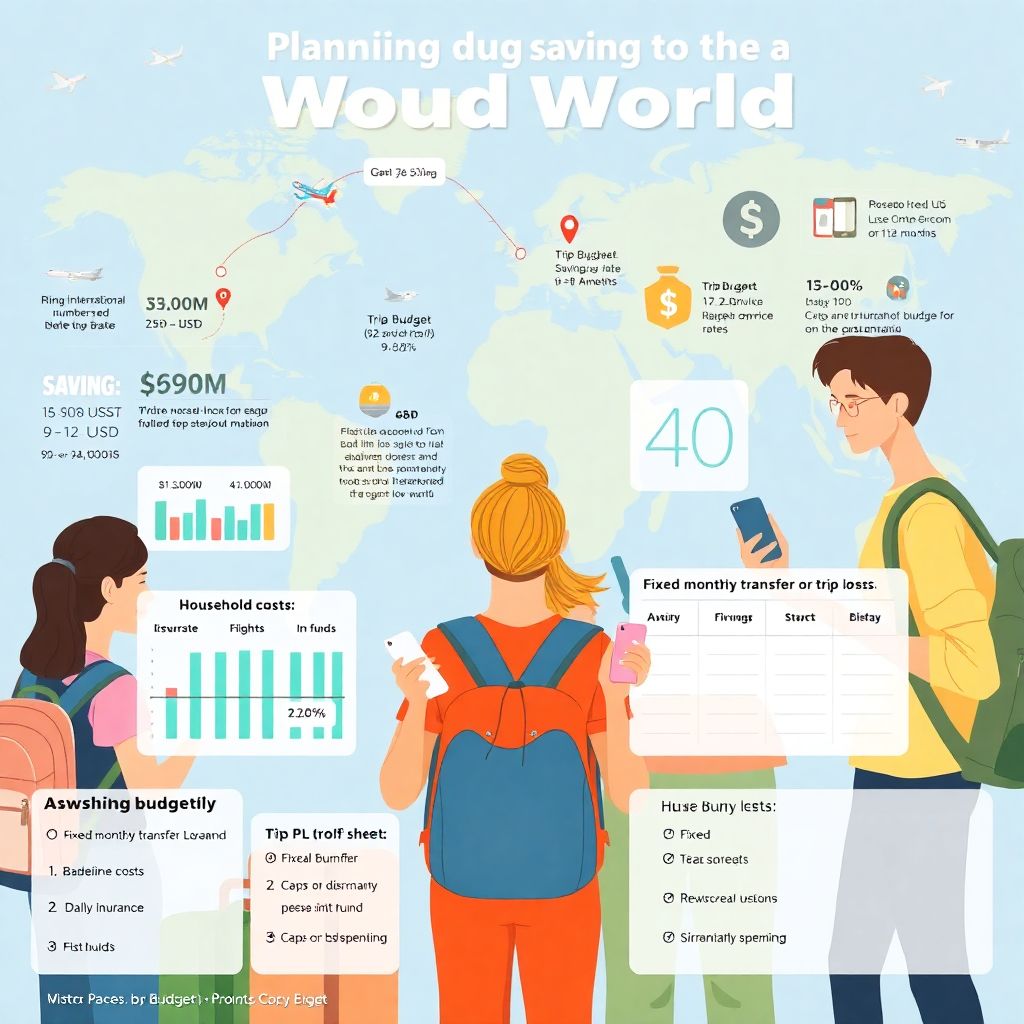
Planning a round-the-world journey no longer looks like a fringe lifestyle choice. Between 2022 and 2024, international tourist arrivals rebounded from about 960 million to an estimated 1.3 billion trips, according to UN Tourism, and long-stay, multi-country itineraries form a growing niche. At the same time, household balance sheets remain under pressure: in 2023, inflation in advanced economies averaged around 5–6%, while real wages barely outpaced price growth. This creates a tension between mobility and money: people want extended travel but cannot afford to jeopardize retirement contributions, emergency reserves or debt repayment. The core task is to engineer a savings plan that treats a world trip as a finite, funded project rather than an impulsive lifestyle upgrade.
—
Macro trends and statistical context
Over the last three years, economic volatility has redefined how people allocate disposable income. Data from 2022–2024 show that average savings rates in OECD countries fell from roughly 12% during the pandemic peak to closer to 9–10% as consumers resumed spending and absorbed higher living costs. Meanwhile, surveys by major booking platforms report that up to 30% of Gen Z and younger millennials in Europe and North America are actively planning a multi-month trip abroad in the next five years. This mismatch—rising travel ambitions and slightly eroding savings rates—demands more rigorous capital allocation. Instead of arbitrarily cutting expenses, travellers need structured cash-flow modeling that aligns lifestyle choices with quantifiable financial resilience thresholds.
—
How much to save and how to model the total budget

The question of how much money to save for a world trip and how to plan it cannot be answered with a single number; it is a function of geography, risk tolerance and opportunity cost. A conservative benchmark for a 9–12 month itinerary across mixed-cost regions (Southeast Asia, parts of Latin America, selected European hubs) is often in the range of 25,000–40,000 USD, excluding pre-existing financial obligations at home. To estimate accurately, decompose the budget into daily burn rate, long-haul transportation, insurance, digital tools and a contingency buffer of at least 15–20%. Empirically, travellers who build in this buffer report 30–40% fewer instances of high-interest borrowing during or after the trip. Structuring the budget this way treats the journey as a finite capital project, not an open-ended drain.
—
Best budgeting strategies to afford a round the world trip
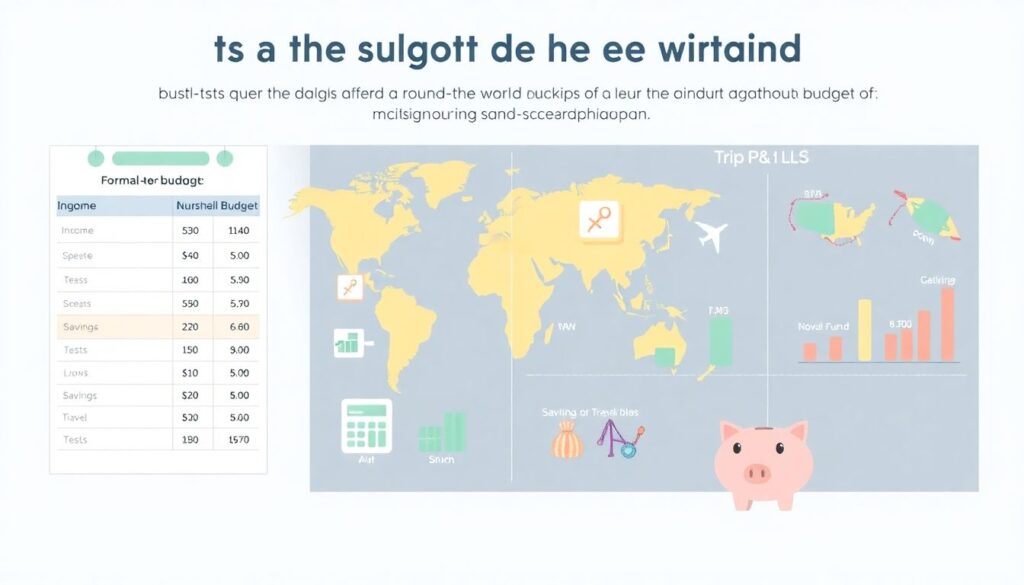
To operationalise the goal, you need the best budgeting strategies to afford a round the world trip without eroding long-range goals. A practical approach is to build a parallel “trip P&L” alongside your normal household budget and stress-test it under different income scenarios. Over the last three years, users adopting zero-based budgeting apps—as reported by large fintech providers—have increased targeted savings success rates by roughly 20%. The idea is simple: every unit of income receives a specific job, whether it is rent, retirement, insurance or trip funding. Non-essential categories are benchmarked against peers or historical averages and intentionally compressed. This creates incremental capital that can be diverted to the travel fund without compromising core risk management components, such as health coverage and emergency reserves.
1. Quantify your baseline cost of living and non-negotiable commitments
2. Set a fixed monthly transfer into a segregated trip fund
3. Cap discretionary micro-spending categories with hard ceilings
4. Allocate windfalls (bonuses, tax refunds) primarily to the travel project
5. Regularly reforecast to reflect income or price-level changes
—
Long-term financial planning and compounding effects
Isolated cost-cutting is insufficient; you need coherent financial planning for long term world trip savings that integrates investment horizons, tax efficiency and liquidity management. Between 2022 and 2024, global equity markets exhibited heightened volatility but delivered positive real returns over most rolling three-year periods. This matters because extending your savings timetable from 12 to 24–30 months enables you to use low-cost index funds or diversified ETFs, rather than leaving all contributions in cash. A phased contribution plan—automated monthly investments combined with a derisking glidepath in the six months before departure—can exploit market growth while protecting against last-minute drawdown. This bridges the gap between short-term travel goals and longer-term capital accumulation, reducing the need to suspend retirement contributions or interrupt compounding during your trip.
—
Travel savings accounts and investment options for long trips
To maintain liquidity and mitigate currency risk, you can combine travel savings accounts and investment options for long trips into a layered capital stack. First, a high-yield savings account or money market fund in your base currency should hold at least six months of post-trip living expenses plus a travel emergency buffer. Over 2022–2024, yields on such instruments in many markets rose from near zero to 3–5%, materially offsetting inflation. Second, medium-horizon funds for the trip itself can sit in diversified, low-cost ETFs, with systematic withdrawals into cash as the departure date approaches. Finally, multi-currency fintech accounts with low foreign-exchange spreads can reduce friction when converting to local currencies, which is critical given that FX fees can add 2–4% to your effective travel cost if unmanaged.
—
How to save money for world travel without going broke
The operational challenge is how to save money for world travel without going broke or eroding your financial shock absorbers. The empirical evidence from personal finance datasets between 2022 and 2024 indicates that individuals who maintain at least three to six months of essential expenses in an emergency fund before departure experience significantly lower default rates on consumer credit afterward. This suggests that emergency liquidity is a non-negotiable constraint, not an optional luxury. Structurally, your trip budget should sit on top of this buffer, not cannibalise it. Additionally, maintaining minimal insurance continuity—health, liability, potentially income protection—prevents a temporary adventure from morphing into a long-term solvency problem. The objective is not maximal travel duration, but sustainable re-entry into the labour market or business operations.
—
Impact on the travel and financial industries
The rise of intentional, savings-driven world travel is altering both tourism and financial services. Airlines and accommodation platforms are responding to longer booking windows and price-sensitive, itinerary-flexible customers by offering subscription-style products and dynamic fares that reward early commitment. On the finance side, challenger banks and robo-advisors are packaging goal-based investment features explicitly marketed at long-term travellers, blending budgeting tools with portfolio construction. From 2022 to 2024, major neobanks reported double-digit growth in “spaces” or “vaults” dedicated to travel, signalling durable demand. This convergence of travel-tech and fintech reduces informational friction: users can simulate scenarios, adjust savings rates and monitor currency fluctuations in real time, enabling world trips to be treated as rational, funded projects rather than financially hazardous escapades.