
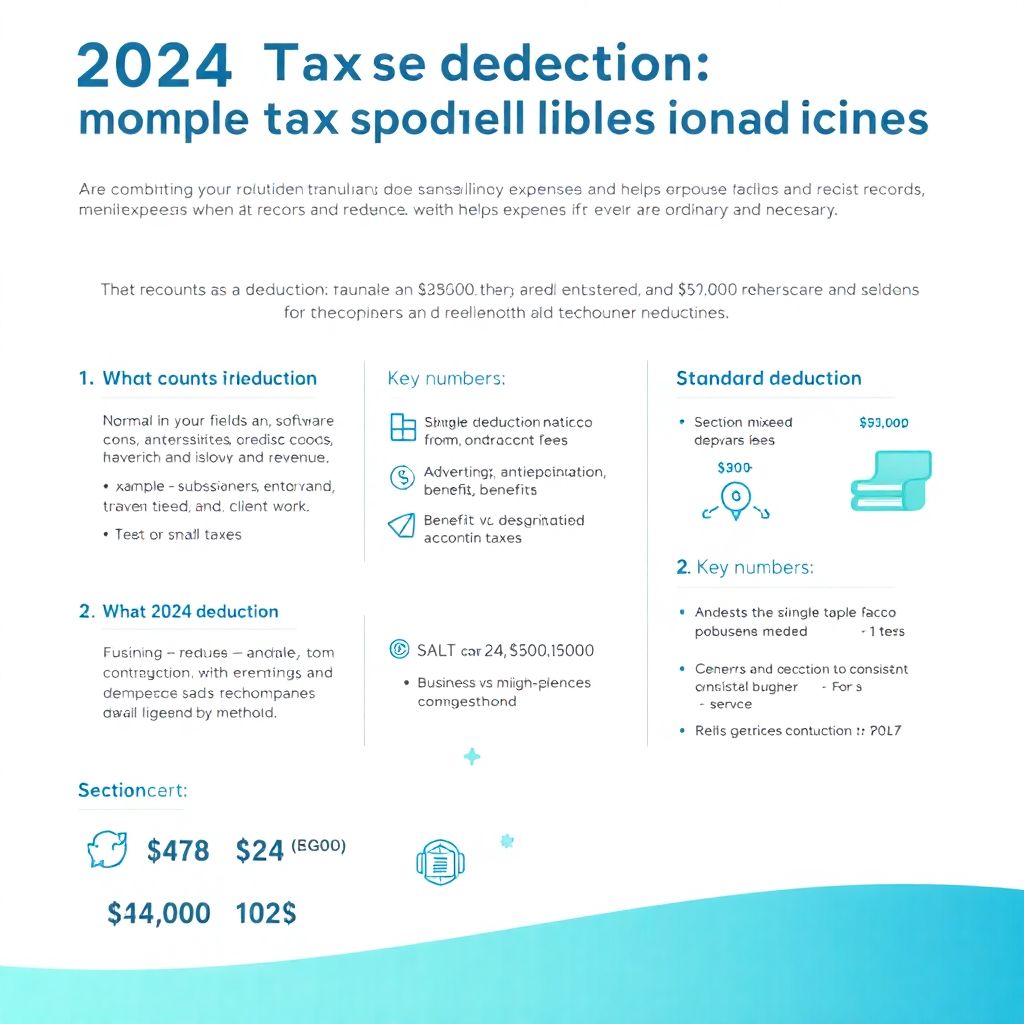
Deductions aren’t magic; they’re the disciplined way to translate real costs into lower taxes. Think of them as the story your books tell about how you earn income. When that story is consistent and supported, tax deductions reduce taxable income dollar-for-dollar, which can shift you into a lower bracket or just lighten the bill. The trick is to combine a practical recordkeeping habit with a clear understanding of what the IRS calls “ordinary and necessary” for your work, then apply those rules with the same rigor you use to price your time.
What actually counts as a deduction?
If a cost is normal in your field and helps you produce revenue, it likely qualifies. For freelancers, that can mean software subscriptions, contractor fees, advertising, and travel tied to client work. For owners, small business tax deductions extend to depreciation, benefits, and certain taxes. The line is use: the same laptop can be fully deductible if used 100% for business, or partially if mixed. Keep an allocation method, and apply it consistently year over year.
Key numbers you should know in 2024
For tax deductions 2024, anchor yourself on thresholds. The standard deduction is $14,600 (single), $29,200 (married filing jointly), and $21,900 (head of household). The SALT cap remains $10,000. Section 179 expensing tops out at $1,220,000 with a phaseout beginning at $3,050,000, while bonus depreciation is 60% this year. The business mileage rate is 67¢ per mile. The simplified home office deduction is $5 per square foot up to 300 sq. ft., capping at $1,500; actual-expense method may exceed that if your costs are high.
Self-employed: where the real savings hide

The most overlooked self employed tax deductions are often routine: health insurance premiums, half of self-employment tax, retirement contributions (SEP IRA, Solo 401(k)), and professional insurance. Track subcontractors with W-9s to avoid mismatches. If you drive to client sites, log trips the day they happen. Over a year, even 4,000 business miles yields a $2,680 deduction at the 2024 rate, which, in a 24% bracket, could cut tax by about $640—before state benefits.
Small businesses: timing and method matter
For corporations and LLCs taxed as corporations, inventory accounting, capitalization policy, and depreciation choices drive results. Small business tax deductions multiply when you coordinate: 179 for equipment you place in service, de minimis safe harbor for items under your threshold (often $2,500 per invoice), and accountable plans to reimburse owner-employees. Cash-basis filers can accelerate expenses by paying before year-end; accrual-basis recognize when incurred—choose methods that match your cash reality and margins.
Real-world examples that add up
A designer spends $1,800 on software, $3,200 on a laptop, and drives 3,000 business miles. Using 60% business use for the laptop, they deduct $1,920 via 179 and claim $2,010 for mileage. Add $1,800 subscriptions: total $5,730. At a 22% federal rate, that’s roughly $1,260 saved. A bakery buys a $40,000 oven, elects 179, and reduces income directly by $40,000; if profit was $120,000, the deduction alone could trim over $9,000 in federal tax depending on bracket and QBI interplay.
Home office deduction without the headaches
To claim a home office deduction, the space must be used regularly and exclusively for business, and be your principal place of business or a place where you meet clients. The simplified method is clean: square footage × $5, up to 300 sq. ft. If your rent, utilities, and insurance are high, the actual-expense method—allocating costs by business-use percentage—may yield more. Document the square footage, take photos for your records, and keep utility statements in one digital folder.
Technical details block
– Depreciation: 60% bonus in 2024; remaining basis depreciates per MACRS class life. Consider 179 before bonus if you want targeted write-offs.
– Vehicle rules: Choose either actual expenses with business-use percentage or the 67¢/mile standard rate; you must stick with a consistent approach for that vehicle.
– QBI: Sole props, partnerships, and S corps may get up to a 20% deduction on qualified business income; wages and specified service limits can apply above certain thresholds.
Common pitfalls that invite scrutiny
Mixing personal and business spend is the fastest way to weaken a return. A single-purpose business account and card keep the audit trail clean. Big round numbers look guessed; itemize and keep receipts or bank evidence. For travel, a clear business purpose, itinerary, and meeting notes go a long way. And remember hobby-loss rules: if you report losses year after year without a profit motive, the IRS can reclassify and disallow deductions, creating back tax and penalties you don’t want.
Expert moves that pay for themselves
– Adopt a written capitalization policy (e.g., expense items under $2,500) before the tax year begins.
– Use an accountable plan to reimburse owner-employees for home office, phone, and mileage from the corporation, keeping those reimbursements tax-free.
– Batch quarterly reviews: reconcile books, scan receipts, and estimate taxes so you can time purchases and 179 elections before December 31.
How to decide between standard and itemized
Itemizing only beats the standard deduction when your total of mortgage interest, charitable gifts, medical costs above the threshold, and SALT (capped) exceeds the standard. For many households in 2024, the standard remains tough to beat. Business expenses, however, are separate: they reduce business income whether or not you itemize personally. That’s why clean books for tax deductions and a simple year-end close process matter more than chasing borderline personal write-offs.
The bottom line
Deductions reward good habits more than heroic last-minute moves. Capture expenses when they occur, choose methods that fit your scale, and revisit elections annually. With tax deductions 2024 shifting bonus depreciation and preserving generous 179 limits, planning is worth real money. For self employed tax deductions and small business tax deductions alike, the home office deduction, mileage, and retirement funding remain reliable levers. Nail the basics, and the code will do the heavy lifting for you.