

Understanding the Financial Architecture of a Move
Relocating isn’t just about boxes and trucks; it’s a compact financial project with multiple cost centers, risk factors and cash‑flow constraints. Before choosing a neighborhood or signing a lease, you need a quantified view of the total cost of moving to a new city: transportation of belongings, deposits, temporary housing, duplicated expenses during overlap of leases, and the ramp‑up period before your income stabilizes. Thinking about the move as a small, time‑bound “budgeting project” gives you clarity and control instead of surprises and stress.
In other words, you’re not just moving — you’re executing a controlled redeployment of your personal capital.
Core Cost Categories You Must Model
To construct a realistic budget, break down the move into discrete cost categories. This turns an overwhelming question into a set of measurable items you can price‑check and adjust.
Key categories typically include:
– Housing transition costs: application fees, security deposit, first/last month’s rent, utilities connection fees, parking permits.
– Transportation of possessions: professional movers, truck rental, gas, tolls, packing materials, storage.
– Travel and accommodation: flights or fuel for the trip itself, hotels or short‑term rentals, meals on the road.
– Setup and replacement: furniture, appliances not included in the new place, household items you choose not to move.
– Administrative and compliance: driver’s license update, car registration, professional licenses, pet registration, school enrollment fees.
– Income ramp‑up buffer: emergency fund and living expenses until your first few paychecks or freelance payments arrive.
The point is to avoid “miscellaneous” as a category; if you can name it, you can price it and plan for it.
Why a Dedicated Move Budget Beats “General Savings”
A generic savings account hides the actual burn rate of your move. A dedicated moving budget, separated from normal living expenses, lets you simulate scenarios, add buffers, and respond quickly if one line item spikes.
You’re essentially building a short‑term financial model specifically for relocation, not just hoping your main savings account is “enough”.
Essential Tools and Data Sources for Budgeting a Move

You don’t need fancy software, but you do need a minimum “toolkit” to turn vague estimates into structured numbers. Treat these tools as your measurement instruments: they let you convert guesses into data, and data into decisions.
At a minimum, assemble:
– Spreadsheet or budgeting app (Excel, Google Sheets, YNAB, Notion): for your cost breakdown and scenario analysis.
– Moving cost calculator: many moving platforms and insurance sites offer these; use them for baseline price ranges on distance, volume, and optional services.
– Price aggregators: flight search engines, hotel sites, rental listings, and local cost‑of‑living dashboards.
– Note‑taking system: to store quotes, phone call notes, and deadlines so you don’t rely on memory.
These tools don’t decide for you, but they compress the research phase and make it easier to compare options objectively.
Locating Reliable Service Providers Without Overpaying
One of the fastest ways to lose control of your budget is to rely on the first mover or rental you find. Instead, standardize how you search and compare.
Run localized searches like “best budget moving services near me” and “cheap long distance moving companies”, then normalize quotes by converting them into cost per mile, cost per cubic foot, and cost per service (packing, loading, storage). This turns emotional decisions (“they sounded nice on the phone”) into quantitative comparisons you can document in your spreadsheet.
You’ll quickly see who’s genuinely affordable and who just markets themselves that way.
Step‑by‑Step Budgeting Workflow for a New City Move
To stay organized, treat the move as a linear workflow with checkpoints. Each phase has a specific financial output: a number, a decision, or a contingency plan. This reduces rework and late‑stage panic.
Step 1: Define Scope, Constraints and Timeline
Before estimating anything, define three parameters:
– Scope: Are you moving solo, with family, with pets? How much volume are you taking vs. selling?
– Constraints: Moving deadline, visa/work start date, school term, lease end, health considerations.
– Timeline: Not just your move date, but when deposits are due, notice periods end, and when income changes.
This “requirements gathering” phase prevents you from optimizing the wrong things, like chasing the absolute cheapest truck when your real problem is needing flexible storage.
Step 2: Build a Baseline Cost Model
Now create your first draft budget. List all cost categories from earlier, then populate each line with a conservative estimate (err on the high side).
A practical sequence:
1. Housing entry costs: research typical security deposits and first‑month rent in your target neighborhoods, plus likely application fees.
2. Transport options: run scenarios for DIY truck rental vs. partial service vs. full‑service movers using at least one moving cost calculator, then record low, medium, and high estimates.
3. Travel to the new city: model costs for your actual travel day(s), adding a buffer for potential schedule changes.
4. Setup and replacement: list critical purchases only (bed, work setup, basic kitchen gear) and estimate them conservatively.
5. Administrative items: check official state/city sites for current license, registration, and permit fees.
This baseline model is not final; it’s your starting hypothesis, which you’ll refine as quotes and real prices come in.
Step 3: Determine How Much Money to Save Before Moving Out
Now convert that baseline into a savings target. The usual mistake is only saving for the one‑time move costs and ignoring the runway afterward.
A robust approach:
– Add up all one‑time relocation expenses (move, deposits, setup, admin).
– Add 3–6 months of living expenses in the new city (rent, utilities, food, transport, insurance).
– Add a 10–20% contingency buffer for overruns or emergencies.
The result is a concrete number answering the question “how much money to save before moving out.” For example, if your moving and setup costs total $6,000 and your monthly baseline in the new city is $2,500, a cautious target might be:
– $6,000 (one‑time)
– + $7,500–$15,000 (3–6 months runway)
– + 10% buffer
You can adjust based on job security, remote‑work flexibility, and access to backup funds, but documenting the math prevents wishful thinking.
Step 4: Align Income, Cash Flow and Deadlines
Next, map cash in vs. cash out over time. A static budget shows totals; a cash‑flow timeline shows when money leaves and arrives.
Create a simple schedule:
– Mark due dates for deposits, movers, flights, overlap rent, and subscription changes.
– Mark income dates: paychecks, contract payments, known bonuses, tax refunds.
– Identify weeks where outflows exceed inflows by more than your available savings.
You’re looking for temporary liquidity issues (e.g., three major bills in one week). If you see a crunch, you can negotiate different payment dates or phase purchases to avoid short‑term debt.
Step 5: Optimize and Lock Key Decisions
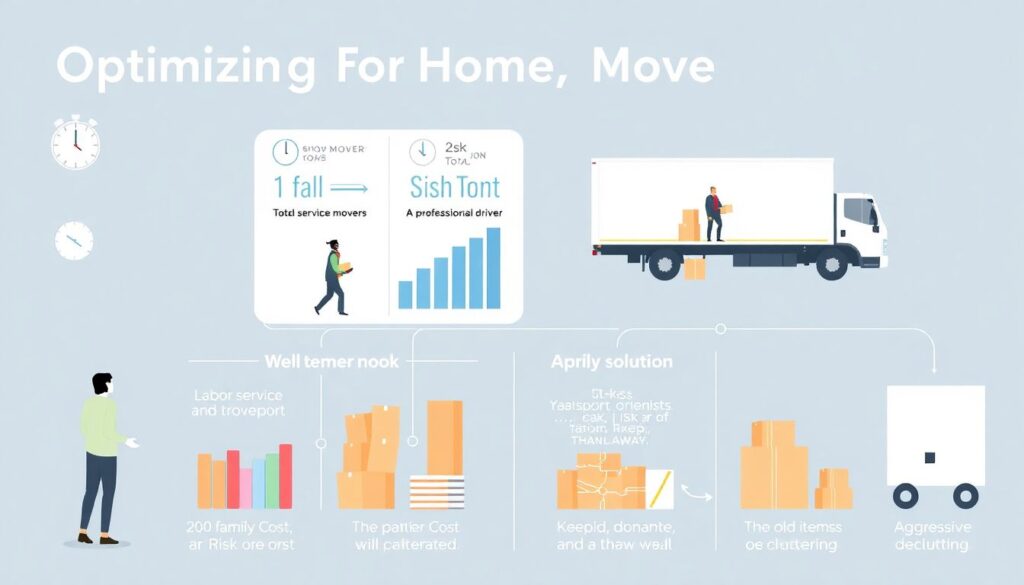
With the timing visible, it’s time to optimize—not just for the lowest total cost, but for risk, stress, and time.
Typical optimization levers:
– Mode of transport: swap from full‑service movers to a hybrid solution (you pack, they drive) if labor is expensive.
– Load volume: aggressively declutter so you can downsize to a smaller truck or fewer containers.
– Timing: shifting the move to off‑peak seasons or weekdays, when prices and demand are lower.
– Housing choice: accepting a slightly higher rent in exchange for lower commute and car costs.
Once you pick a configuration (e.g., “we’re using a POD, moving mid‑week, and staying in a short‑term rental for 10 days”), lock it into your spreadsheet and treat it as the “current plan” version.
Controlling Costs Without Compromising Safety or Sanity
Cost cutting should be structured, not random. You want to remove inefficiencies, not create new risks or hidden expenses that show up later.
When to Use Professional Movers vs. DIY
Professional help makes sense when you have time constraints, heavy items, or long distances that amplify the cost of mistakes. DIY or partial DIY works best when you’re flexible on timing and comfortable with logistics.
A balanced approach:
– Use cheap long distance moving companies for the transport of larger volumes when driving a truck yourself would require extra time off work or hotel stays.
– Take a DIY approach to packing, labeling, and disassembly to reduce billable labor hours.
– Reserve professional help specifically for fragile, high‑value items where damage would be very expensive.
You’re not choosing between “all pro” and “all DIY”; you’re architecting a mix that fits your constraints and budget.
Tactical Cost‑Saving Moves That Actually Work
There are many “budget moving hacks” online, but only some hold up under scrutiny. Focus on tactics with clear, calculable benefits:
– Downsize aggressively: measure your new space and sell or donate items you can replace cheaply or won’t use. Lower volume directly cuts transport and storage costs.
– Time‑shift purchases: delay nonessential items (decor, second TV, premium furniture) until after the move, when you have real data on your new cash flow.
– Cluster tasks: if you’re renting a car or truck, batch errands (thrift store drop‑offs, big‑box store runs) to cut fuel and time costs.
– Leverage local networks: ask colleagues or local forums about seasonal discounts and community resources (furniture exchanges, neighborhood Facebook groups, campus sales).
These tactics compound: less volume leads to cheaper movers and potentially smaller housing, which in turn reduces monthly burn.
Troubleshooting Common Budgeting and Moving Issues
Even with careful planning, real moves rarely follow the script. The key is having predefined responses for typical failure modes, so you adjust course instead of reacting emotionally.
Problem: Quotes Are Much Higher Than Your Baseline Model
If actual quotes exceed your plan, don’t just accept the overrun. Diagnose the gap:
– Did you underestimate distance, volume, or required services?
– Are you moving during a peak pricing window (end of month, summer, holidays)?
– Have fuel surcharges or labor rates increased since you last checked?
Then apply structured responses:
– Reduce volume (sell, donate, or store long‑term near your origin).
– Change timing (midweek, mid‑month, off‑season).
– Split services: hire professionals only for loading/unloading and drive a rental yourself.
Iterate your spreadsheet each time you adjust, so you always see the new total impact.
Problem: Cash‑Flow Crunch Right Before or After the Move
Sometimes the total budget is fine, but everything is due at once. This is usually a sequencing issue, not a catastrophic one.
Potential fixes:
– Negotiate payment schedules: some movers and landlords accept split payments or later dates.
– Advance income where possible: request earlier start dates, signing bonuses, or partial freelance prepayments.
– Phase nonessential expenses: defer big furniture buys and subscriptions until your first paychecks land.
Your objective is to smooth the cash‑flow curve, not reduce every cost line to zero.
Problem: Unexpected Costs in the New City
It’s common to discover higher transport fares, more expensive groceries, or mandatory local fees after arrival.
To contain damage:
– Re‑baseline your monthly budget in the first 2–4 weeks using real receipts.
– Identify two or three large recurring expenses (commute, food, housing) and optimize those first instead of focusing on tiny line items.
– Use your contingency buffer deliberately; it exists for exactly this adjustment period.
This early recalibration turns a one‑time surprise into a controlled, updated financial model for your new life.
Future Trends in Budgeting for Relocation (2025 and Beyond)
By 2025, moving has become more data‑driven: people increasingly treat relocation as both a lifestyle decision and a financial strategy. Over the next five years, the way we calculate and manage the cost of moving to a new city will keep evolving in several ways.
More Predictive, Integrated Planning Tools
Expect moving platforms to merge several functions into unified dashboards. Instead of running a separate moving cost calculator, rental search, and budgeting app, you’ll see:
– Integrated tools that ingest your income profile, credit score, and desired cities, then output a tailored relocation plan with risk scores.
– Real‑time feeds from rental markets, fuel prices, and labor rates that update your projected move cost weekly.
– Simulations where you can compare “move now vs. in six months” scenarios, including opportunity cost and inflation.
In practice, that means fewer surprises and more precise answers when you ask whether a specific move is financially viable this year or better postponed.
AI‑Assisted Negotiation and Service Matching
Matching with service providers is also likely to become more algorithmic. Instead of manually calling six movers, you’ll authorize platforms to:
– Auto‑collect standardized quotes from vetted vendors.
– Normalize them by distance, volume, and service inclusions.
– Highlight the statistically best budget moving services near you, based on performance data and your constraints (e.g., flexibility vs. speed vs. full insurance).
Some services already experiment with AI‑driven negotiation bots that try to lower your quote during off‑peak hours or bundle services (storage, cleaning, packing) for net savings.
Relocation as a Career Strategy, Not Just a Life Event

As remote and hybrid work mature post‑2025, more people will move repeatedly for better pay‑to‑cost‑of‑living ratios rather than just for single, lifetime relocations. In that environment:
– Budgeting for relocation becomes a repeatable workflow, not a one‑off project.
– Individuals maintain a “relocation file” with templates, checklists, typical cost baselines, and personal thresholds for when a move makes sense.
– Employers and platforms may increasingly offer standardized relocation stipends, making your personal budgeting model crucial to decide if the package is adequate.
Understanding and controlling relocation costs becomes a competitive advantage: the more efficiently you can move, the more freedom you have to pursue opportunities across cities and regions.
Conclusion: Treat Your Move Like a Small but Serious Financial Project
Budgeting for a move to a new city is not about obsessively tracking every coffee receipt; it’s about building a structured, realistic model that captures your one‑time costs, your post‑move runway, and your risk tolerance. With a clear toolkit, a step‑by‑step workflow, and predefined troubleshooting strategies, you gain the ability to say “yes” or “not yet” to a move based on numbers instead of guesswork.
As tools get smarter and relocation becomes a more frequent part of modern careers, those who approach moving as a disciplined financial project will spend less, stress less, and adapt faster—no matter which city comes next.