
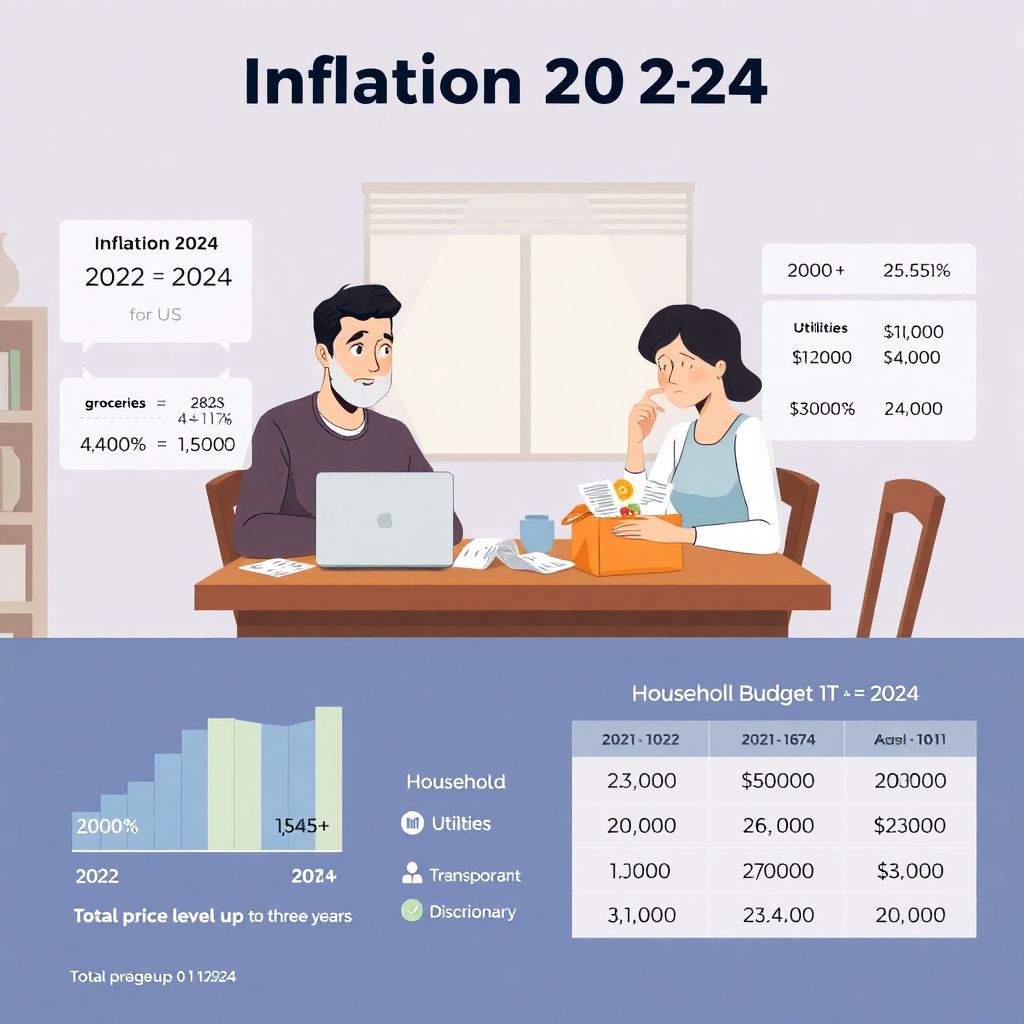
Inflation has a sneaky way of messing with your household budget. Prices don’t explode overnight (most of the time), they just quietly drift up until you suddenly realise your paycheck doesn’t stretch the way it did even a couple of years ago.
Let’s unpack what’s happened with inflation over the last three years and then go through practical, numbers‑driven steps you can take to defend your money.
—
What Actually Happened With Inflation: 2022–2024
From 2022 to 2024, inflation stopped being a boring macroeconomic term and turned into something you could feel every time you opened your shopping app or paid your utility bill.
United States (CPI, all items, year‑over‑year, BLS data):
– 2022: Inflation averaged about 8.0% for the year – the highest in roughly 40 years.
– 2023: It cooled, but was still high by recent standards, averaging about 4.1%.
– 2024: Through most of 2024, annual inflation hovered roughly in the 3–4% range (it moved month to month, but stayed above the Fed’s 2% target).
If you compound that:
> Technical note: If prices rise 8% in 2022, 4.1% in 2023 and say 3.5% in 2024, the cumulative increase over three years is:
>
> (1.08 × 1.041 × 1.035) − 1 ≈ 16–17%
>
> In plain English: something that cost $100 in early 2022 might cost around $116–117 by late 2024.
Euro area (HICP, Eurostat):
– 2022: Around 8.4% average inflation.
– 2023: Down, but still elevated, around 5.4%.
– 2024: Broadly in the 2–3% band for much of the year, with some variation by country.
So even if you live in a country that “tamed” inflation in 2023–2024, you’re still living with a price level that jumped massively since 2021.
—
How Inflation Hits a Typical Household Budget
Inflation doesn’t hit every line of your budget equally. That’s why some people feel it much more than others.
Take a middle‑income household in 2021 spending (per month):
– $800 on groceries and household supplies
– $1,200 on rent
– $300 on utilities
– $400 on transport (fuel, public transit, car costs)
– $300 on discretionary stuff (eating out, entertainment, small luxuries)
Total: $3,000
Now apply roughly the real‑world inflation pattern we’ve seen:
– Groceries up about 11–12% in 2022, 5–6% in 2023, then a slower 2024
– Rents in many cities up 15–25% over the period
– Utilities up sharply in 2022–2023, then stabilising
– Fuel very volatile, but higher on average than 2021
You get something like this by late 2024:
– Groceries: $800 → roughly $950+
– Rent: $1,200 → somewhere around $1,400–1,500 in many urban areas
– Utilities: $300 → around $350–380
– Transport: $400 → around $450–480
– Discretionary: people usually cut this to cope, say $250–270
That’s easily $3,400–3,500 for the same lifestyle, a 13–17% jump – which lines up with the cumulative inflation numbers. If your income didn’t grow at least that much, you’ve experienced a *real* pay cut.
—
Real‑Life Example: When Stable Income Meets Rising Prices
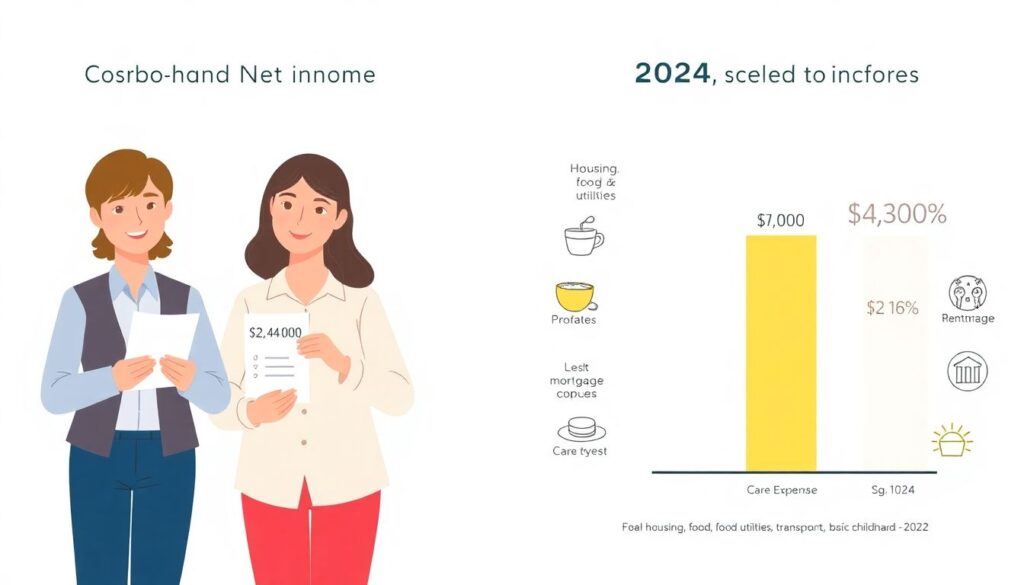
Imagine a couple, both salaried employees. Between 2022 and 2024:
– Their combined net income goes from $4,000 to $4,400 (nominal increase of 10%).
– Their core expenses (housing, food, utilities, transport, basic childcare) go from $2,800 to $3,300 (about 18% growth).
They *feel* poorer, because their “free cash” shrinks:
– 2022: $4,000 − $2,800 = $1,200 left over
– 2024: $4,400 − $3,300 = $1,100 left over
Their income rose on paper, but their room for savings, investments and fun actually fell. That’s inflation at work in a household budget.
—
The Quiet Killer: How Inflation Eats Savings
Inflation doesn’t just hit your monthly cash flow. It slowly erodes anything sitting in cash or near‑zero‑yield accounts.
Suppose you kept $10,000 in a regular savings account earning 1% a year from 2022 through 2024, while prices rose cumulatively by roughly 16–17%.
After three years:
– Your account balance: $10,000 × 1.01³ ≈ $10,300
– Your *purchasing power*: $10,300 / 1.16 ≈ $8,900 in 2022 dollars
So in “real” terms, you lost over $1,000 of value, even though the bank statement looks a little higher.
This is why people search for how to protect savings from inflation: the risk is real, not theoretical.
> Technical note:
> Economists talk about *nominal* vs *real* returns.
>
> – Nominal return ≈ your account’s % gain.
> – Real return ≈ nominal return − inflation.
>
> If your nominal return is 1% and inflation is 4%, your real return is roughly –3%. You’re quietly losing money every year.
—
Step One: Measure the Damage in Your Own Budget
Before you try to fix anything, you need to know *where* inflation is hitting you.
Here’s a simple workflow:
1. Pull your bank and card statements for 2021 (or 2022) and for the latest full month or quarter.
2. Group spending into 5–8 big categories: housing, food, utilities, transport, healthcare, debt payments, childcare, discretionary.
3. Calculate the percentage change in each category.
You might find, for example:
– Groceries: +22% since 2021
– Rent: +18%
– Utilities: +28%
– Transport: +9%
– Discretionary: −10% (because you cut back)
That pattern tells you exactly where how to budget during inflation should focus: not on guessing, but on data from your own accounts.
—
How to Budget During Inflation: Practical Adjustments
You don’t control macroeconomic inflation, but you absolutely control your *personal inflation rate*.
A practical, inflation‑aware budget usually does three things:
– Protects essentials
– Locks in or lowers big fixed costs where possible
– Aggressively trims low‑value, variable spending
Concrete moves:
– Renegotiate or reset big contracts.
– Revisit rent at lease renewal, explore slightly less central areas or smaller space if your rent exploded.
– Shop aggressively for insurance (home, auto, health add‑ons). Premiums often drift up unnoticed.
– Swap brands and channels for high‑inflation items.
– Many households saw 20–30% grocery inflation on their *usual* brands. Switching to store brands can cut 10–15% off the bill without changing quantities.
– Use bulk buying for shelf‑stable items when they’re genuinely discounted (watch unit price, not final ticket).
– Automate “guard rails”.
– Set hard caps for categories that tend to creep (dining out, subscriptions, impulse shopping).
– Use banking apps to set alerts when you cross your discretionary budget for the month.
One mental trick that helps: treat every recurring payment like a “mini‑rent”. If it renews every month or year, it deserves scrutiny in an inflationary environment.
—
How to Save Money During Inflation Without Just Suffering
Cutting spending doesn’t have to mean living in permanent scarcity mode. The goal is to delete *low‑utility* costs so you can keep or even grow your savings rate.
Examples that work well in practice:
– Replace, don’t remove, some luxuries.
– Swap 3 restaurant dinners a month for 1 dinner out + 2 decent home‑cooked “event meals”. Savings: easily $80–150/month for a couple.
– Replace some paid entertainment with free or low‑cost activities, but schedule them so life still feels rich.
– Attack “invisible inflation” categories.
– Subscription creep: streaming, cloud storage, software. Many households can cut 20–40% here just by cancelling overlaps.
– Small daily purchases: coffee, snacks, delivery fees. These often climbed 15–25% in price over 3 years, and you feel it only when you add them up.
– Optimise energy consumption.
– In 2022–2023, utilities and energy bills spiked in many countries. Simple steps like upgrading to LED bulbs, sealing drafts, or programming the thermostat can cut 5–15% from bills in a year.
The aim of how to save money during inflation isn’t deprivation; it’s to redirect spending away from inflated, low‑value habits and into your own balance sheet.
—
Where to Keep Cash: Safety vs Erosion
Keeping some cash is necessary for liquidity and risk management. The question is *where*.
Over the last three years, central banks’ rate hikes have at least made interest‑bearing cash more attractive:
– In the US, “high‑yield” savings accounts and money market funds have often offered 4–5% annual yields since 2023, vs near‑zero in 2021.
– If inflation is sitting around 3–4%, that can give you a slightly positive real return or at least greatly reduce the damage.
> Technical note:
> Money market funds and high‑yield savings accounts are not the same as checking accounts.
>
> – They typically invest in short‑term government or high‑grade corporate paper.
> – They’re not risk‑free in the theoretical sense, but in practice they’re very low‑risk and highly liquid in developed markets.
>
> Always verify: deposit insurance coverage, fund structure, and expense ratios.
Short version: for your emergency fund and short‑term goals (0–3 years), move away from near‑zero‑yield accounts and closer to instruments whose yield tracks interest rate hikes.
—
Best Investments During High Inflation: What Actually Helps
When people ask about the best investments during high inflation, they usually want something like: “Tell me where to put my money so inflation stops being a problem.” There’s no magic asset, but there are categories that historically held up better than plain cash.
Key options to consider (always matched to your risk tolerance and time horizon):
– Inflation‑linked bonds
– In the US, TIPS (Treasury Inflation‑Protected Securities); in other countries, local equivalents.
– Principal and/or interest payments adjust with inflation indexes, so their real value is more stable.
– Broad stock index funds (equities)
– Over long periods, companies can raise prices and grow earnings faster than inflation.
– In the short run (1–3 years), markets can be very volatile, especially around rate hikes and inflation shocks.
– Real assets
– Real estate, infrastructure, and in some cases commodities or commodity‑linked funds.
– These can benefit from rising replacement costs and rental income, but they come with liquidity, leverage and sector risks.
– Short‑duration bonds or bond funds
– Shorter maturities are less sensitive to interest rate movements.
– They can be a middle ground between pure cash and long‑duration bonds when rates are rising.
For most households, the goal is a balanced portfolio designed with inflation in mind, not an all‑in bet on any single asset.
—
How to Protect Savings From Inflation: A Simple Framework

You don’t need a PhD to build an inflation‑resilient plan. You need a structure.
A straightforward, tiered approach might look like this:
– Tier 1: 3–6 months of expenses
– High‑yield savings or money market funds for quick access.
– Primary goal: capital preservation and liquidity.
– Tier 2: 3–10 year goals (house down payment, education, major renovations)
– Mix of short‑ to intermediate‑term bonds, some inflation‑linked bonds, and a moderate allocation to equities.
– Goal: outpace inflation with controlled volatility.
– Tier 3: 10+ year goals (retirement, financial independence)
– Heavier allocation to diversified equities, possibly real estate or real‑asset funds, plus a stabilising bond component.
– Goal: significantly exceed inflation over time.
In other words, learning how to protect savings from inflation is mostly about *where* you park long‑term money and how much risk you’re reasonably able to take, not guessing which stock or coin will “moon” next year.
—
Income Side: Fighting Inflation by Earning More
There’s a hard limit to how much you can optimize your expenses. At some point, the more powerful lever is income.
Options many households have used between 2022 and 2024:
– Job switching and internal promotions
– Data from labour markets in the US and Europe show that job switchers often saw annual pay bumps of 10–20% in the tight labour market of 2022–2023, outpacing inflation.
– If your employer is giving you 2–3% raises while your field is moving faster, you’re falling behind in real terms.
– Monetising skills and hobbies
– Freelance consulting, tutoring, niche online services, or local services (from childcare to repairs) became common side income sources.
– The key is to treat it like a *mini‑business* with its own P&L, not random pocket money.
– Upskilling and credentialing
– Short, targeted certifications in high‑demand areas (cloud, data analysis, project management, specialised trades) often led to significant salary jumps.
– Even a 10% salary increase, maintained for several years, has a far larger lifetime effect than cutting another $50/month from streaming accounts.
Combining a more disciplined budget with even a modest income boost is the most reliable way to get ahead of inflation over the medium term.
—
Inflation‑Aware Planning: When to Get Professional Help
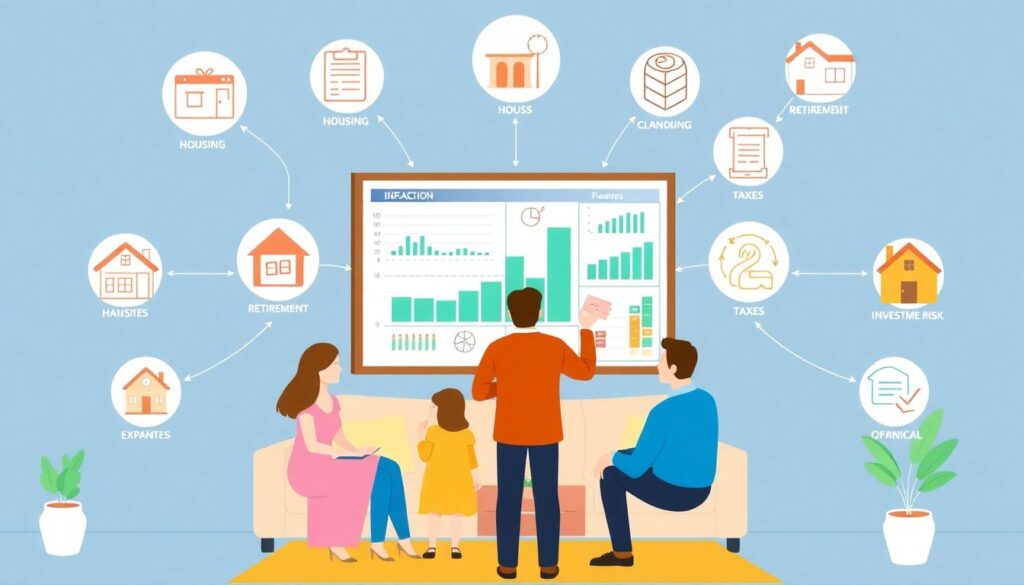
For many households, the complexity isn’t in *understanding* inflation, it’s in fitting all the moving parts together: debt, housing decisions, kids, retirement, taxes, and investment risk.
That’s where inflation proof financial planning services can add real value:
– Building a full cash‑flow model that includes realistic inflation assumptions for different categories (healthcare, education, housing, etc.).
– Stress‑testing your plan against higher‑than‑expected inflation or lower market returns.
– Optimising tax, retirement account choices, and portfolio structure so that your *after‑tax, after‑inflation* wealth actually grows.
Even if you don’t hire anyone long term, a one‑time checkup can reveal gaps you might not see on your own.
—
Pulling It Together: A 12‑Month Action Plan
To finish, here’s a practical, short list you can actually act on over the next year:
– Month 1–2
– Audit your last 12–24 months of spending. Measure category‑level inflation in your own life.
– Create or update a budget that reflects reality, not habits.
– Month 3–4
– Move your emergency fund to a higher‑yield, low‑risk account or instrument.
– Cancel or renegotiate at least 2–3 recurring expenses (subscriptions, insurance, memberships).
– Month 5–6
– Define your 3–10 year and 10+ year goals.
– Align your investments with these time frames, incorporating some inflation‑resistant assets.
– Month 7–9
– Explore one concrete income‑raising step: a job move, a promotion path, or a structured side project.
– Re‑check your spending for “creep” and adjust caps on discretionary categories.
– Month 10–12
– Recalculate your net worth and compare it *in real terms* to a year ago (adjusting roughly for inflation).
– If needed, consider a session with a planner to refine your strategy.
Inflation over the last three years has been painful, but it’s also been a wake‑up call. Households that update how they budget, save and invest can still move forward in real terms. The key is to stop assuming yesterday’s rules still apply and start running your finances with inflation as an explicit, measurable factor in every decision.