

Talk about money early, briefly, and often, using simple facts and zero shame. Share age-appropriate, not adult-level details, separate a child’s worth from what you can afford, and use real-life moments to practice choices. Start small: name money, set clear rules for allowance, and normalize questions.
Essential Money Lessons to Prioritize
- Money is a tool for choices, not a measure of a person’s value or success.
- Every amount of income benefits from a simple plan: some to spend, some to save, some to give.
- Waiting and planning (delayed gratification) usually create better options than impulse spending.
- Mistakes with small amounts are normal, fixable, and valuable learning opportunities.
- Family money rules can be firm and kind at the same time: We do not buy everything we want, even when we can.
- Privacy matters: kids can understand enough versus not enough without seeing every adult number.
Preparing Yourself: Mindset, Language and Financial Privacy
This guide fits parents and caregivers who want calm, practical money talks with kids from about age 3 through late teens. It is especially helpful if you feel guilt about your own money history, are raising kids across different households, or did not grow up with healthy money conversations.
Postpone in-depth talks if you are in the middle of a crisis (for example, an eviction notice or an unsafe conflict about money). In those cases, focus first on immediate safety and basic needs. Keep messages to kids short and reassuring: you are working on it, and adults are in charge of solutions.
Before you start, reset your mindset:
- Notice shame-phrases like I am terrible with money and replace them with I am still learning, and I am changing how I handle money.
- Decide which topics are open (earning, saving, spending choices) and which numbers stay private (exact income, debts, or other adults’ finances).
- Agree with co-parents on a few shared principles, even if you do not agree on every detail (for example, no debt for in-app purchases).
Use clear, neutral language:
- Prefer We choose not to spend on that over We cannot afford anything.
- Say This is not in our budget this month instead of Because I said so.
- Keep your tone calm when you say no, so kids learn that limits are normal, not emergencies.
Finally, define your privacy boundaries in advance so you are not caught off guard:
- Safe to share: what things cost at the store, general concepts like rent, how saving works, your childhood money stories (filtered).
- Keep private: exact salary, other people’s money, conflicts with a partner, and any detail that would make a child feel responsible for adult bills.
Age-by-Age Conversation Guide: Preschool to Late Teens

You do not need to be a financial expert or enroll in a teaching kids about money course to start. Use ordinary household tools: cash, your wallet, grocery receipts, and everyday moments. Below is an age-by-age guide with suggested tools and conversation starters.
Preschool (3-5 years)
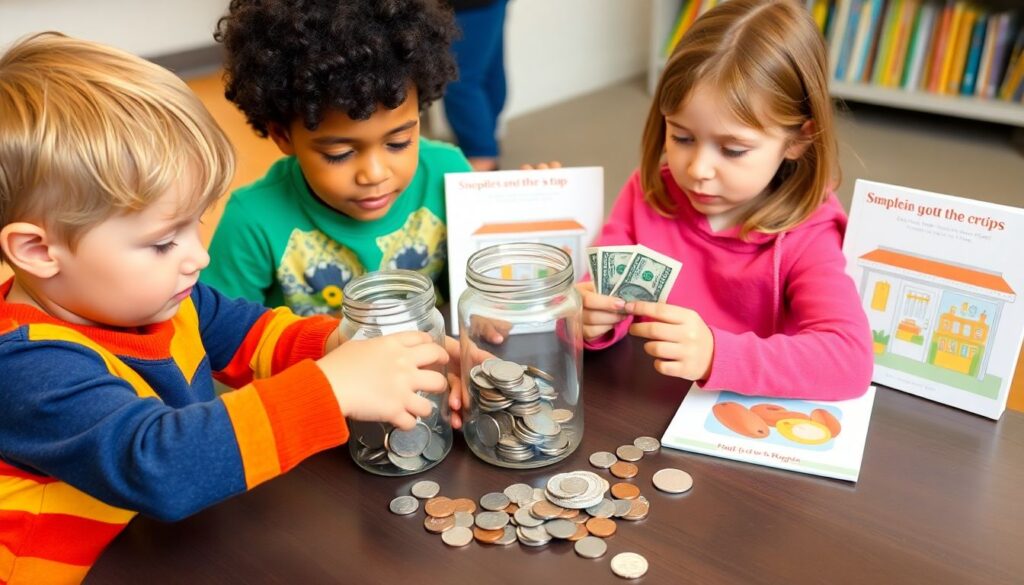
Goal: Notice money, trade, and waiting.
- Tools: Coins and small bills, a clear jar, simple picture books about shops and saving.
- Talk like this: Money is what we use to pay for things. When we give money, we can take the food home.
- Activities: Sort coins, put spare change in a jar, choose one small item from the dollar section with a limit.
Early Elementary (6-8 years)
Goal: Connect work, money, and simple choices.
- Tools: A 3-part piggy bank or three jars (Spend / Save / Give), simple chore chart, money management games for kids (board or app with parental controls).
- Talk like this: When money comes in, we give each dollar a job: some for now, some for later, some to help others.
- Activities: Small allowance, paying at the checkout, choosing between two items that fit the budget.
Upper Elementary (9-11 years)
Goal: Plan ahead and manage a small budget.
- Tools: Kid-friendly wallet, notebook or spreadsheet for tracking, beginner-friendly allowance apps for kids and parents, age-appropriate best books to teach kids about money.
- Talk like this: Let us list what you want this month and see what your allowance can cover.
- Activities: Plan a birthday budget, track weekly allowance, compare prices per unit at the store.
Middle School (12-14 years)
Goal: Understand income, larger goals, and digital money.
- Tools: Youth debit or prepaid card (if available and supervised), library access to financial literacy programs for children, simple bank app with alerts.
- Talk like this: Every time money comes in, we will log it and decide what percentage to save and what percentage to spend.
- Activities: Track spending for a week, plan saving for a big item, discuss ads and influencer marketing.
High School (15-18 years)
Goal: Prepare for real-world money decisions.
- Tools: Actual bank account with view-only access for you, comparison sites for colleges or training, beginner investing content (index funds, risk vs reward).
- Talk like this: Let us run numbers on part-time work, gas, and your savings goals for the next year.
- Activities: First job income plan, mock rent and utility budget, compare different education and work paths.
Practical Frameworks: Allowances, Chores and Simple Budgets
Use this step-by-step process as a safe baseline. Adapt amounts to your reality; the structure matters more than the numbers.
- Define your family money rules first. Spend a few minutes writing 3-5 simple rules. Examples: no lending money between siblings, no debt for digital extras, and adults are in charge of rent and bills while kids are in charge of their fun money.
-
Separate family responsibilities from paid work. Decide which chores are expected as part of being in the family (unpaid) and which tasks are optional earning opportunities.
- Family chores: making their own bed, clearing dishes, basic tidying.
- Paid jobs: washing the car, deep cleaning, helping with a garage sale.
-
Choose an allowance structure that matches your capacity. Start simple: weekly or monthly, delivered the same day.
- Option A: Fixed allowance not tied to chores, used to practice budgeting.
- Option B: Base allowance plus extra pay for agreed gig-style tasks.
- Option C: No standing allowance; only pay for clearly defined jobs or projects.
-
Set up clear containers for Spend, Save and Give. For young kids, use three labeled jars; for older kids, use a mix of jars and digital categories or allowance apps for kids and parents.
- Agree on a simple split, like at least some in each jar each time.
- Let kids choose the exact percentages after you explain the trade-offs.
-
Build a mini-budget together once a month. Sit down for 10-15 minutes and list their expected income (allowance, gifts, part-time work) and likely expenses (snacks, games, outings).
- Ask: What is most important to you this month?
- Use that answer to decide how much goes to short-term versus long-term goals.
-
Practice pause before purchase every week. Create a family rule that most non-essential buys over a set amount require a 24-hour wait.
- Teach kids to add items to a list instead of buying immediately.
- The next day, ask: Do you still want this, or is there something better to save for?
-
Review and celebrate learning, not perfection. Once a month, look back together at how they used their money.
- Ask: What are you proud of? and What would you change next time?
- Share one of your own small money mistakes and what you learned.
Fast-Track Plan for Busy Parents
- Pick 3 family money rules and say them out loud at dinner.
- Give a small, regular allowance and require kids to split it into Spend / Save / Give.
- Add a 24-hour wait rule for any non-essential purchase over a set amount.
- Once a month, spend 10 minutes reviewing choices and adjusting goals together.
Hands-On Learning: Earning, Saving and Beginner Investing Tasks
Use this checklist to see whether your money talks are turning into real skills. Aim to gradually check off more items as your child grows.
- Your child can explain, in their own words, the difference between earning, receiving a gift, and borrowing.
- They can name at least one way they personally can earn money that is safe and age-appropriate.
- They can describe a current savings goal and roughly how long it might take to reach it.
- They regularly set some money aside before spending, even if the amount is small.
- They have experienced at least one money mistake, such as buyer’s remorse, and you debriefed it calmly.
- Older kids can read a simple bank or allowance app statement and spot where their money went.
- Teens can outline a basic plan for their first job income: what to save, what to spend, and what to avoid, such as high-interest debt.
- Teens have heard a simple explanation of investing, including owning pieces of companies, risk, and time, without pressure to start right away.
- They know that it is okay to ask you money questions, even about topics you might answer with That is private, but here is what I can tell you.
De-escalation Strategies: Managing Guilt, Shame and Sibling Comparisons
These are common traps that create stress or guilt during money conversations. Notice them early and gently correct course.
- Using money labels on kids: Saying You are so bad with money or You are the saver, your sibling is the spender can lock them into roles.
- Comparing siblings’ earnings or gifts: Public comparisons, such as Your brother saved more than you, fuel rivalry and shame.
- Over-sharing adult stress: Venting about bills or debt to kids can make them feel unsafe or responsible.
- Buying to erase guilt: Overspending after a fight or a divorce to make up for it teaches that money is for mood-fixing, not values.
- Shutting down questions with fear: Replies like Do not ever talk about money, it is rude prevent kids from learning healthy curiosity.
- Changing rules in the heat of the moment: Cancelling agreed allowance or punish-spending, such as Now you pay for everything, confuses boundaries.
- Letting kids hear fights about money: Heated arguments in front of them link money with conflict and anxiety.
- Assuming older kids should already know this: Skipping basics because of their age can leave real knowledge gaps and silent shame.
Values in Practice: Teaching Giving, Consumption Choices and Long-Term Goals
Different families will choose different ways to live their money values. Here are several workable approaches you can adapt.
- Weekly micro-decisions: Focus on small, repeated choices (snacks, in-app items, rideshares) as your main teaching tool. Best when you want low-pressure, frequent practice with quick feedback.
- Project-based learning: Center learning around a few bigger projects each year, such as saving for a bike, planning a low-cost trip, or organizing a small fundraiser. Works well for kids who are motivated by clear goals.
- Community and giving focus: Build in regular giving choices, including choosing a cause, donating a portion of allowance, or volunteering. Ideal if you want kids to see money as one way, not the only way, to contribute to others.
- Guided curriculum support: Combine your home approach with structured resources like financial literacy programs for children, a teaching kids about money course, or carefully chosen best books to teach kids about money. This is useful if you prefer a clearer roadmap or want to cover topics you feel less confident about.
Quick Answers to Common Parental Money Concerns
How early is too early to start talking about money with kids?
You can start around ages 3-4 with very simple ideas: what money is, that it is limited, and that we use it to buy things we need and want. Keep it concrete and short, naming coins, putting money in a jar, or paying at the store together.
Should allowance be tied to chores or not?
Both approaches can work if you are consistent. Many parents separate basic family chores, which are unpaid responsibilities, from optional paid jobs, then use allowance mainly to practice budgeting rather than as a reward or punishment tool.
What if I have made a lot of money mistakes myself?
You can still be an excellent money teacher. Share age-appropriate parts of your story, focus on what you are changing now, and avoid putting your shame on your child. Modeling learning and repair is more powerful than pretending to be perfect.
How do I handle That is not fair, my friend gets more?
Stay calm and repeat your family rules. You might say, Different families do money differently. In our family, we follow our own plan, and then explain your approach briefly. Acknowledge their feelings without debating or criticizing other families’ choices.
Is it safe to let my child use a debit card or money app?
It can be safe if you start with low limits, strong parental controls, and regular check-ins. Begin with small amounts, turn on alerts, and review transactions together weekly. Emphasize that digital money is still real money.
How do I talk about being low-income without scaring my child?

Focus on honesty plus reassurance. Share only what they need to know, for example, We have to be careful with money right now, so we are cutting back on extras, but adults are working on it and you are safe. Keep detailed stress conversations between adults.
Are games and books actually helpful for money learning?
They can help if you choose them intentionally and talk about them. Money management games for kids, well-chosen best books to teach kids about money, or a structured teaching kids about money course can reinforce your messages and make practice feel fun, not heavy.