

Index funds are pooled investments that simply track a market index, making them powerful, low‑maintenance tools for long‑term wealth. For beginners, they offer instant diversification, low fees, and predictable rules. You focus on saving regularly and staying invested, while the fund automatically follows the market.
Core Principles of Index Investing
- Own the whole market cheaply instead of trying to pick winning stocks.
- Use low cost index funds for long term investing to let compounding work.
- Accept market ups and downs instead of timing entries and exits.
- Keep a simple, rules‑based allocation that fits your risk tolerance.
- Automate contributions and rebalancing to remove emotional decisions.
What Index Funds Are and How They Differ from Active Funds and ETFs
An index fund is a mutual fund or ETF that aims to match the performance of a specific market index (such as the S&P 500) by holding the same or a representative sample of its securities. The manager does not try to beat the index; the goal is simple tracking.
Active mutual funds employ managers and research teams to pick securities they believe will outperform. This requires more trading, more research, and usually meaningfully higher fees. Many investors seek the best index funds for beginners precisely because they avoid this complexity and cost.
Exchange‑traded funds (ETFs) are a wrapper, not a strategy. You can have index ETFs and active ETFs. Both trade throughout the day like stocks. In contrast, traditional index mutual funds price once at the end of the trading day. For most long‑term investors, the difference is mainly about trading flexibility and tax treatment, not performance.
For someone comparing how to start investing in index funds, the main choice is usually between an index mutual fund with automatic monthly contributions, and a low‑fee index ETF you buy periodically through a brokerage account.
| Feature | Index Mutual Fund | Active Mutual Fund | Index ETF |
|---|---|---|---|
| Goal | Match index | Beat index | Match index |
| Fees | Low | Higher | Very low to low |
| Trading | End‑of‑day only | End‑of‑day only | Intraday like a stock |
| Strategy Risk | Market risk only | Manager & market risk | Market risk only |
Scenario example: A busy professional wants to invest every paycheck without thinking about the market. She chooses a total‑market index mutual fund with automatic contributions, trusting the rules of the index instead of researching individual companies.
- Define your primary goal (retirement, down payment, financial independence).
- Choose one broad‑market index (e.g., total U.S. or global) as your core holding.
- Decide whether mutual fund automation or ETF flexibility fits you better.
Historical Returns, Volatility and What to Expect Over Decades
Index funds reflect the behavior of their underlying markets: they can be very volatile in the short term but tend to align with the long‑run growth of businesses and economies. You are trading day‑to‑day excitement for a high chance of capturing the market’s average result.
- Short‑term swings: In any given year, broad stock index funds can be strongly positive or negative. You must be mentally and financially prepared for sharp temporary losses.
- Multi‑year cycles: Over 5-10 year periods, returns still vary widely, but extreme outcomes become less common. Staying invested through full cycles is critical.
- Decade‑plus horizons: Over long horizons, diversified stock index funds have historically rewarded patient investors who did not sell during downturns, though nothing is guaranteed.
- Sequence of returns: The order of good and bad years matters most when you are withdrawing (e.g., in retirement), less so when you are still contributing.
- Role of bonds: Adding bond index funds usually lowers volatility and smooths your experience, at the cost of lower expected return.
Simple calculation example: If you invest $300 per month into a broad index fund and it averages a 6% annual return over 30 years, you end up with roughly $300 × 12 × 30 ≈ $108,000 in contributions, but compounding grows the account to several times that amount. The key driver is time invested, not perfect timing.
Scenario example: A 30‑year‑old planning to work until 65 chooses an 80% stock / 20% bond index mix, accepts annual swings, and focuses on how the portfolio is likely to behave over three decades, not over three months.
- Match your stock/bond split to your time horizon and ability to endure drops.
- Frame performance in 10‑year blocks, not single years or quarters.
- Regularly remind yourself that volatility is normal, not a signal to abandon the plan.
Cost, Tracking Error and Tax Efficiency: How Fees Erode Returns
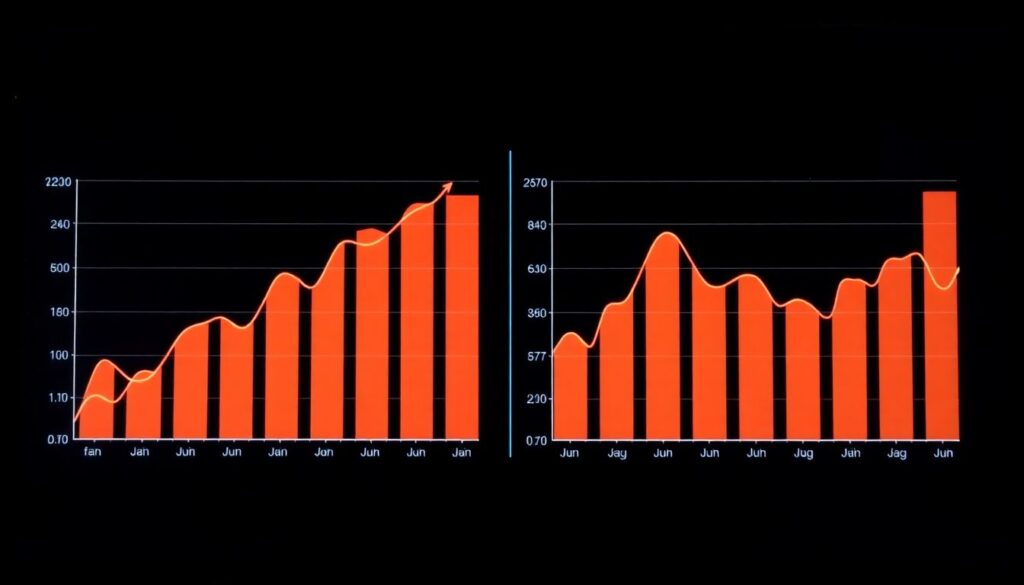
Fees are one of the few factors you directly control. Even modest expense ratios compound against you over time, which is why low cost index funds for long term investing are so emphasized by professionals.
How fees quietly add up: Suppose two similar stock index funds each start with $10,000 and grow before fees at the same rate. One charges an expense ratio of 0.05%, the other 0.75%. The difference sounds small annually, but over many years the higher‑fee fund can leave you with meaningfully less money.
Tracking error: An index fund’s job is to closely follow its benchmark. Small differences arise due to fees, trading costs and sampling methods. Consistently large gaps between fund and index signal poor implementation or higher hidden costs.
Tax considerations: In taxable accounts, index funds tend to realize fewer capital gains because they trade less. ETF structures often add another layer of tax efficiency. This is why many index fund investment strategies for beginners place tax‑efficient index ETFs in taxable accounts and bond funds in tax‑advantaged accounts.
Usage scenarios:
- Retirement saver in a 401(k): Chooses the lowest‑cost broad index funds in the plan, even if the active funds have flashier marketing materials.
- Taxable brokerage investor: Prefers broad index ETFs to keep annual taxable distributions low.
- High‑income earner: Uses tax‑advantaged accounts for bond index funds and keeps stock index funds in taxable accounts.
- Compare expense ratios across all options; favor the lowest cost that tracks a mainstream index.
- Check how closely the fund has tracked its index over at least a few years.
- Place tax‑efficient stock index funds in taxable accounts when possible, and use tax‑advantaged space for less tax‑efficient assets.
Constructing a Simple, Diversified Index Portfolio for the Intermediate Investor
A practical index portfolio for an intermediate investor can be built from just a few funds. The core idea is to diversify across asset classes (stocks and bonds) and regions (domestic and international), while keeping the structure understandable and easy to maintain.
Many people researching which index funds are best for long term wealth end up with a “core and satellite” approach: a broad total‑market index fund as the core, plus one or two satellite funds (such as an international index or small‑cap index) for extra diversification.
Advantages of a simple index portfolio
- Clarity: You can explain your allocation in a few sentences, making it easier to stick with it.
- Low maintenance: Fewer funds mean simpler rebalancing and monitoring.
- Diversification: Broad index funds hold thousands of securities across sectors and countries.
- Scalability: The same structure works when you are investing $100 or $10,000 per month.
Limitations and trade‑offs
- No outperformance chase: You will roughly match the market, not try to beat it via stock picking or market timing.
- Full participation in downturns: You cannot avoid bear markets; diversification reduces but does not eliminate losses.
- Perceived simplicity: Some investors feel a simple portfolio is “too basic” and are tempted to tinker, which can hurt returns.
Example portfolio for an intermediate investor:
- 60% U.S. total stock market index fund.
- 20% international stock market index fund.
- 20% total bond market index fund.
Scenario example: A 40‑year‑old with a stable job chooses the above mix, auto‑invests each paycheck, and rebalances annually. She treats this as her base plan, adding a small satellite REIT index fund only after she is fully comfortable with the core allocation.
- Decide your target stock/bond split, then pick 2-4 broad index funds to implement it.
- Ensure each fund serves a clear role (U.S. stocks, international stocks, bonds).
- Write down your allocation percentages so you can rebalance back to them over time.
Behavioral Pitfalls, Market Timing Temptations and Risk Management
Index funds remove stock‑picking decisions, but they do not eliminate emotional mistakes. Behavior is often the main driver of whether index investing works for you.
- Chasing recent winners: Buying whatever sector or country index has recently surged, then abandoning it after a drop, leads to buying high and selling low.
- Market timing attempts: Moving in and out of index funds based on news headlines or predictions usually results in missing strong rebounds.
- Overconfidence in “safe” assets: Believing bonds or cash index funds are risk‑free can leave your long‑term goals underfunded.
- Panic selling: Selling broad index funds during market crashes locks in losses; historically, many of the best days follow the worst days.
- Over‑complexity: Adding many overlapping index funds creates confusion and makes it harder to manage risk.
Scenario examples:
- An investor sells her stock index fund after a large drop, planning to “get back in when things feel better,” but the market recovers quickly, and she misses much of the rebound.
- Another investor sticks to a pre‑set index fund allocation, rebalances during the downturn, and benefits when markets eventually recover.
- Define your risk tolerance in advance and choose an allocation you can hold through deep declines.
- Commit in writing to avoid making allocation changes based on short‑term news or predictions.
- Review your portfolio on a set schedule (e.g., once or twice a year), not in response to market noise.
Practical Mechanics: Rebalancing, Contributions, Withdrawals and Account Selection
The daily work of index investing is mostly administrative: moving money in, occasionally rebalancing, and eventually taking money out. Mastering these mechanics makes your plan durable.
Rebalancing: Over time, market movements push your allocation away from targets. Rebalancing means selling a bit of what has done well and buying what has lagged, returning you to your desired mix.
Contributions: Automatic monthly investments enforce discipline and remove decision paralysis. This is central to how to start investing in index funds for most beginners: pick the funds and automate the flow of cash.
Withdrawals: In retirement or other drawdown phases, a rules‑based withdrawal plan (for example, withdrawing a fixed dollar amount or percentage) helps you navigate volatility without overreacting.
Account selection: Use tax‑advantaged accounts (401(k), IRA, etc.) when available, and then a taxable brokerage account. Place tax‑efficient index funds in taxable accounts and less tax‑efficient assets in tax‑advantaged ones when possible.
Mini‑case: You choose a 70% stock / 30% bond index mix. Every month, $500 is auto‑invested. Once a year, you check your allocation. If stocks have grown to 75% and bonds fallen to 25%, you sell some stock index fund and buy bond index fund to return to 70/30.
- Automate contributions into your chosen index funds on payday or monthly.
- Set a simple rebalancing rule (e.g., once a year or when allocations drift by 5 percentage points).
- Plan in advance how you will withdraw funds later (sequence, accounts, and amounts).
Quick Self‑Check Before You Invest

- I can summarize my index fund strategy (goals, allocation, accounts) in a few sentences.
- I know which low‑cost funds I will use and why they fit my time horizon.
- I have an automation plan for contributions and a simple rule for rebalancing.
- I accept that volatility is normal and will not change my plan based on headlines.
- I understand that the best index funds for beginners are usually broad, low‑fee, and easy to stick with.
Common Investor Queries and Short Answers
What makes index funds a good starting point for beginners?
They offer broad diversification, low fees, and simple rules. You do not need to pick individual stocks or time the market; you just choose your allocation, automate contributions, and hold for the long term.
How do I choose the best index funds for beginners?
Focus on broad market coverage (total U.S., total international, or global), very low expense ratios, and reputable providers. Make sure the funds align with your risk level and are easy to buy in your available accounts.
How to start investing in index funds with a small amount of money?
Open a low‑cost brokerage or retirement account, pick one broad index fund or ETF, and set up automatic monthly contributions, even if the amount is modest. The habit and time in the market matter more than starting size.
Are index funds safe for long term wealth building?
Index funds are not risk‑free; they will fall during market declines. However, diversified, low‑cost index funds held over long periods have historically been a robust tool for building wealth compared to cash or trying to pick individual winners.
How many index funds do I really need?

Most investors can build a solid, diversified portfolio with just two to four funds, such as U.S. stocks, international stocks, and bonds. More funds do not necessarily mean better diversification.
What role do bond index funds play in my portfolio?
Bond index funds generally reduce volatility and provide a stabilizing force when stock markets are turbulent. They usually have lower long‑term returns than stock index funds but help many investors stay invested through downturns.
Which index funds are best for long term wealth if I am comfortable with risk?
For investors with long horizons and high risk tolerance, broad stock index funds covering domestic and international markets are often the core. You can tilt slightly toward small‑cap or value indexes, but simplicity and low fees remain priorities.