
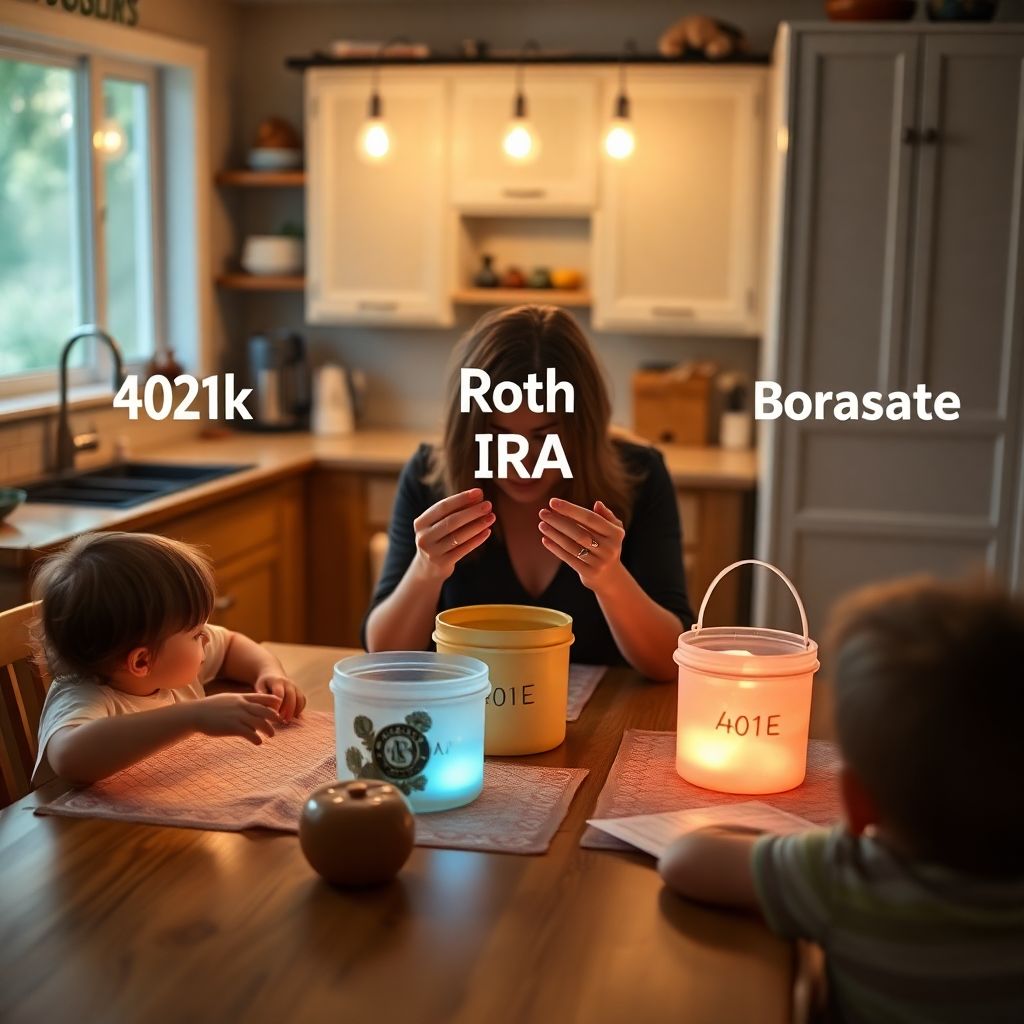
401(k) or brokerage account? That choice feels huge, especially when you’re a single mom, juggling work, kids, and a million other responsibilities. Let’s break it down in very simple terms and then add some grown‑up detail so you can actually make a confident decision.
—
Step 1: Understand the “buckets” for your money
Think of your money as going into different buckets:
1. Emergency savings bucket – for “oh no” moments (job loss, car breaks, kid gets sick).
2. Retirement buckets – 401(k), Roth IRA.
3. Flexible investing bucket – taxable brokerage account (money you can use before retirement age with fewer restrictions).
You already:
– Have an emergency fund
– Max out your Roth IRA
– Contribute to your 401(k)
– Started a brokerage account
You’re doing a lot right already.
—
Step 2: What a 401(k) really is (kid-level version)
A 401(k) is like a special piggy bank for old-you that:
– Is tied to your job
– Lets you put money in before taxes (traditional 401(k))
– Often comes with free money from your employer (the match)
– Has rules about when you can take money out (usually after age 59½, or you pay penalties)
That employer match is like your job saying:
> “For every dollar you put in (up to a limit), we’ll put in some of our own money too.”
If you skip the match, you’re literally walking away from free money.
—
Step 3: What a brokerage account is
A regular brokerage account is like a normal investing bucket:
– No special tax perks like a 401(k) or Roth
– No age rules: you can take money out whenever you want
– You can buy the same kinds of investments (stocks, funds, etc.)
– You pay taxes on dividends, interest, and profits when you sell
So:
– 401(k) = tax benefits + restrictions
– Brokerage = flexibility + less tax help
—
Step 4: The usual “priority” order
For most people, a simple order of operations looks like this:
1. Build an emergency fund (3-6 months of expenses; more if you’re a single parent with one income).
2. Contribute to 401(k) up to employer match.
Never skip free money.
3. Max out Roth IRA.
You’re already doing this – excellent.
4. Go back and add more to 401(k) (beyond the match) or invest in a brokerage account, depending on your goals.
5. If you still have extra, balance between more retirement savings and flexible investing.
You’re at step 4. This is exactly where your question lives:
“Do I max the 401(k) or just do the match and send the rest to brokerage?”
—
Step 5: Pros of putting more into your 401(k)
Reasons to max out your 401(k beyond the match):
1. Tax savings now
Traditional 401(k) contributions lower your taxable income. You pay less in taxes today, and the money grows tax-deferred.
2. Automatic saving
Comes straight out of your paycheck before you can spend it. Great for people who don’t want to manually move money each month.
3. Big boost for retirement
The earlier you are, the more compounding can work for you. At 36, you still have decades for this money to grow.
4. May protect you from lifestyle creep
The more goes into 401(k), the less you see as spendable cash, which can quietly keep your lifestyle in check while building future wealth.
5. Some states/jobs offer creditor protections
Retirement accounts often have stronger legal protections if you’re ever sued or in big financial trouble.
—
Step 6: Cons of putting *too much* into your 401(k)
Where a 401(k) can be tricky for someone in your situation:
1. Less flexibility
Need money before retirement? You’ll usually face taxes and penalties if you withdraw early (with some exceptions).
2. You’re a single mom with one main income
Flexibility matters. Big chunks locked away until you’re older might feel scary if you want more access to funds in your 40s or 50s.
3. Plan quality varies
Some 401(k) plans have high fees or limited investment choices. If your employer’s plan is expensive or low quality, that weakens the argument for maxing it out.
—
Step 7: Pros of putting more into a brokerage account
Reasons you might want to send extra money to a brokerage instead:
1. Total flexibility
You can:
– Invest for retirement
– Use it for a house down payment
– Fund a kid’s education
– Start a small business
– Or just have extra security for mid-life emergencies
2. No age restrictions
Take the money out anytime. No early withdrawal penalty. You will pay taxes on gains, but you won’t be punished for needing your own money sooner.
3. Great for “early retirement” or work flexibility
If one day you want to cut your hours as a nurse, switch to a less stressful role, or semi-retire before 59½, brokerage money becomes the bridge between now and full retirement age.
4. Same type of investments
You can buy similar index funds or ETFs in a brokerage as in a 401(k). The difference is mostly tax treatment and flexibility, not what you can invest in.
—
Step 8: The “single mom” layer: safety vs. growth
For a single mom, there’s an extra question:
> “How much do I need to feel safe now, and how much can I afford to lock away for later?”
Ask yourself:
– Is your emergency fund truly solid?
(At least 3-6 months of expenses, maybe leaning closer to 6-9 since you’re a one‑income household.)
– Do you have any big‑ticket goals in the next 5-10 years?
– Buying a home?
– Moving to a different state?
– Helping a child with major expenses?
– How stable is your job as a nurse?
Healthcare is generally in demand, but your specific situation matters.
If:
– Your emergency fund is strong
– Your debt is low or manageable
– You don’t have big near-term expenses
…then putting more into your 401(k) becomes more attractive.
If:
– You feel “thin” on liquid savings
– You might want money for a house, career shift, or your kid within the next 5-10 years
…then investing more in a brokerage account can be a smart move.
—
Step 9: A simple rule-of-thumb strategy
Here’s a straightforward approach you could follow:
1. Keep doing 401(k) up to employer match.
That’s non-negotiable free money.
2. Keep maxing your Roth IRA.
You’re already doing this – it’s one of the best retirement tools out there.
3. Split extra contributions
If you have extra money and no immediate huge goals, you could do something like:
– 50% of extra money → extra 401(k) contributions
– 50% of extra money → brokerage account
That way:
– Future-you gets more tax-advantaged retirement savings
– Present-you keeps flexibility for mid-life needs
You can adjust the split based on your comfort:
– More nervous about unexpected life events? Tilt more toward brokerage.
– Very focused on locking in a strong retirement? Tilt more toward 401(k).
—
Step 10: Tax angle in simple terms
Very basic version:
– 401(k):
– Pay less tax now
– Pay tax later when you withdraw in retirement
– Brokerage:
– No tax break on money going in
– Pay tax on profits/dividends as you go, usually at capital gains rates
If you’re in a higher tax bracket right now, putting more into a 401(k) can save you more money immediately. If your income is modest, the tax savings are still helpful but not always a slam-dunk reason to max out 401(k) at the expense of all flexibility.
—
Step 11: Check these before deciding
To make a truly smart choice, look at:
1. Your 401(k) fees and investment options
– If the plan has low-cost index funds, putting more in is more attractive.
– If it’s expensive and full of high-fee funds, that’s a reason to favor brokerage.
2. Your emergency fund size
– If it’s under 3 months of expenses, focus first on boosting this.
– If it’s 3-6+ months, you have more freedom to invest aggressively.
3. High-interest debt
– If you have credit card debt or high-interest personal loans, often the best “investment” is paying those down first.
—
Step 12: A sample “good enough” plan for someone like you
For a 36-year-old nurse, single mom, already doing all the basics, a balanced plan might look like:
1. Maintain or increase:
– 401(k) contribution to at least the full employer match
– Max Roth IRA every year
2. With remaining extra money:
– If your emergency fund is under 6 months:
– Build that up first.
– Once emergency fund is solid:
– Put perhaps half of the extra into additional 401(k) contributions
– Put the other half into a brokerage account invested in diversified, low-cost funds
3. Revisit this every year:
– Got a raise? Maybe increase 401(k) by 1-2% of your salary.
– Big upcoming expenses? Redirect more toward the brokerage or even short-term savings.
—
Step 13: One-sentence summary, “1st grader” style
– Put some money into the work-retirement piggy bank (401(k)) to get all the free money your job gives.
– Put some money into your own special piggy bank (brokerage) so you can use it anytime you need it in life.
– After you grab all the free money and fill your safety jar (emergency fund), you can slowly add more to both piggy banks over time.
—
In plain terms:
Don’t stop at just the employer match if your emergency fund is strong and your 401(k) is decent. But as a single mom, it’s completely reasonable-and often wise-to keep building your brokerage account too, so you’re not trapping every spare dollar in accounts you can’t easily touch until you’re older. A mix of both is usually the safest, smartest path.