
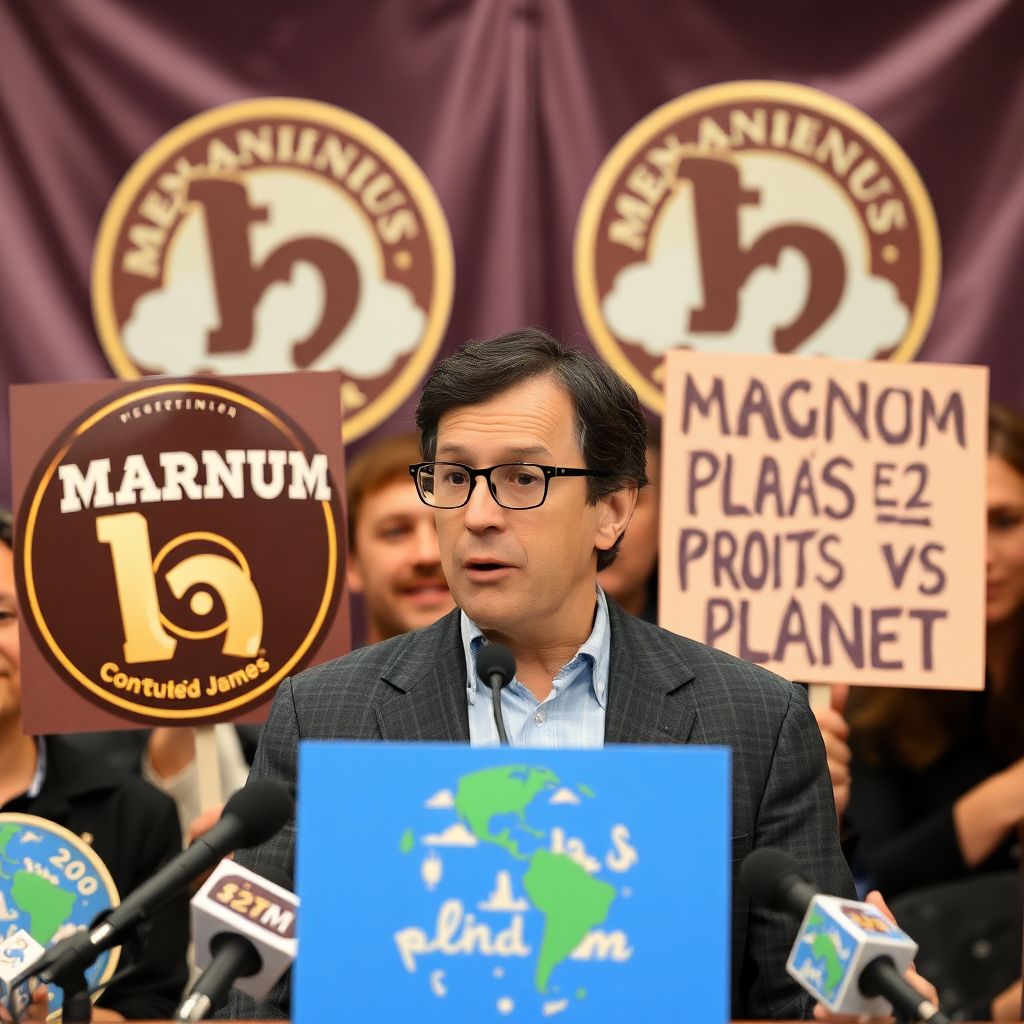
Ben & Jerry’s co‑founder has sharply criticized the growing influence of activist investor Nelson Peltz’s fund over Magnum ice cream, warning that the pressure for short‑term shareholder returns could undermine the brand’s social and environmental responsibilities.
According to his public comments, the ice cream entrepreneur is alarmed that Peltz’s fund is pushing the parent company to focus more aggressively on margins, cost‑cutting, and financial engineering. In his view, when a powerful activist investor takes a significant stake and demands rapid improvements in profitability, brands like Magnum risk drifting away from commitments to fair supply chains, climate action, and ethical marketing that consumers increasingly expect.
He argues that ice cream is not just another packaged good, but a highly emotional product tied to pleasure, comfort, and shared experiences. For that reason, he believes brands in this category have a special obligation to act responsibly: from how they source dairy and cocoa to how they treat workers and how honestly they communicate with customers. The fear is that under intense investor pressure, issues such as farmer livelihoods or deforestation in supply chains may be treated as negotiable expenses rather than non‑negotiable principles.
Peltz’s fund has built a reputation as a forceful activist investor, typically taking stakes in large consumer companies and then lobbying management for restructuring, divestitures, or more aggressive efficiency drives. Supporters say such campaigns unlock value, streamline bloated organizations, and make companies more responsive to shareholders. Critics, including the Ben & Jerry’s founder, warn that this model often prioritizes quarterly earnings over long‑term resilience, innovation, and social impact.
In his criticism of the fund’s influence over Magnum, the founder highlights a deeper tension running through today’s consumer‑goods industry: can a global brand be both a vehicle for profit maximization and a robust champion of progressive values? He contends that when activist funds become too powerful, boardrooms start to treat sustainability commitments as “nice‑to‑have” marketing tools rather than binding obligations. Once that shift happens, cutting a farmer program or slowing climate initiatives can appear like a quick and easy way to boost the bottom line.
Magnum, as a premium ice‑cream brand, sits at the center of this debate. Its image depends heavily on indulgence, quality ingredients, and an aura of sophistication. The Ben & Jerry’s co‑founder suggests that this kind of aspirational positioning is incompatible with a behind‑the‑scenes race to the lowest possible cost. If consumers discovered that the brand’s success relied on squeezing suppliers or scaling back environmental protections, the carefully built identity could quickly erode.
He also raises questions about who ultimately gets to decide what a brand stands for. When activist funds secure board seats or significant influence, they can push management to adjust strategy in ways that ordinary customers never voted for. The critique is not only about profits versus ethics; it is about democratic accountability in the corporate sphere. Should a small group of institutional investors be able to override years of work on social missions because they want a faster return?
The Ben & Jerry’s story is often used as a contrasting model. The company’s founders built their brand around a set of explicit social goals alongside financial ones, and they have repeatedly argued that a strong mission can create durable loyalty and resilience. Drawing on that experience, the co‑founder insists that commitments to climate justice, racial equity, and fair trade are not optional extras or marketing slogans; they are integral to the long‑term health of both society and business.
In the current dispute over Magnum, he frames the issue as a warning to the entire sector. If activist investors learn that they can successfully roll back or dilute corporate responsibility programs without pushback from consumers, employees, or regulators, similar campaigns will likely spread. Other brands may feel pressured to downplay their sustainability investments or soften their public promises to avoid becoming targets for cost‑cutting demands.
The criticism also touches on the broader shift in consumer expectations. Younger buyers in particular are more likely to research brand behavior, question supply chains, and challenge companies publicly when they see contradictions between advertising and action. From that standpoint, he argues, the strategy championed by funds like Peltz’s may be outdated: it risks extracting short‑term financial gains while degrading the trust that keeps brands relevant in the long run.
At the same time, the controversy underscores how fragile corporate commitments to purpose can be. Many large companies have made high‑profile pledges on carbon emissions, plastic reduction, or ethical sourcing. Yet these promises often sit in tension with investor demands for constant cost efficiencies. The Ben & Jerry’s co‑founder suggests that unless sustainability goals are structurally protected in governance documents, they can quickly be sacrificed when an activist investor appears with a compelling financial narrative.
From a governance perspective, his critique implicitly calls for stronger safeguards around a brand’s mission. That could mean separating certain social and environmental objectives from everyday budget battles, building them into the company’s charter, or granting independent oversight bodies a say in key decisions. Without such mechanisms, he warns, even well‑intentioned boards may feel forced to concede to activist demands.
For Magnum, the outcome of this clash may shape not only its own trajectory but also the wider debate over the future of responsible business. If financial activism succeeds in redirecting the brand’s priorities, other companies might interpret that as a signal that investor pressure will be rewarded, even at the expense of ethics and sustainability. Conversely, if consumer and stakeholder backlash proves strong enough to limit that influence, it could encourage more firms to double down on long‑term commitments rather than retreat from them.
Ultimately, the Ben & Jerry’s co‑founder is using the conflict around Magnum as a case study in what happens when two visions of capitalism collide: one focused primarily on maximizing shareholder value as quickly as possible, and another that measures success through a balance of profit, planet, and people. His attack on the Peltz fund’s role is less about a single ice‑cream brand and more about the rules he believes should govern global business in an era of climate crisis, inequality, and heightened public scrutiny.