
If the alphabet soup of money talk still throws you off, you’re not alone — even pros keep a cheat sheet. Consider this your friendly guide to financial terms explained, tuned to where money and tech actually are in 2025.
Why our money language got so dense in the first place

Over the last few years, finance fractured into multiple micro‑worlds — from real‑time payments and tokenized assets to AI‑driven advice — and each spawned its own dialect. Regulators added acronyms, fintechs marketed “simple” products with complex mechanics, and social media mashed buzzwords into memes; the result is a noisy glossary that can feel like insider code unless someone translates it into plain speech.
Now the good news: the core ideas haven’t changed; the context has.
A living finance glossary you can actually use
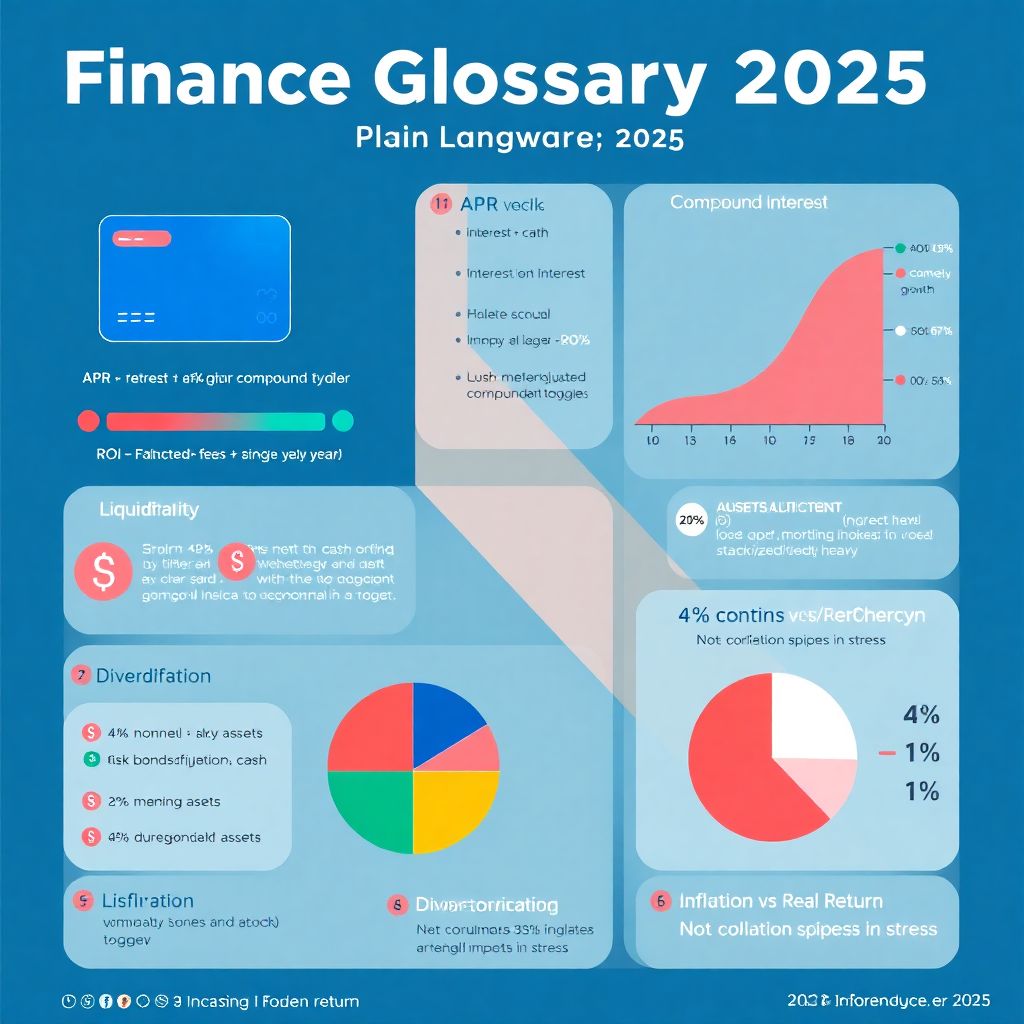
Let’s keep this pragmatic. Below is a compact, 2025-ready finance glossary that answers the most Googled questions and shows how they echo through everyday decisions.
1) What is APR? Annual Percentage Rate folds together a loan’s interest plus mandatory fees into a single yearly number, so you can compare credit cards or buy‑now‑pay‑later plans on equal footing. If two offers look similar, the lower APR usually wins — unless hidden perks or timing change the math.
2) What is compound interest? It’s interest earning interest on a schedule (daily, monthly, etc.). Faster compounding and longer timelines turbocharge growth — or debt — which is why emergency funds in high‑yield accounts and revolving card balances behave so differently.
3) What is ROI? Return on Investment measures gain relative to what you put in. It’s simple division, but in 2025 most teams pair plain ROI with risk‑adjusted cousins (like Sharpe) when markets are jumpy or projects are AI‑heavy and uncertain.
4) Liquidity: How quickly you can turn an asset into spendable cash without a big price haircut. Helpful when markets wobble or you need runway.
5) Diversification: Spreading bets so one flop doesn’t sink the ship. In modern portfolios, that can include cash, bonds, stocks, and sometimes tokenized assets — but correlation can spike in stress, so it’s not a magic shield.
6) Inflation vs. real return: What matters is purchasing power. A 4% yield with 3% inflation is roughly 1% real — the realistic yardstick for goals.
7) Dollar‑cost averaging: Investing fixed sums on a schedule. It dampens timing mistakes and suits volatile assets, especially when AI headlines yank prices around.
Short version: start with these, and the rest of the jargon slots into place.
Different ways to learn the language — and how they stack up
You’ve got choices: traditional courses and books, interactive apps, AI chatbots that explain receipts line by line, and data‑viz tools that turn concepts into sliders and scenarios. Each path teaches the same principles but differs in friction and feedback, which matters when your attention is split between work, messages, and markets moving in milliseconds.
If you want speed and context, AI tutors shine; if you want depth and accreditation, structured curricula still rule.
Tech that helps (and sometimes hurts): pros and cons in 2025
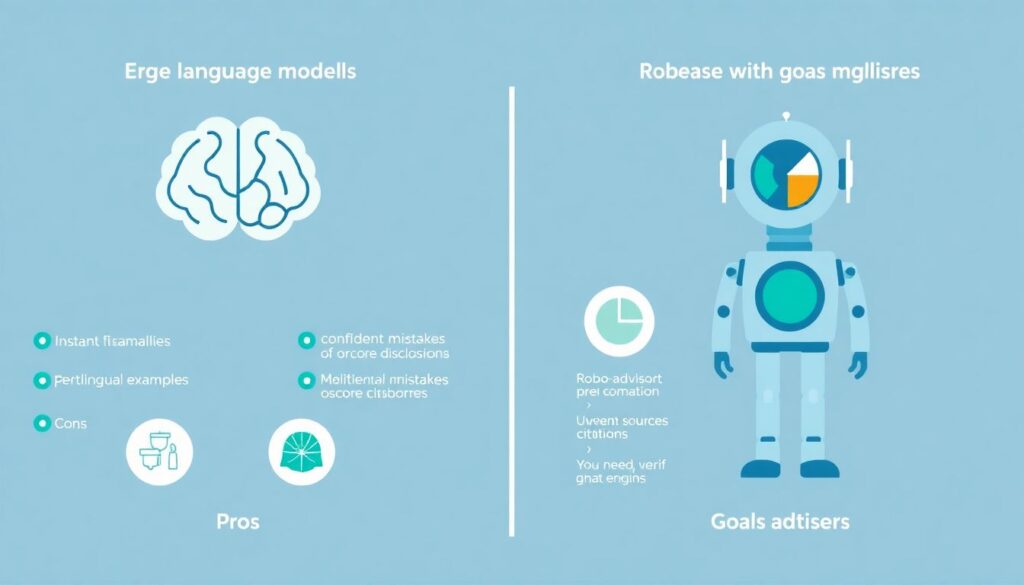
– Large language models: Pros — instant analogies, personalized examples, multilingual explanations of obscure disclosures. Cons — confident mistakes (hallucinations) and uneven source citations; you need verification for high‑stakes calls.
– Robo‑advisors with goals engines: Pros — automatic rebalancing, tax‑loss harvesting, and nudges keyed to your milestones. Cons — model drift in odd markets and limited customization unless you pay up.
– Open banking and real‑time payments: Pros — unified cashflow views and instant transfers help you manage liquidity in the moment. Cons — API outages and security hygiene vary by provider, so consent screens deserve your full attention.
Bottom line: tech reduces friction, but judgment still carries the load.
How to pick your toolkit without drowning in options
Start by matching tool to task: if you’re decoding credit offers, prioritize clear summaries of fees and “what changes your APR” simulators; for long‑term saving, look for compound‑interest calculators that let you tweak deposit frequency and inflation. Prefer platforms that show their assumptions, let you export data, and offer a “cite sources” toggle so you can audit claims.
Keep the human loop: a fee‑only advisor or a smart friend can sanity‑check an AI‑generated plan in fifteen minutes.
Current trends shaping the jargon in 2025
– “Personalized APR” is spreading as lenders use richer data under tighter privacy rules; more apps now answer not just what is APR but how your behavior nudges it up or down in real time.
– Compounding is getting visual: savings and debt tools animate daily accruals, making what is compound interest feel tangible rather than abstract.
– ROI talk has matured: teams increasingly ask what is ROI alongside “time to break even,” scenario ranges, and carbon or AI‑safety impacts, especially as ESG 2.0 shifts from virtue signaling to verifiable metrics.
– Tokenization moved from headlines to boring utility — fractional real‑world assets exist, but due diligence still looks like old‑school credit analysis.
– Education is “ambient”: search, banking apps, and even receipts embed clickable financial terms explained so you learn at the moment of decision.
In short, clarity wins the day, and the tools finally meet people where they are.
Comparing approaches: rules of thumb vs. models vs. advisors
Rules of thumb (like 50/30/20 or “three months of expenses”) are quick, forgiving, and good for getting unstuck; models (Monte Carlo, risk‑adjusted ROI) handle uncertainty better; human advisors integrate nuance — taxes, visas, healthcare, family. The trade‑off is speed versus precision versus cost.
When in doubt, start simple, then layer sophistication only when it changes the decision.
Practical next steps
– Translate one bill or offer a week into plain English and save it to your personal finance glossary; repetition cements understanding and exposes sneaky fees.
– Automate small wins: round‑ups to savings, scheduled investments, and alerts when APRs or fees change.
– Use verification habits: ask tools to show calculations, confirm with a second source, and note assumptions (tax rate, inflation, compounding frequency).
That’s the playbook: learn just enough vocabulary to see how money moves, use tech that explains rather than obscures, and keep your choices aligned with real‑world goals.