
Context and scope: why access matters in dispersed territories
Rural households and microenterprises operate in thin markets with patchy infrastructure, so the cost of finding, understanding, and using financial products is disproportionately high. Effective financial literacy programs for rural communities therefore must integrate education with last‑mile delivery, not just distribute brochures. When training is paired with practical, low‑friction actions—such as opening a savings wallet on the spot or role‑playing debt negotiations—adoption and retention rise. The baseline is clear: literacy is not an abstract curriculum; it is a sequence of informed decisions aligned with seasonal cashflows, local norms, and risk exposure to weather and commodity price shocks.
Comparing delivery approaches: embedded, broadcast, and digital-hybrid
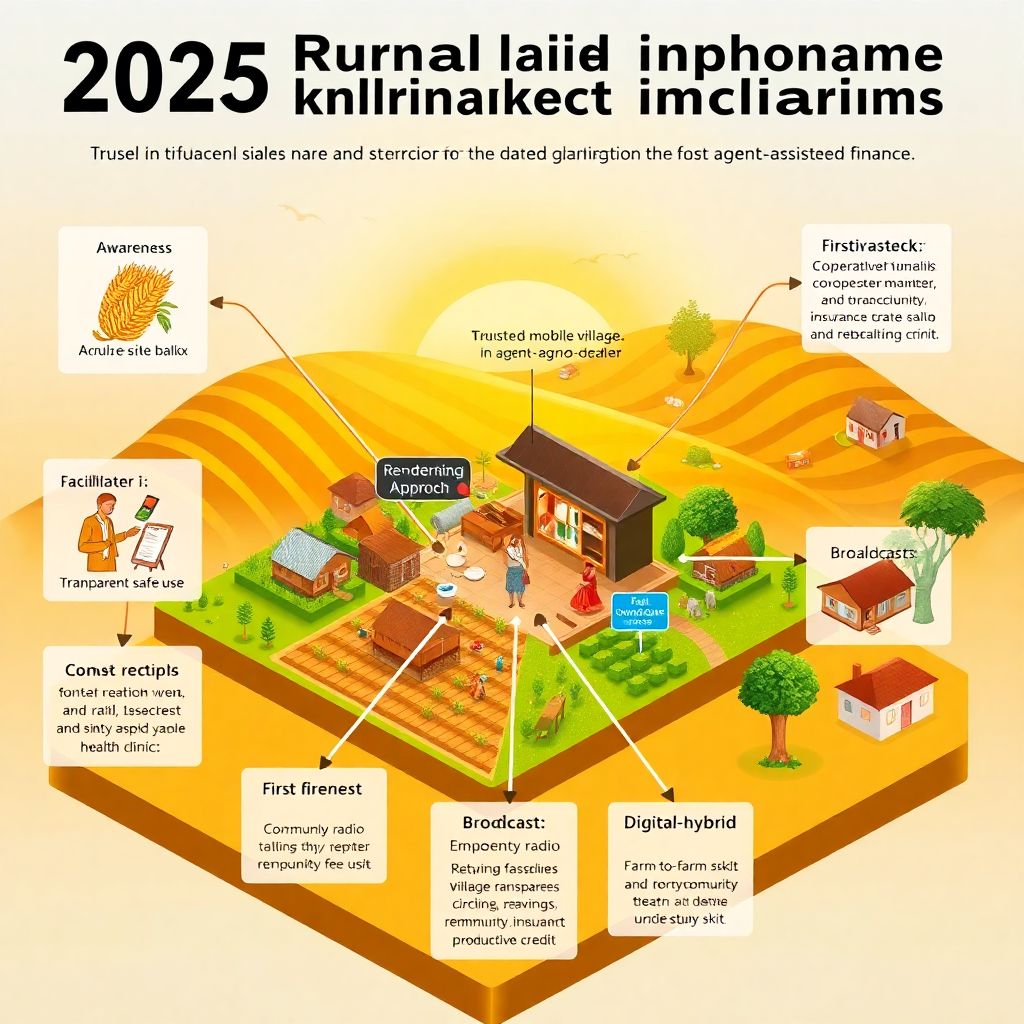
There are three dominant architectures. First, embedded approaches tie coaching to real transactions via producer cooperatives, input dealers, or health clinics; they excel at trust but scale slowly. Second, broadcast methods (radio call‑ins, community theater, farm‑to‑farm demos) create reach and social proof, yet struggle with personalization. Third, digital‑hybrid models blend agent networks with apps and USSD menus; they scale cheaply but depend on connectivity. In 2025, the most resilient mixes stitch together farmer field schools with mobile banking services for rural areas, enabling on‑site KYC and immediate wallet activation while preserving in‑person troubleshooting through trusted agents.
Technology: advantages, constraints, and design trade-offs
Technologies lower marginal costs and enable data‑driven nudges, but they import new risks. Advantages include 24/7 access, automated reminders synced to harvest calendars, and vernacular content via IVR for low‑literacy users. Constraints include handset fragility, intermittent power, and gendered phone access. Privacy is non‑trivial: poorly governed data sharing can expose vulnerable borrowers to predatory offers. For credit‑linked curricula, microfinance programs for rural entrepreneurs should decouple learning milestones from loan approval to avoid rote box‑ticking. Technically, offline‑first apps, USSD for 2G coverage, small-footprint video, and secure, consent‑driven data flows are essential to keep friction low and trust high.
Decision framework: how to choose an intervention stack

Selecting a model should be a structured exercise rather than a guess. Below is a pragmatic, field-tested sequence that program owners can adapt without bloating overheads or compromising outcomes in dispersed geographies.
1) Diagnose demand and constraints with granular segmentation. Map household cash cycles, literacy levels, and device access by village cluster, not just district averages. If connectivity is poor and women’s phone access is limited, prioritize agent‑assisted channels, IVR hotlines, and community cohorts over app‑only rollouts. Tie the curriculum to concrete goals—input planning, post‑harvest storage, or eligibility for rural small business grants and loans—so each module leads to a specific transaction that reinforces learning.
2) Assemble a minimal viable stack aligned to incentives. Pair one trusted local partner (cooperative, clinic, or agro‑dealer) with a regulated e‑money provider. Build simple pathways: save‑to‑reach‑goal, insure‑to‑protect‑asset, borrow‑to‑expand‑inventory. Bake in safeguards such as transparent fee disclosures, opt‑in data consent, and repayment simulations under price‑shock scenarios. Where handset turnover is high, prefer USSD/IVR and agent notebooks that sync when online, rather than brittle, update‑heavy apps that break during planting season.
3) Instrument and iterate with outcome metrics, not vanity counts. Track indicators like durable savings balances across seasons, on‑time repayment post‑shock, and uptake of productive assets. Use A/B tests for message framing and timing, but convert insights into facilitator playbooks. If participants aim to access value chains or formal credit later, integrate referrals to accredited providers that handle rural small business grants and loans and document the handoff so learners are not stranded between institutions.
Accessing resources: financing channels and navigation tips
Resource access typically spans four lanes: savings mechanisms, risk pooling, credit, and transfer programs. For liquidity smoothing, rotating groups and basic wallets reduce travel time and leakage; pairing them with escrow features helps households earmark funds for inputs. On risk, crop and livestock covers only work when claims are timely and explanations are in plain language; teach payout logic alongside agronomic practices. For enterprise growth, blend mentorship with vetted microcredit, and where possible, ladder clients from group lending to individual lines as record quality improves. Do not overlook rural small business grants and loans administered by subnational bodies—they can co‑finance storage, irrigation, or solar dryers when proposals demonstrate cashflow discipline learned through the training.
2025 trends and forecast: where the field is heading

Several shifts define 2025. First, lightweight AI tutors embedded in IVR and WhatsApp clones provide conversational guidance in local languages, with offline caching for weak networks. Second, interoperability is improving: mobile money rails connect to cooperative cores, making transfers and audit trails seamless. Third, satellite‑enabled weather feeds inform just‑in‑time messages about planting, pest risk, and index insurance triggers. Finally, compliance is tightening, with regulators demanding explicit consent receipts and grievance hotlines. Expect convergence: financial literacy will increasingly bundle with agronomy, energy access, and health financing, turning curricula into cross‑sector service gateways that reduce search costs at the edge.
Policy and institutional levers: aligning incentives for inclusivity
Public policy can amplify or undermine outcomes. Streamlined e‑KYC using national IDs reduces onboarding friction while keeping AML/CFT intact; exemptions for low‑risk wallets help first‑time users transact. Targeted government financial assistance for rural families—school fee stipends, climate‑shock relief, nutrition top‑ups—works best when disbursed into wallets that are covered in the training, with grievance redress integrated. Meanwhile, well‑supervised microfinance programs for rural entrepreneurs should report to credit bureaus using privacy‑preserving IDs to avoid over‑indebtedness, and they should publish effective interest rates so borrowers can compare products without specialist help.
Risks, ethics, and safeguards in practice
Even well‑intentioned programs can create harm if they push products ahead of comprehension. Key risks include hidden fees, coercive cross‑selling, and social pressure within groups. Ethical baselines should mandate clear disclosures, simple comparison tools, and cooling‑off periods before loan acceptance. Grievance mechanisms must be accessible via toll‑free IVR and agent escalation logs. Where mobile banking services for rural areas are central, ensure SIM‑swap protection and shared‑phone protocols to protect women’s privacy. Embedding third‑party audits and publishing outcome dashboards create accountability and a feedback loop that communities can trust.
Practical access pointers for households and microenterprises
For households seeking liquidity, start with a wallet that supports goal‑based sub‑accounts and low‑fee cash‑in points; add basic insurance that aligns with your main risk (health or weather). For microenterprises, align financing with inventory turns: use short‑tenor working capital before considering asset loans. Explore cooperatives and accredited lenders that can channel rural small business grants and loans when you meet documentation thresholds learnt in training. Keep paper and digital records; they unlock better terms. If a product feels opaque, pause and request a plain‑language explanation and a fee breakdown before signing.
Bottom line: an integrated pathway to resilient adoption
Sustainable literacy in rural settings looks like a pipeline, not a workshop: awareness, first transaction, repeated safe use, and progression to more sophisticated tools as incomes stabilize. When local facilitators, interoperable rails, and responsive support converge, participants graduate from basic savings to insurance and productive credit without spikes in default. With the continuing push toward interoperable wallets, agent professionalism, and evidence‑based messaging, access will deepen, and the promise of equitable growth will feel less like a pilot and more like standard practice across dispersed geographies.