
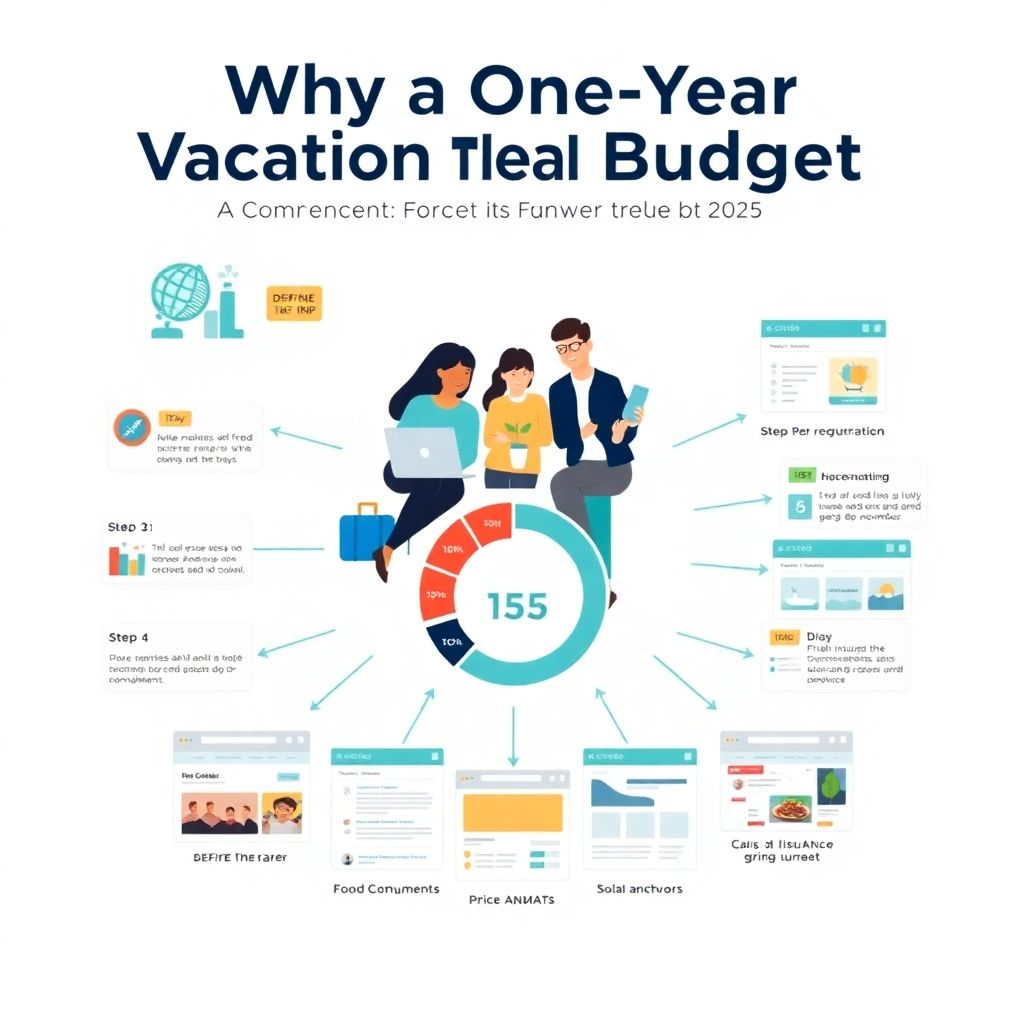
Why a One-Year Vacation Budget Is Smarter Than Ever in 2025
Planning a trip a year ahead used to sound obsessive. Now, with airfare algorithms, dynamic hotel pricing, and booking windows that change weekly, giving yourself 12 months isn’t overkill, it’s risk management. In 2025, ticket prices can jump 20–30% in a week due to fuel surcharges or demand spikes, and a bit of planning time is one of the few tools you still control. When you understand how to budget for a vacation a year in advance, you’re not just setting money aside, you’re building a financial buffer against all that volatility, instead of praying that “future you” will somehow be richer and calmer.
If you look back a bit, travel budgeting was far simpler. In the 1980s–1990s many families just put “summer vacation” on a physical envelope, dropped in cash throughout the year, and drove somewhere within a few hours’ radius. No dynamic pricing, no resort fees, no micro‑charges for seat selection. After 2000, low-cost airlines, online agencies and later mobile apps made flights cheaper but more unpredictable. Post‑2020, with pandemic shocks and then inflation, the game changed again: flexible tickets, higher demand, and price swings pushed people toward structured planning tools instead of gut feelings. In 2025, a good vacation budget is closer to a mini project plan than to a casual wish list.
—
Step 1. Define the Trip Before You Define the Numbers

Before spreadsheets, apps and calculators, you need a concrete scenario. “Two weeks somewhere warm” is not a plan; it’s a mood. Your costs depend on destination, season, travel style and headcount. A travel budget planner for family vacation in Italy in June will look very different from a solo digital‑nomad adventure in Thailand in November. The more specific your trip outline is, the less likely you are to underestimate expenses by 30–40%—which is exactly what usually happens when people skip this step and then are surprised by local transport, city taxes or paid attractions on site.
Clarify the core parameters
Write down the answers to a few essential questions, like you’d fill out a project brief. Treat this as a design phase for your future holiday, not as a vague Pinterest board. When details are written, it becomes harder to lie to yourself about costs, and easier to use any vacation savings plan calculator or app later.
– Who is going? Adults, kids, older relatives, friends with different budgets?
– Where exactly? Country, region, typical city or island, not just “Europe” or “Asia”.
– When? Month and approximate dates, plus flexibility: ±3 days, ±1 week, or fixed?
– How long? Door-to-door number of days, not just “7 nights in a hotel”.
– What’s your style? Budget, mid‑range, or “one-time splurge but still controlled”?
Example from practice: a couple in Chicago plans “a Mediterranean trip next summer.” Once they specify: “10 days in late May, flying from Chicago to Rome, then trains to Florence and Venice, mid‑range hotels, 1–2 paid tours, no car rental,” their potential cost range narrows from $2,000–$8,000 to something like $4,000–$5,500. That gap is the difference between guesswork and structured budgeting.
—
Step 2. Break the Trip Into Cost Components

Once your scenario is clear, split the vacation into cost buckets. Historically, people mentally grouped everything into “travel, hotel, food, other,” which made overruns nearly guaranteed. Modern trip planning borrows from project management: you tag and isolate the main spending categories and then add a realistic “contingency” buffer. The process is more technical, but it’s what turns a dream into a controlled financial plan you can track over twelve months.
Standard budget categories
Think in categories that are concrete enough to price, but not so granular that you drown in micro‑line items. For a 10–14 day international trip in 2025, the usual budget structure looks like this:
– Transport: international flights, trains, local public transport, taxis, fuel, tolls, parking.
– Accommodation: hotels, rentals, resort fees, cleaning fees, city taxes.
– Food & drinks: restaurants, groceries, snacks, coffee, occasional bar expenses.
– Activities: museums, tours, excursions, theme parks, equipment rental.
– Insurance & documents: travel insurance, visas, vaccinations (if required), passport renewal.
– Gear & prep: luggage, travel adapters, clothing, tech accessories, SIM/eSIM.
– Buffer: unexpected costs, price increases, minor emergencies.
Technical block — Target ranges for a mid‑range international trip (2025):
For a typical 10‑day moderate‑comfort trip from North America to Europe for two adults in 2025, a realistic structure often looks like this, assuming economy flights and 3‑star hotels in a major city: flights $1,000–$1,600 total (depending on season and booking timing), accommodation $100–$180 per night, so $1,000–$1,800 overall, local transport $150–$300, food $70–$120 per day for two (so roughly $700–$1,200), activities $200–$500, insurance and paperwork $80–$200, and a 10–15% contingency buffer on top of the subtotal. These are reference bands, not quotes, but they give you an order of magnitude before you deepen the research.
—
Step 3. Research Realistic Price Anchors
In the past, travel budgeting used brochures and a travel agent’s word. In 2025, you have near‑real‑time data, which is both a blessing and a trap. It’s easy to get lost comparing thirty hotel tabs and five airfare aggregators and still not have a hard number. To use the available data smartly, you need “price anchors”: concrete examples that define the likely cost level for each category.
Start by checking airfares for your rough dates using 2–3 different tools. Look for median prices over a month, not just today’s promotional rate. Many users now combine an aggregator with the native airline site to identify any surcharge differences. For accommodation, pick 3–4 properties per destination area at your desired quality level, and average their nightly rates. Do the same with restaurant menus, local transit passes and typical attraction tickets. This method eliminates wishful thinking—like assuming you’ll “cook at home” daily in a city apartment, then eating out half the time anyway.
Technical block — Using numbers instead of feelings:
When researching, avoid relying on a single “too good to be true” deal as your basis. For instance, if flights show $650, $710, $740, $760 and suddenly a $430 outlier with extreme layovers or baggage restrictions, use something around $700–$750 as your flight anchor. For hotels, if three 3‑star places cluster at $130–$150 per night, but there’s one at $89 with awful reviews and poor location, anchor at $140 rather than at the cheapest point. Consistently choosing the low edge of the range is the most common source of budget blowouts.
—
Step 4. Turn the Total Budget Into a Monthly Savings Target
Once you have a realistic total cost, the central question becomes how much to save each month for vacation without strangling your current life. This is where you move from vague intention to a measurable savings rate. The good news of planning a full year ahead is that time smooths out the pain. Even a $4,000 family trip becomes manageable if split across 12–14 months instead of stuffed into the last 60 days.
Say your researched budget for a beach holiday for a family of four next summer is $5,400, including flights, a rental, food, and a 15% buffer. If you have 12 months, you need to set aside $450 per month on average. With 14 months, that drops to about $385. If this number clearly doesn’t fit your current cash flow, you don’t give up on the idea; instead, you either extend the horizon, slightly downgrade the trip specs, or deliberately cut some expenses in your everyday budget. The important part is seeing this as an explicit trade‑off, not as a shortfall that magically fixes itself later.
Technical block — Simple math vs. a vacation savings plan calculator:
The base formula is straightforward:
Required monthly saving = (Total trip budget – Money already available) ÷ Number of months left.
The nuance comes from irregular expenses (bonuses, tax refunds, seasonal income). Dedicated tools and any decent vacation savings plan calculator let you simulate scenarios like “put $300 per month from salary, plus 50% of my annual bonus” or “frontload savings more heavily in the first half of the year.” This matters if your income is lumpy or if specific months are always tighter (holidays, school fees, etc.).
—
Step 5. Choose Tools: Apps, Accounts, and Automation
In 2025, nobody is limited to envelopes and paper charts, unless they want that on purpose. The tech ecosystem around personal finance is mature: you can track, forecast, and even partially automate the entire process. That said, tools only help if they fit how your brain works. If you hate categorizing every coffee, you won’t suddenly become a monk of micro‑tracking just because the icon set is pretty. Your setup should reduce friction, not add rituals.
Many people now use a separate savings account or digital “space” labeled “Summer 2026 Trip” and set up an automatic monthly transfer on payday. This is basic behavioral finance: you hide the money from yourself before you can spend it. On top of that, you can integrate one of the best budgeting apps for vacation savings to monitor whether you’re on pace. Some apps let you define the goal amount, deadline, and then show a progress bar and daily “available to spend” without harming the plan. This visual feedback loop replaces anxiety with data.
Technical block — Minimal viable system using apps:
1) Open a dedicated high‑yield savings account or digital sub‑account to isolate the vacation fund. 2) Use your primary budgeting app (or a specialized travel app) to register the vacation as a separate goal with a target amount and end date. 3) Turn on automatic transfers that cover at least 80–90% of the required monthly savings. 4) Manually top up the rest whenever you receive irregular income. This way, even without constant attention, most of your plan runs on autopilot.
—
Step 6. Use a Travel Budget Planner for Family Vacation Scenarios
Families face more complexity: school schedules, different appetites, varying comfort expectations, and the sheer cost of multiplying everything by four or five. That’s where a dedicated travel budget planner for family vacation planning offers real value. These planners let you break down child‑specific costs—kids’ tickets, discounted attraction entries, extra snacks, an extra bedroom or a bigger rental—and avoid the classic trap of “kids fly cheap, so it’ll be fine,” only to realize at the airport that fees and luggage doubled your transport expense.
A practical trick in real life is to pre‑simulate two or three variants of the same trip: the “ideal version,” a “lean version,” and a “backup local alternative.” For instance, a family considers 10 days in Costa Rica as their primary plan, an 8‑day version with fewer paid tours as Plan B, and a 7‑day domestic national park road trip as an emergency fallback. This doesn’t mean they are pessimists; it’s risk design. If income unexpectedly drops mid‑year, they can pivot to Plan B without feeling like the dream collapsed—because it was pre‑modeled, not improvised in panic.
—
Step 7. Track Progress and Adjust Quarterly
A year is long enough for life to change: job moves, rent hikes, car repairs, health surprises. The strength of a one‑year vacation budget is not in rigid obedience, but in flexibility plus regular check‑ins. Instead of constantly worrying, you can set a quarterly review and ask one question: “Are we on track for this trip under current income and expenses?” That simple discipline has saved more vacations than miracle windfalls ever did.
Every three months, compare your actual savings to the planned trajectory. If you’re ahead, you can either upgrade a component (a slightly better hotel, one more paid excursion) or simply enjoy the margin of safety. If you’re behind, you reconsider scope: maybe travel in shoulder season instead of peak, shave two days off the trip, or cut some everyday discretionary expenses temporarily. The point is to react in March or June, not in the week before departure when most options are locked in and prices are higher.
Technical block — Variance management:
A simple but effective technique is to define acceptable variance. For example, if by month 6 you planned to have $2,400 saved and you actually have at least $2,200 (less than 10% behind), you treat it as “on track” and make small tweaks. If you’re below 20% of the target for that point, you either adjust the monthly transfer or explicitly downgrade at least one major trip component. This kind of threshold rule spares you emotional overreactions to minor fluctuations while still forcing action when things clearly drift.
—
Step 8. Micro‑Optimization: Everyday Habits That Feed the Fund
A one‑year horizon is excellent for habit‑level tweaks. You don’t have to become an ascetic; you just need to redirect some small recurring leaks. Historically, families in the 1970s–1980s would literally keep a vacation jar in the kitchen and drop change into it. With digital payments now dominant, you can replicate the idea algorithmically: round‑up transfers, “save the change” features, or weekly auto‑sweeps of leftover checking account balances into the trip fund. Over 12 months, these minor flows add up to hundreds of dollars.
Consider aligning a few everyday costs with your goal rather than trying to power through on willpower alone. For example, if your monthly streaming and “small subscription” stack is $80–$100, trimming even $30 and earmarking that for the vacation gets you an extra $360 per year, often without a feeling of real loss. If you add a conscious “eating out only twice a week instead of three times” rule, that might free another $100–$150 monthly in many cities. The key is to label the savings mentally as “trip money,” not as generic savings—our brains are more willing to cooperate when a vivid reward is attached.
– Cancel or pause low‑value subscriptions and move the savings automatically to the vacation account.
– Introduce one or two “no‑spend evenings” per week devoted to trip planning, movies at home or free local activities.
– Use cash‑back or rewards cards strategically: not to justify extra spending, but to accumulate points toward flights or hotels you already budgeted for.
—
Step 9. Leverage Digital Helpers Without Overcomplicating

Because we’re in 2025, everyone assumes that the solution to every planning problem is “just use another app.” In reality, more tools can mean more friction if they’re not chosen carefully. The smart approach is lightweight integration: pick one core budgeting tool, one goal‑tracking tool (sometimes it’s the same app), and optionally a simple vacation savings calculator or spreadsheet for “what-if” simulations. That’s enough for most people; the rest is overengineering.
When experimenting with tools, check how easily they fit into your existing routine. If you already manage your finances in one app, see whether it can create a dedicated goal for the trip instead of forcing yourself into a second ecosystem. Some of the best budgeting apps for vacation savings now offer travel‑specific templates: pre‑labeled categories for flights, lodging, and activities, along with alerts that warn you if your bookings exceed the planned cap. Used correctly, these alerts act like a future version of you tapping your shoulder and saying, “We can book this, but know that we’re stealing from next month’s restaurant budget on the trip.”
– Prioritize automation (scheduled transfers, automatic rule‑based savings) over manual discipline.
– Avoid duplicating data in too many places; centralize numbers in one primary “source of truth.”
– Back up your plan in a simple format (e.g., a note or email to yourself) so the trip details survive if an app changes or shuts down.
—
Step 10. Keep the Plan Human: Motivation, Not Just Math
Purely technical plans often fail because they ignore emotion. A vacation is not a tax: you’re not paying a bill, you’re investing in a set of future experiences. Historically, that’s why even quite modest‑income households prioritized some kind of annual break—whether it was a simple trip to a nearby lake in the 1950s or a road trip in the 1980s. The break in routine mattered, and people justified saving for it even when other things were tight. Your one‑year budget will hold better if you make that connection explicit, not just implied.
One simple trick: visually track progress not only in dollars but in “pieces of the trip.” When you hit the amount earmarked for flights, mark them as “bought in your head,” even if you haven’t booked yet. When the accommodation chunk is saved, celebrate with a deliberate planning session to pick your top three options. Turning the savings milestones into small events keeps the plan alive for an entire year. Instead of “I can’t buy this gadget now,” the narrative becomes “We’re 70% of the way to two weeks in Spain next May,” which is far easier to accept.
—
Putting It All Together: A One-Year Roadmap
To sum up, learning how to budget for a vacation a year in advance is really about running a controlled mini‑project: define the scope, estimate realistically, convert the total into monthly targets, and install systems that protect the plan from everyday chaos. Use real price anchors rather than optimistic guesses, lean on a mix of simple math and a vacation savings plan calculator when needed, and keep your tools minimal but reliable.
In 2025, the landscape is noisy—prices fluctuate, offers come and go, algorithms tweak fares overnight. A solid one‑year budget won’t eliminate that noise, but it will insulate you from it. Instead of scrambling at the last minute or going into debt for a trip you can’t truly afford, you arrive at the departure date with your flights paid, your accommodation funded, and a clear idea of what you can comfortably spend on the ground. That’s not just better money management; it’s the difference between a tense, guilt‑ridden holiday and a genuinely restorative break.