
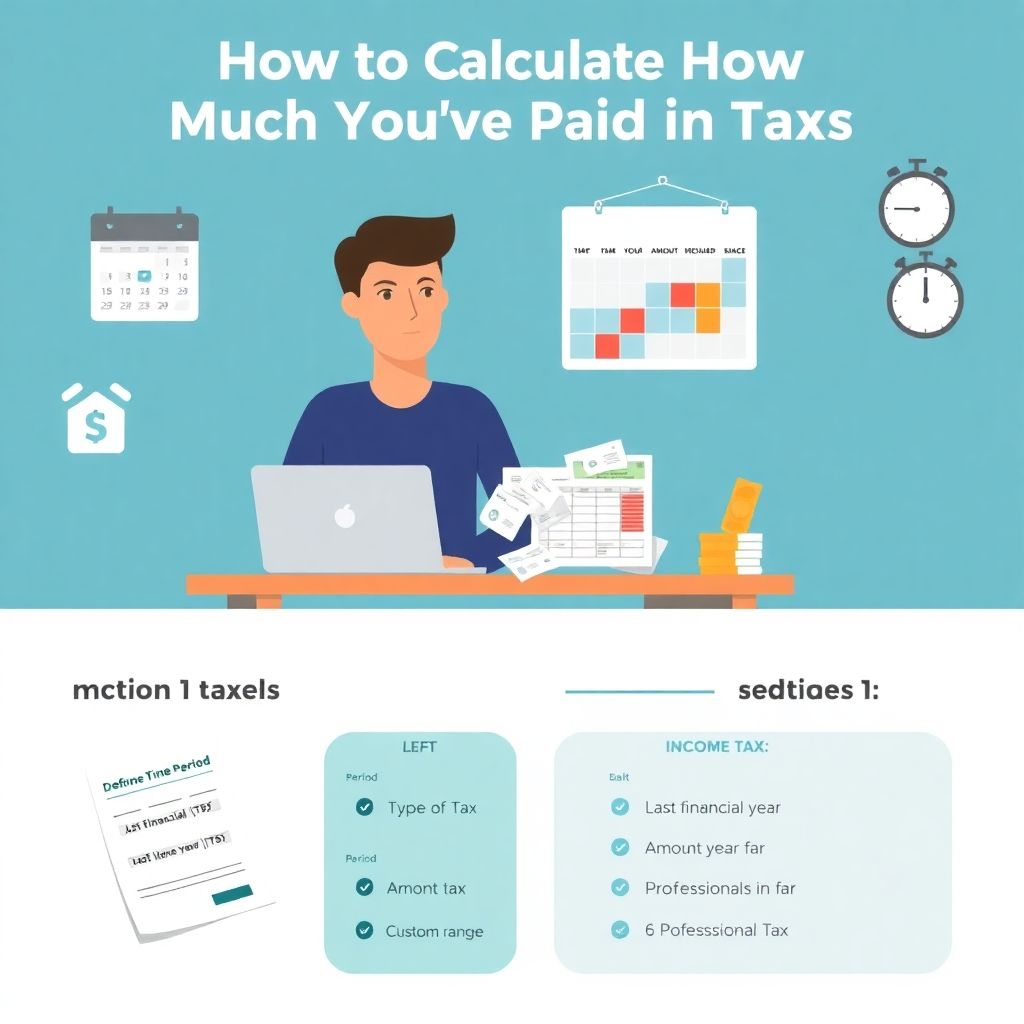
How to Calculate How Much You’ve Paid in Taxes (GST, Property, Water, Income, PF and More)
Understanding how much of your money actually goes to taxes can be confusing, especially when payments are scattered across different bills, payslips and annual returns. Yet with a bit of organisation you can get a surprisingly accurate picture of your total tax burden over a year.
Below is a step‑by‑step way to estimate how much you’ve paid in various taxes such as GST, property tax, water tax, income tax, PF‑related deductions and other common charges.
—
1. Start by Defining the Time Period
First decide the period you want to analyse:
– Last financial year
– Current calendar year so far
– A custom range (e.g., last 6 months)
This matters because:
– Some taxes are paid once or twice a year (property tax).
– Others are continuous and appear every month (income tax, PF, water charges, GST on purchases).
Create a simple sheet (paper, spreadsheet, or notes) with columns for:
– Type of tax
– Period covered
– Amount paid
– Source (bill, payslip, statement)
This will help you avoid counting anything twice.
—
2. Tracking Income Tax
Income tax is usually the easiest part to calculate, especially if you are salaried.
If you are salaried:
– Check your monthly payslips.
– Look for lines such as:
– Income Tax (TDS)
– Professional Tax (if applicable)
– Add these monthly deductions for the full year.
In many countries, your employer also issues an annual tax summary at the end of the year. This document:
– Shows the total salary paid.
– Lists the total income tax deducted.
– Sometimes includes social security or similar contributions.
Use that annual figure as your reference for the year. If you’ve changed jobs mid‑year, collect the summary from each employer and add them together.
If you are self‑employed or have business income:
– Refer to your tax returns for the year and the payment receipts you received when paying advance tax or self‑assessment tax.
– Add together:
– Advance tax payments
– Self‑assessment tax
– Any tax deducted at source shown in your annual tax statement
The total will give you a good estimate of your income tax paid for that period.
—
3. Calculating PF and Similar Mandatory Contributions
Provident Fund (PF) or similar retirement/social security schemes are not generally “taxes” in the strict sense, but they are compulsory deductions, and many people want to count them when analysing how much money is effectively locked away by law.
To calculate:
– Revisit each monthly payslip.
– Identify:
– Employee PF contribution
– Employer PF contribution (if shown)
If you only want to know how much you personally paid, only add the employee share. If you want to know the total amount going into the system on your behalf, add both employee and employer contributions.
Multiply the monthly PF deduction by the number of months you worked within your chosen time range, or just sum the exact amounts if you have all payslips.
—
4. Estimating GST Paid on Purchases
Goods and Services Tax (GST) is embedded in most invoices for goods and many services. The challenge is that it’s spread across every purchase rather than paid in one big lump.
If you are a consumer (not claiming input credit):
You can calculate GST in two ways:
1. Using detailed invoices
– For big, infrequent purchases (electronics, furniture, appliances), check your invoices.
– Most invoices show:
– Base price
– GST rate
– GST amount
– Add up the GST amount from each invoice.
2. Using an approximate method for daily spending
– For frequent, small purchases where you don’t keep bills (groceries, restaurants, basic services), an exact calculation is unrealistic.
– Estimate:
– Rough monthly spending in categories that usually include GST (eating out, online orders, shopping).
– Average GST rate (for many items this may be 5%, 12% or 18%, depending on your country’s slab system).
– Example:
– If you spend 20,000 units of currency a month on GST‑taxable items, and you estimate an average 12% GST:
– Tax component ≈ 20,000 × (12 / 112) ≈ 2,143
– Adjust the formula depending on whether prices are quoted inclusive or exclusive of tax in your country.
Do this for each major spending category and multiply by 12 for a yearly estimate.
If you are a business registered under GST:
– Look at:
– Total GST you collected from customers.
– Total GST you paid on your purchases (input tax credit).
– Your net GST outflow is:
– GST paid in cash to the government
– plus any GST not claimable as credit.
However, if your goal is just to understand your personal “tax burden” on consumption, focus on the portion of GST that you ultimately could not claim back.
—
5. Property Tax: Annual or Half‑Yearly
Property tax is usually paid to local authorities, either annually or semi‑annually.
To calculate:
– Look at your property tax receipts for the year.
– If you own more than one property, collect the receipts for each.
– Sum all payments made during your chosen period.
Important details:
– Include any penalties or interest only if you want to see your total out‑of‑pocket cost.
– If you are sharing ownership, decide whether to count only your share or the full tax for that property.
If you pay property tax through a home loan escrow or similar arrangement, check your annual mortgage or loan statement, which often shows property tax disbursed on your behalf.
—
6. Water Tax and Other Municipal Charges
Water tax, sewerage charges, and other local levies are often:
– Billed monthly, bi‑monthly, or quarterly.
– Embedded within your utility bill.
To work out how much you paid:
1. Collect all water or utility bills for the period.
2. Identify the separate “tax” or “cess” components, if they are itemised.
3. If not itemised, check if the bill explains the tax rate, then calculate:
– Base service charge vs. tax portion.
4. Add all tax components across the year.
If your water tax is charged once a year, similar to property tax, use the receipt for that payment.
You can apply the same method to:
– Garbage collection fees or environmental cess
– Urban development charges
– Other municipal levies that appear on your bills
—
7. Don’t Forget Smaller or Less Visible Taxes
Beyond the obvious ones, there are often several smaller charges that function as taxes or quasi‑taxes. Depending on your country, this could include:
– Road tax or vehicle tax (paid when buying a vehicle or annually).
– Toll charges for highways and bridges (which are, in effect, user‑based taxes).
– Stamp duty and registration charges on property or major asset transactions.
– Excise duties embedded in the price of fuel, alcohol, or tobacco products.
– Special cesses or surcharges added on top of existing taxes.
If you want a very thorough picture:
– Include big, one‑time payments (like stamp duty or vehicle registration) in your yearly total.
– For fuel and tolls, you can:
– Check card or wallet statements for total annual spend.
– Apply an estimated tax percentage based on typical fuel tax structure in your country.
—
8. Combining Everything into One Total
Once you’ve gathered all the data, summarise it clearly. A simple structure might look like this:
– Income tax: [amount]
– Professional tax (if any): [amount]
– Employee PF contribution (if you choose to count it): [amount]
– GST (estimated total on consumption): [amount]
– Property tax: [amount]
– Water tax and other utility‑related taxes: [amount]
– Vehicle/road taxes and tolls: [amount]
– Stamp duty and registration charges (if applicable in that year): [amount]
– Any other statutory levies: [amount]
Then calculate:
– Total tax paid in the period = Sum of all the categories you decided to include.
You can also:
– Divide this total by your total income for that period to get an effective tax rate.
– Or divide by 12 to see how much tax, on average, you effectively pay per month.
—
9. How Precise Can You Get?
Absolute precision is difficult because:
– Many taxes are embedded in prices and not always broken out.
– You may not keep every small bill or receipt.
– Tax systems often mix fees, surcharges and cesses in a complicated way.
However, you can still get:
– A highly accurate figure for formal, documented taxes (income tax, PF, property tax, municipal bills).
– A reasonably good estimate for consumption‑related taxes (GST, fuel excise, tolls).
It’s helpful to treat this as an estimate rather than an exact audit, unless you’ve tracked every single transaction from the start of the year.
—
10. Setting Up a Simple Tracking System for the Future
If you want to know these numbers more easily next year, it’s worth setting up a light‑weight system now:
– Keep digital copies of big‑ticket invoices
Save PDF or photo copies of invoices for electronics, appliances, rent with GST, insurance, and major services. File them by year.
– Save all annual statements
Store salary summaries, tax certificates, loan statements and investment reports together in one folder.
– Log major tax payments as they happen
Each time you pay property tax, water tax, vehicle tax, or stamp duty, note the date, type of tax, and amount in a simple spreadsheet or note.
– Tag transactions in your banking app or budget tool
Many tools let you label expenses. Tag obvious taxes so you can quickly filter and total them later.
With these habits, next year’s “how much did I pay in tax?” won’t require digging through months of paperwork.
—
11. Deciding What to Count as “Tax”
One important conceptual question: what exactly do you want to measure?
Some people only want:
– Direct, explicit taxes (income tax, GST, property tax).
Others also want to include:
– Mandatory social contributions (PF, social security).
– Fees that behave like taxes (road taxes, tolls, environmental fees).
Before you start, decide:
– Whether to include PF and similar contributions as “tax” or treat them separately.
– Whether to focus only on what you personally pay, or also include what your employer or others pay on your behalf (like employer PF contributions).
Clarity on this point will make your final total more meaningful and easier to compare year to year.
—
12. What You Can Do With This Information
Once you’ve calculated your total tax outflow, it can be used in several useful ways:
– Budgeting:
Knowing your real annual tax burden helps you plan net, take‑home cash more accurately.
– Tax planning:
You can see whether you’re using all available deductions and exemptions. If your income tax is high, you might want to explore legal ways to optimise it.
– Lifestyle and consumption choices:
Understanding how much tax is embedded in certain purchases (like fuel or luxury items) can influence how you spend.
– Negotiation and career decisions:
When considering job offers, you can look at net, after‑tax income instead of just gross salary.
The goal is not only to satisfy curiosity, but also to make more informed financial decisions based on how much of your money ultimately goes to taxes and mandatory charges.
—
By systematically going through income, payroll deductions, property‑related charges, utilities, and consumption taxes, you can build a clear, structured view of how much you actually pay in taxes in a year. It requires some initial effort, but once you’ve done it once, repeating and refining the calculation in future years becomes much easier.