
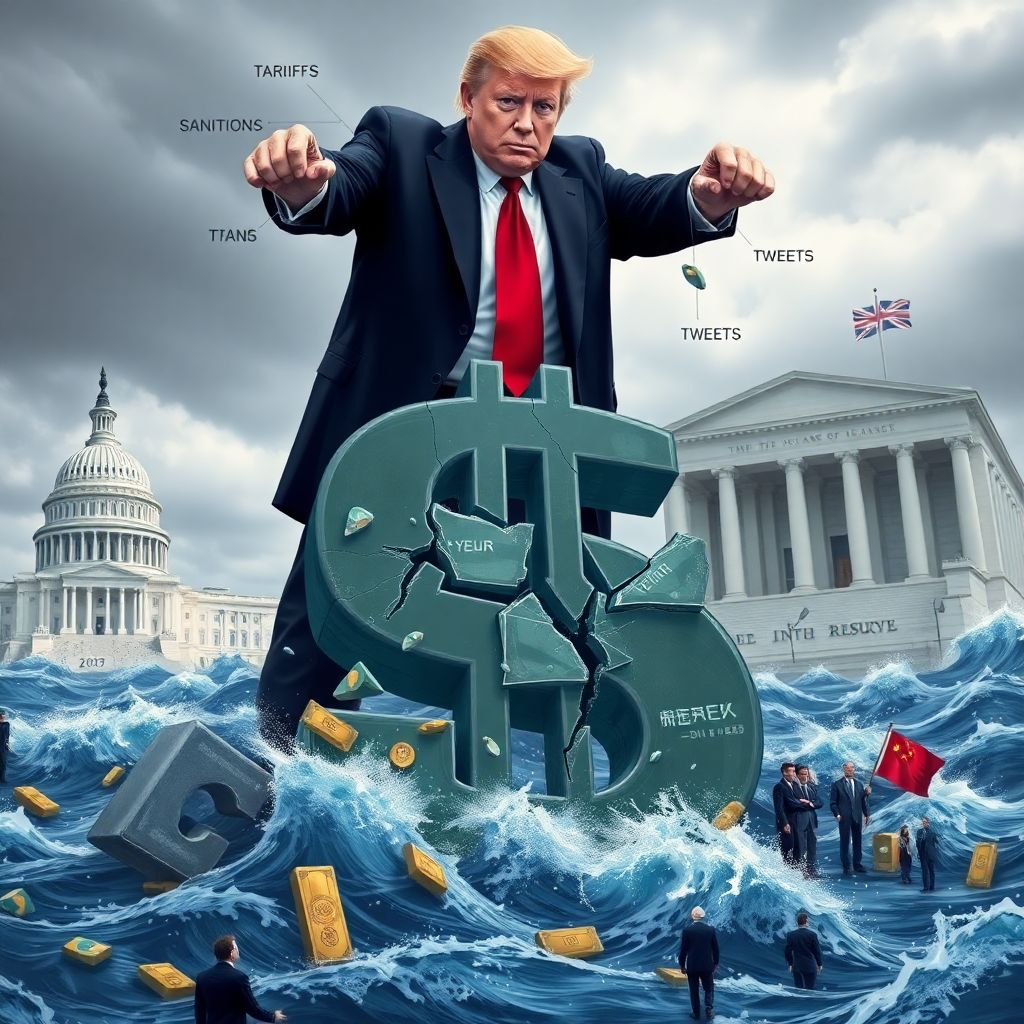
How Trump Is Undermining the Dollar and Chipping Away at U.S. Economic Dominance
For decades, the strength of the United States economy has rested on more than its GDP or military power. Its true backbone has been trust: trust in the stability of U.S. institutions, the rule of law, predictable policy, and—above all—the reliability of the U.S. dollar as the world’s primary reserve currency. Under Donald Trump’s presidency, that foundation of trust has been repeatedly shaken, and the long‑term consequences could be profound.
At the center of this erosion is the administration’s use of economic power as a blunt political instrument. Tariffs, sanctions, threats of trade wars, and even bizarre geopolitical gambits—like floating the idea of “buying” Greenland and coupling diplomacy with public intimidation—signal something crucial to the rest of the world: U.S. policy is no longer anchored in stable principles, but in the president’s short‑term political instincts and personal whims.
For global investors, this unpredictability is toxic. Large institutions, sovereign wealth funds, and central banks typically crave one thing above all: certainty. They don’t need to agree with U.S. policy, but they need to know that rules will not be rewritten overnight on social media. When tariffs are imposed without warning, alliances are questioned in public, and long‑standing agreements are threatened, investors begin to reassess the safety of keeping their capital denominated in dollars or parked in U.S. assets.
The strength of the dollar has always depended on more than interest rates or growth figures. It rests on confidence that the United States will honor its obligations, preserve the independence of its central bank, and avoid using its currency as a weapon for short‑term political gain. Trump’s repeated attacks on the Federal Reserve—pressuring it to cut rates to juice markets and boost his political prospects—signal to the world that monetary policy can be dragged into partisan battles. That is the first step toward debasing not just the dollar’s value, but its reputation.
At the same time, the administration’s aggressive and often erratic use of sanctions has made foreign governments and companies acutely aware of how vulnerable they are when operating in a dollar‑centric system. When access to U.S. financial infrastructure can be threatened or cut off at the stroke of a pen, other nations begin searching for ways to insulate themselves. That means exploring alternative payment systems, expanding the use of other currencies in trade, and building mechanisms to bypass the dollar entirely. Each of those steps, even if small, weakens the centrality of the U.S. currency over time.
Trump’s approach to trade policy has further undermined U.S. credibility. Instead of building coalitions to pressure unfair practices, his administration frequently chose unilateral tariffs and public insults against allies and rivals alike. The message to international partners was clear: international rules and long‑standing relationships could be discarded if the president felt personally slighted or politically cornered. When trade deals and security partnerships can be reversed by a tweet, the incentive to tie oneself too closely to the U.S. system diminishes.
Foreign investors don’t respond only to economic data; they read political signals. When they see institutions being hollowed out, norms being ignored, and diplomacy conducted via threat and spectacle, they begin to reassess risk. Some may not exit U.S. markets immediately, but they start diversifying—holding more euros, yen, or gold, and increasing exposure to other regions. That gradual rebalancing, if sustained, chips away at the “exorbitant privilege” the United States has enjoyed for generations: the ability to borrow cheaply and run persistent deficits because the world is eager to hold dollars.
The Greenland episode, while seemingly absurd on its face, fits into this larger pattern. When a U.S. president openly entertains the idea of acquiring territory from another country and follows up with threats and insults when rebuffed, it does not simply appear eccentric; it looks erratic and volatile. For international observers managing billions in assets, it is one more data point suggesting that the world’s leading power is led by someone who treats global affairs like a real‑estate negotiation—except this time, the collateral is the credibility of the U.S. state.
Eroding trust in the dollar has direct economic consequences at home. If foreign demand for U.S. Treasury bonds wanes, borrowing costs can rise over time. A weaker appetite for dollar assets can pressure the currency downward, making imports more expensive and potentially stoking inflation. While a competitive dollar can help exporters in the short run, losing reserve‑currency prestige is far more damaging in the long term. It risks turning a structural advantage into a vulnerability.
Trump’s policies also fuel the perception that the U.S. is retreating from its traditional role as a stabilizing force in the global economy. Withdrawing from multilateral agreements, undermining international bodies, and constantly threatening new trade conflicts tells the world that Washington is less interested in maintaining a rules‑based order than in extracting transactional, short‑term gains. This accelerates the global search for alternatives—whether in regional trade blocs, new financial arrangements, or deeper economic ties that bypass U.S. leadership entirely.
Another underappreciated risk lies in the politicization of economic data and institutions. When government officials dismiss unfavorable statistics as fake, pressure independent agencies, or fire experts for contradicting political narratives, markets take note. Investors may not react immediately to each incident, but a picture builds over time: the institutions that once insulated economic policy from day‑to‑day politics are under strain. That perception alone is enough to make some capital more cautious.
In addition, Trump’s brand of economic nationalism sends a troubling signal about future policy directions. If the governing philosophy normalizes tariffs as a routine tool, demonizes trade deficits without nuance, and frames allies as economic enemies, then foreign partners cannot rely on continuity from one administration to the next. Even if future leaders seek to restore stability, the memory of abrupt policy swings will linger, encouraging governments and businesses to design systems less dependent on any single country.
The longer these trends persist, the harder they are to reverse. Trust, once broken, typically returns more slowly—if at all. Even if investors do not immediately abandon U.S. markets, the process of hedging against American unpredictability can permanently reduce the centrality of the dollar. Parallel payment systems, alternative reserve baskets, and expanded use of other currencies in trade, once established, develop their own momentum.
There is also a deeper symbolic dimension. The dollar has never been just a unit of account; it has been a symbol of relative predictability and institutional strength. When U.S. politics look chaotic, when norms are flouted and alliances casually disparaged, that symbol starts to tarnish. Other powers—whether they are ready to replace the U.S. system or not—gain an opening to propose their own financial architectures and strategic narratives.
For Americans, the implications go far beyond prestige. A diminished role for the dollar can make everyday life more expensive and uncertain. It can mean higher interest rates on mortgages and loans, greater sensitivity to global shocks, and less room for policymakers to respond to crises with aggressive fiscal and monetary tools. The bill for years of short‑term political theater may not arrive immediately, but it will arrive.
Ultimately, what is being debased is not just the currency itself, but the trust that underpins it. A strong dollar requires more than tough talk or boasts about stock market highs; it requires steady institutions, consistent rules, and respect for the long‑term health of the system. When economic power is wielded as a weapon in domestic political battles or personal feuds, the rest of the world looks for safer ground.
If the United States wishes to preserve its economic dominance, it must recognize that leadership is built on reliability as much as on strength. Undermining allies, browbeating partners, threatening bizarre territorial “deals,” and politicizing core economic institutions send the opposite message. Step by step, such behavior encourages investors and governments alike to think twice before entrusting their future to the dollar—and that, more than any tariff or sanction, is how a superpower quietly erodes its own foundation.