
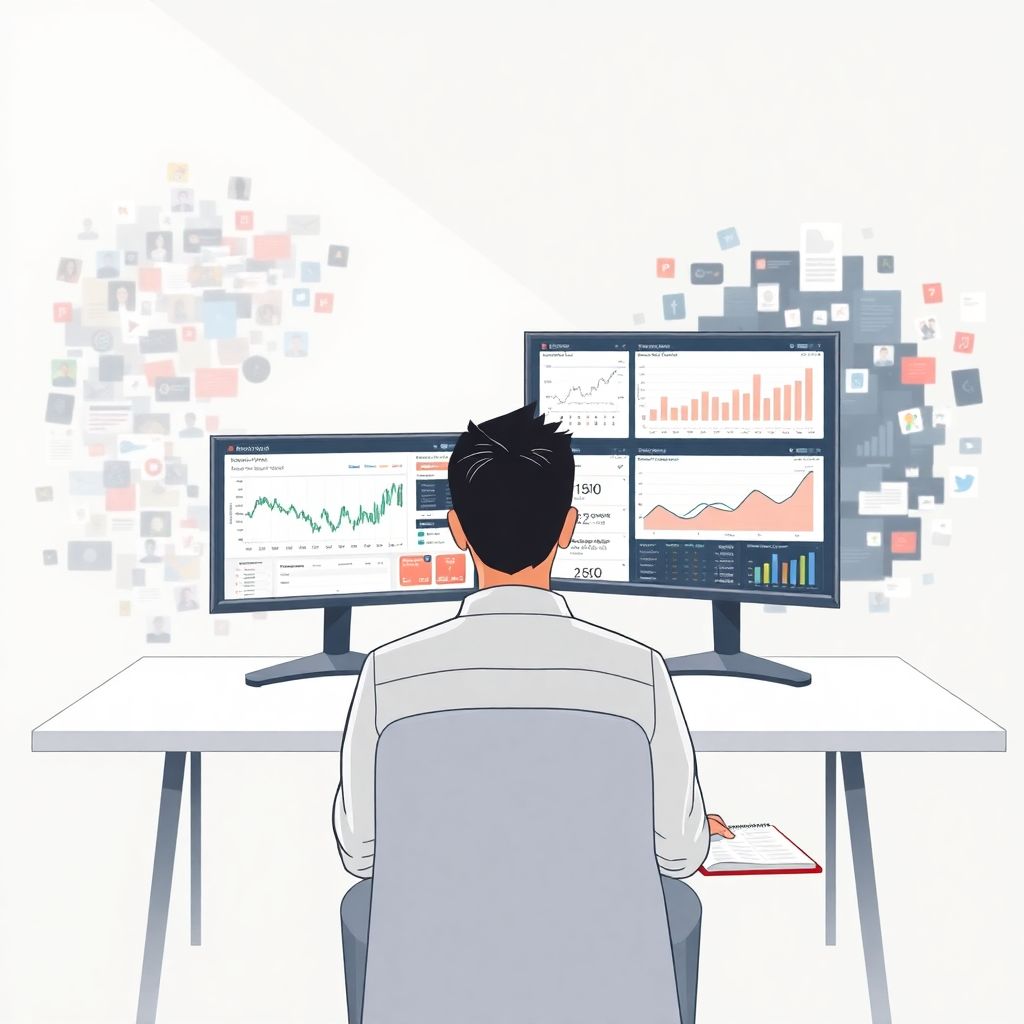
What platforms do you actually need to stay on top of markets and economic forecasts — without drowning in noise?
There’s an endless stream of market “insights” everywhere: financial news portals, social media hot takes, endless video content, and self-proclaimed gurus predicting the next crash or rally. The result is information fatigue: plenty of opinions, but often very little signal.
A more sustainable approach is to narrow your sources, prioritize data over drama, and build a simple system you can actually maintain. Below is a structured way to think about platforms and tools that help you stay informed without being overwhelmed.
—
1. Start with a core set of data-focused platforms
Instead of jumping between dozens of sites, choose a small set of platforms that give you:
– Real-time or near real-time market data
– Historical charts
– Economic indicators
– Company fundamentals
Examples of what to look for in such platforms:
– Market dashboards: Sites that aggregate stock indices, bonds, commodities, FX, and crypto in one place.
– Economic calendars: Tools that list upcoming macro events like interest rate decisions, employment data, inflation releases, GDP, and sentiment indices.
– Fundamental data terminals: Even lightweight ones that show earnings, balance sheets, valuation ratios, and analyst estimates.
The key criterion: platforms where you see actual numbers, charts, and historical context, not just headlines or opinions. If a tool helps you answer “what is happening and how does it compare to the past?”, it belongs in your core set.
—
2. Use news platforms for context – not for predictions
Financial news can be useful if you use it for context, not for guidance.
When choosing news platforms, look for:
– Clear separation between news and opinion pieces
– Concise market summaries (daily or weekly)
– Coverage of macro trends: rates, inflation, employment, global trade, geopolitics
A practical way to use news:
– Read market wrap-ups once a day or even a few times per week.
– Use them to understand *why* markets moved, then cross-check with actual data.
– Avoid chasing every intraday headline; it adds stress but rarely improves decisions.
Set a time limit: for example, 15–20 minutes a day for news, then stop.
—
3. Treat social media as optional — and heavily filtered
Social platforms can be useful for discovering new ideas, but they are also where noise multiplies fastest. Algorithms reward bold, emotional, and extreme claims — not accuracy.
If you decide to use social platforms for market and economic content:
– Curate aggressively
– Unfollow accounts that constantly push fear, hype, or clickbait.
– Prioritize those who share data, charts, methodology, and admit uncertainty.
– Check track records
– Don’t be impressed by one “perfect call.”
– Look for consistency over time and whether someone explains when they’re wrong.
– Use lists or folders
– Create custom lists of a few economists, analysts, and data-driven investors.
– Open only those lists instead of a full feed flooded with random content.
And remember: social media should be a supplement, not your primary source of truth.
—
4. Rely on economic and market calendars for structure
One way to reduce anxiety is to know what’s coming up instead of constantly reacting to surprises.
A good economic or market calendar helps you track:
– Central bank meetings and rate decisions
– Inflation (CPI, PCE) releases
– Employment data
– GDP, PMI, consumer confidence
– Major earnings announcements
How to use it:
– At the start of each week, skim the calendar and mark a few key events.
– Before each event, understand what the consensus expectation is.
– After the release, compare the actual data to expectations and monitor market reactions.
This framework anchors your attention on facts and expectations, not rumors.
—
5. Use newsletters and summaries to save time
Instead of scrolling for an hour, you can let a few good sources summarize the day or week for you.
Look for newsletters or briefings that:
– Are data-heavy and narrative-light
– Provide charts, bullet points, and key macro developments
– Offer weekly or daily recaps without excessive commentary
A reasonable approach:
– One or two daily market briefings
– One or two weekly macro analysis pieces
This way you’re staying informed while outsourcing the initial filtering to people who specialize in it.
—
6. Build a simple personal “information stack”
Rather than asking “what are the best platforms?”, a more useful question is: what’s the minimum set of tools I need to stay informed confidently?
For example, a lean information stack might look like:
– Daily
– One market data platform (indices, bonds, FX, major commodities)
– One short market news summary
– Weekly
– One macro/markets newsletter or video with deeper analysis
– Review of economic calendar for the coming week
– Monthly or quarterly
– Deeper review of macro trends (inflation, rates, earnings cycles)
– Portfolio check against your macro view, if you invest
Once you define this stack, resist the urge to constantly add more sources. You can always swap one out if it disappoints, but keep the total number small.
—
7. Prioritize platforms that show historical patterns
A common trap is focusing on today’s headlines without seeing the longer-term pattern.
Platforms that are genuinely helpful over time:
– Let you overlay multiple indicators (e.g., inflation vs. interest rates vs. equity performance)
– Offer long-term charts (10–30 years), not just 1-day or 1-month moves
– Provide recession indicators, yield curves, and long-term earnings data
When you see data in a decade-level context, daily volatility becomes less frightening and more understandable. This also improves your ability to interpret current forecasts: you see the cycle, not just the moment.
—
8. Set strict boundaries to avoid overload
Even the best platforms become a problem if you check them 30 times a day.
To keep your information diet healthy:
– Decide in advance:
– When you’ll check markets (e.g., once in the morning, once in the evening)
– When you’ll read news (e.g., after markets close or before bed, but for a limited time)
– Turn off non-essential notifications:
– Disable price alerts for every small move.
– Keep alerts only for major events or levels that matter to your strategy.
– Avoid multitasking:
– When you’re reviewing data or reading a serious analysis, close other tabs and apps.
– Focused 20 minutes beats distracted 2 hours.
Your goal is a calm, repeatable routine — not constant reaction to every tick.
—
9. Evaluate platforms by their incentives and transparency
Not all information sources are created equal. Some make money from ads, some from subscriptions, some from trading fees, and some from selling “exclusive insights.”
When choosing where to get your market and economic information, ask:
– How does this platform make money?
– Does it benefit when I trade more, panic more, or click more?
– Are forecasts backed by models, data, and clear reasoning, or just flashy narratives?
– Does the platform or author ever review and score their own past predictions?
The more transparent the methodology and incentives, the more you can trust what you’re seeing.
—
10. Balance forecasts with scenario thinking
No matter which platforms you use, forecasts are never guarantees. Markets and economies are complex systems, and even top experts are frequently wrong.
A more resilient approach:
– Instead of looking for “the” forecast, identify several plausible scenarios
– Example: soft landing, mild recession, deep recession, re-acceleration.
– Map how different assets might behave in each scenario.
– Align your decisions with the idea that any of the scenarios could happen.
Use platforms that help you explore these scenarios with data, not just bold one-way calls.
—
11. Keep your goals in mind when choosing platforms
How you stay updated should reflect why you want to stay updated.
– If you are a long-term investor:
– Focus on macro trends, valuation, earnings cycles, and long-term risks.
– You don’t need minute-by-minute quotes or aggressive trading platforms.
– If you are a short-term trader:
– You may need more real-time feeds, order book data, and intraday charts.
– But you still benefit from high-quality macro and earnings calendars.
– If you’re just trying to understand the economy:
– Emphasize educational content, long-term charts, and plain-language explanations.
– Avoid platforms that push you to trade or react emotionally.
Your objective should dictate your tools, not the other way around.
—
12. A practical way to get started or reset
If you currently feel overwhelmed:
1. Make a list of every platform, app, feed, and channel you use for markets and macro.
2. Cut it down to:
– 1–2 data platforms
– 1 economic calendar
– 1–2 news or summary sources
– (Optional) a small, curated list of data-driven social accounts.
3. Test this minimalist setup for a month.
4. Only add a new platform if it clearly solves a problem your current setup cannot.
Over time, this approach builds a customized, efficient information system you trust, instead of a chaotic feed you constantly chase.
—
Staying updated on markets and economic forecasts doesn’t require chasing every opinion or using every platform available. A small, carefully chosen set of data-centric tools, combined with clear routines and strict filters, is usually enough to stay informed, make better decisions, and avoid information overload.