
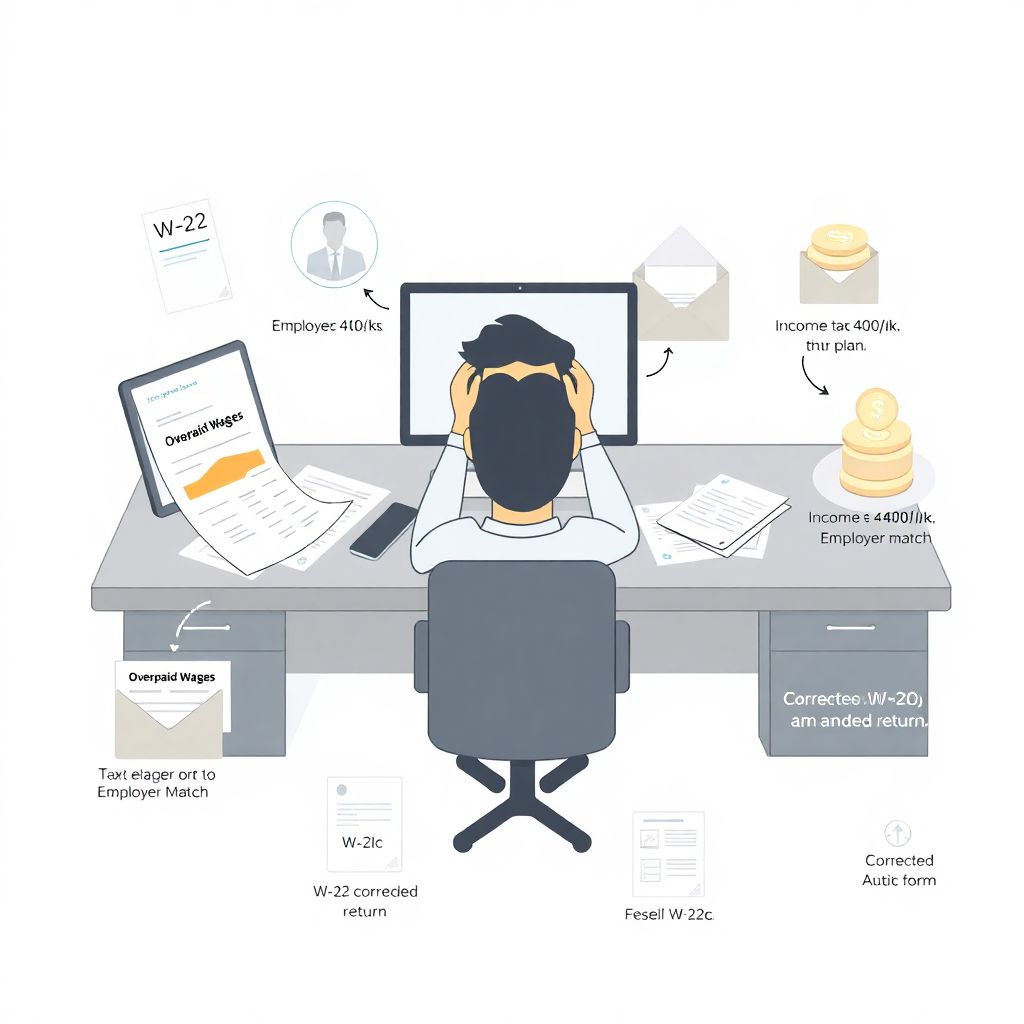
Overpaid wages and taxes: what to do when your employer wants money back after you’ve already filed
Finding out you were overpaid by a former employer is stressful enough. Discovering it *after* you’ve already filed your tax return adds another layer of confusion. Who pays back what? What happens to the W‑2 that was already reported to the IRS? And how are 401(k) contributions and FICA handled?
Below is a structured breakdown of the main issues, based on the situation where:
– You were overpaid in 2025
– Your former employer issued a W‑2 including that overpayment
– You’ve already filed your tax return using that W‑2
– The employer is now asking you to repay:
– Net pay
– 401(k) deferrals (both employee and employer portions)
– Income tax withholding
– And to sign a document letting them recover FICA from the IRS and promising you won’t claim those FICA taxes
—
1. What does your employer usually have a right to recover?
In a genuine wage overpayment scenario, employers generally are allowed to recover:
– The gross amount of the overpayment (the actual wages you weren’t entitled to), or
– At minimum, the net pay you received in your bank account that was tied to those improper wages
However, how that recovery is processed, and how taxes and benefits are corrected, matters a lot. It’s not just “pay them back whatever they ask for and move on.” Each type of item—401(k), federal income tax, FICA—has its own rules.
—
2. 401(k) deferrals: should you pay them back personally?
Your employer is asking you to repay 401(k) deferrals (both employee and employer portions). That’s a red flag for how this is being handled.
Employee 401(k) deferrals
If a portion of the overpaid wages was contributed to your 401(k) account:
– Those contributions were pretax deferrals of compensation you technically shouldn’t have received.
– In a clean correction, this is typically handled through the 401(k) plan itself, not by you simply writing a check back to the employer.
– The plan administrator can:
– Reverse the mistaken contribution, and
– Return those deferrals (and possibly related employer contributions and earnings/losses) as a plan correction.
If you just repay the 401(k) deferral amount directly to the employer without a formal plan correction:
– The IRS may still see the original deposit as a tax‑deferred contribution based on the W‑2 you received.
– That could create mismatches between:
– What your W‑2 says you contributed
– What is actually in your account after the employer takes money back from you outside the plan
– In short, it can look like you had tax‑deferred contributions on income you never legitimately earned.
Key point: In many cases, 401(k) errors are fixed by plan reversal/correction, not by the employee handing back retirement contributions in cash. You have good reason to be skeptical about paying back deferrals without a documented, proper correction through the plan.
—
3. Employer 401(k) match (ER contributions)
Employer match (or other employer contributions):
– Are never your money in cash; they exist only inside the 401(k) account.
– If the wages that triggered the match were invalid, the match should usually be corrected inside the plan by reversing the employer contributions.
You generally shouldn’t be paying your employer back out‑of‑pocket for their own 401(k) match. That should be handled administratively by the plan and the employer together.
—
4. FICA (Social Security and Medicare): what happens after you’ve already filed?
FICA taxes (Social Security and Medicare) are usually:
– Partly paid by you (employee portion, withheld from your paycheck), and
– Partly paid by your employer (employer portion, out of their own funds).
When there is a wage overpayment:
– The employer can seek a refund of their own FICA portion from the IRS, but certain conditions must be met.
– Often, they’ll ask you to confirm that you won’t claim the FICA amounts on your individual tax filings to avoid double refunds.
You mentioned:
> They want me to sign a document stating they have my permission to recoup FICA from IRS and that I will not file claiming those taxes paid, but I already did.
That means:
– You have already filed a tax return that reflects those wages and the associated FICA withheld.
– The employer now wants paperwork ensuring they can reclaim FICA on their side and that you won’t later try to reclaim the same FICA from the IRS.
If you don’t sign their FICA authorization
If you refuse to sign:
– They may still correct wages and file amended employment returns, but it could complicate their process.
– They generally cannot force you to waive rights you already used (you’ve already filed).
– However, if they do correct the wage records with the Social Security Administration and IRS, that might eventually affect your own reported earnings for Social Security purposes.
What if you already claimed FICA indirectly?
Typically, you don’t “claim” FICA in the same way as income tax; it’s withheld and reported. Issues arise later if:
– Wage corrections mean you overpaid Social Security or Medicare.
– Then you might need to amend returns or file for refunds if the wage base changes.
This is where professional guidance is important: your employer’s payroll corrections can interact with your prior filings in non‑obvious ways.
—
5. Should you pay back income tax withholding?
The employer is asking for income tax withholding back in addition to net pay. This part is especially sensitive.
When an overpayment is discovered:
– The ideal timing is before year‑end and before W‑2s are issued. Then the employer can:
– Adjust the payroll records
– Correct withholdings
– Issue an accurate W‑2 reflecting the corrected, lower wages
But in your case:
– You already have a W‑2 that includes the overpayment.
– You’ve already filed your tax return using that W‑2.
– Your withholding, as reported, was credited toward your tax liability.
If you simply hand back the income tax withholding to the employer *after the fact*, without any official correction of your W‑2 and your return:
– You would be returning money that the IRS currently sees as your tax payment.
– Unless the employer issues a corrected W‑2 (W‑2c) and you amend your tax return, the IRS will still think:
– You earned the full wages
– You had the full withholding
– And they will have applied that withholding to your tax bill
That can put you in a position where:
– You’ve paid taxes to your employer (by refunding withholding)
– The IRS still counts that withholding as yours, unless the employer reverses it properly and you amend.
Normally, proper correction involves:
1. Employer corrects wage and tax records (including withholding).
2. Employer issues a W‑2c to you.
3. You file an amended tax return to reflect the corrected wages and withholdings.
4. The overstatement of taxes paid is removed from your return, and everything lines up.
Because you’ve already filed, any major change should go through that formal process, not just informal paybacks.
—
6. How should FICA be handled now that you’ve already filed?
From your side:
– You reported wages and FICA withholding as they appeared on your W‑2.
– If the employer later reduces the amount of Social Security and Medicare wages and taxes reported, it may require:
– A corrected W‑2 (W‑2c)
– Potential amendments if the changes affect your return (for example, if the adjustment also changes taxable wages for income tax purposes)
From the employer’s side:
– To recover employer‑paid FICA, they generally:
– Correct their payroll tax filings
– Possibly secure your consent or notify you so you don’t seek the same amounts
– If you’ve already filed, the timing and method of correction matter; they can’t simply undo it without creating inconsistencies.
If you decline to sign the document:
– They may need to treat the situation differently or provide alternative documentation.
– You should insist on understanding exactly how your W‑2 information and Social Security earnings record will be impacted before agreeing to anything.
—
7. Do you need a CPA or tax professional?
Given:
– The overpayment occurred in the same year as your filing (2025)
– You’ve already filed your tax return using the original W‑2
– The employer is requesting:
– Repayment of net pay
– Repayment of 401(k) deferrals (EE and ER)
– Repayment of income tax withholding
– A signed statement about FICA recovery and your future rights
– Multiple systems are involved: payroll, retirement plan, income tax, Social Security
It is highly advisable to consult:
– A CPA or enrolled agent with experience in payroll corrections and amended returns, and/or
– A tax attorney if the amounts are large or the employer is pressuring you to sign complex waivers.
A professional can:
– Review the exact numbers and documents the employer sent you
– Explain whether:
– A W‑2c will be issued
– You will need to file an amended return
– You are being asked to repay more than is appropriate
– Help you respond in writing to the employer with clear, legally sound questions and conditions
The cost of professional advice is often justified by:
– Avoiding double payments or improper repayments
– Preventing future IRS or Social Security headaches
– Ensuring your 401(k) record is properly fixed and compliant
—
8. Practical steps before you pay anything back
Before sending money or signing anything, consider:
1. Request detailed documentation
– Exact calculation of the overpayment: dates, gross amounts, taxes, and 401(k) contributions.
– How they propose to correct:
– Payroll records
– W‑2 / W‑2c
– 401(k) plan entries
2. Ask directly about a W‑2c
– Will they issue a corrected W‑2 that reflects the lower, correct wages and taxes?
– If so, when?
– That W‑2c will guide whether you must amend your tax return.
3. Clarify the 401(k) correction method
– Is the plan administrator involved?
– Will contributions and matches be reversed inside the plan?
– Will you receive a statement showing the correction?
4. Get clarity on FICA treatment
– Are they amending their payroll tax returns for Social Security and Medicare?
– If yes, how will that impact your Social Security earnings record?
– What exactly does the FICA waiver document say, and what rights are you giving up?
5. Don’t rush to repay withholding
– Any repayment of income tax withholding should be tied to:
– A clear correction of your reported wages, and
– A plan to amend your tax filing, if necessary.
6. Consult a professional with the documents in hand
– Bring the original W‑2, your filed tax return, and the employer’s letter and proposed forms.
– Ask them to help draft a written response and a repayment plan that aligns with tax law.
—
9. When is it reasonable to push back on the employer’s request?
It’s reasonable to push back or at least demand clarity if:
– They insist you repay 401(k) deferrals and employer match out of pocket instead of handling it through plan corrections.
– They want income tax withholding returned without committing to issuing a W‑2c.
– They require you to sign a broad waiver about FICA and future claims without explaining how they will handle corrections with the IRS and Social Security Administration.
You’re responsible for paying back money you weren’t entitled to, but you’re not required to accept a process that exposes you to extra tax risk or duplicate payments. Everything should be done in a way that:
– Leaves your IRS records accurate
– Properly reflects your retirement plan contributions
– Avoids you paying taxes twice or forfeiting legitimate rights.
—
10. Summary
– 401(k deferrals and employer match are usually corrected through the plan, not by you writing a personal check for both employee and employer contributions.
– FICA corrections after you’ve filed are complex; signing away rights without understanding the impact can backfire.
– Income tax withholding should not simply be handed back unless your employer:
– Corrects your wage and tax records, and
– You’re prepared to file an amended return if needed.
– In a situation involving an overpayment, a filed return, retirement contributions, FICA, and withholding, getting a CPA or similar professional involved is very wise.
Until you fully understand the proposed corrections and see them in writing, it’s reasonable to pause, ask questions, and seek professional advice before signing or paying anything.