
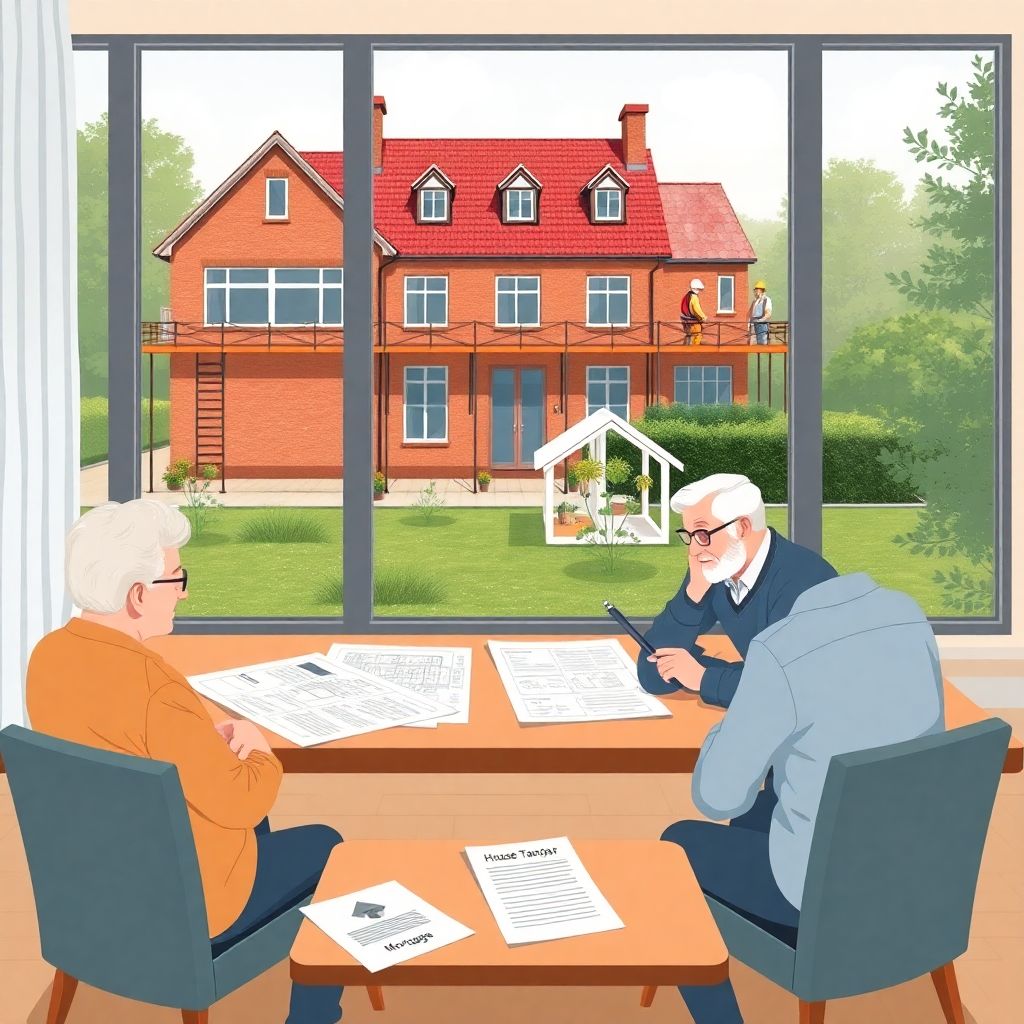
Parent wants to downsize: how to structure the deal, protect everyone, and make the finances work
When a parent reaches retirement with little or no private pension, the family home often becomes the main asset that can provide security for both generations. One common idea is exactly what you’re considering: the adult child takes over the main house, and the parent moves into a smaller, newly built place on the same site. On paper it can look simple; in reality it’s a mix of financial, legal, tax, and emotional decisions that need careful planning.
Below is a structured way to think through your options: transferring the house into your name, getting a mortgage, building a smaller home in the garden, and upgrading the existing property.
—
1. Two main routes: transfer vs formal purchase
You’re essentially weighing up two broad approaches:
1. Parent gifts or transfers the house into your name, then you borrow against it.
2. You formally buy the house from your parent, using a mortgage like any other purchase.
Both can fund:
– The construction of a smaller house in the garden for your parent
– Improvements to the main house (new heating system, insulation, windows, etc.)
The difference is how the transaction is recorded, who has legal security, how lenders view it, and what the tax and inheritance implications might be.
—
2. Option A: parent transfers the house into your name
Under this route, your father would sign over legal ownership of the property to you, possibly at a nominal price or as a gift. You would then seek:
– A remortgage or secured loan using the property as collateral
– Potentially a further advance if there’s already a small existing mortgage
Pros:
– No need for a large cash deposit in the traditional sense, because you’re not buying at full market value in a straightforward sale.
– You may be able to release equity from the property to finance both the new build and renovation works.
– The house ends up in your name early, which might simplify future inheritance.
Cons and risks:
– Your father loses legal ownership. If your financial situation changes (job loss, relationship breakdown, debt problems), he could be at risk of losing his home if the property has to be sold.
– Some families later regret that the parent has no formal protection; this can cause tension with siblings or other relatives.
– There can be tax implications, such as potential capital gains when you eventually sell, depending on how and when you live there.
– Lenders may be cautious if they consider the arrangement complex or non-standard, particularly if a dependent relative will live on the site.
If you go down this route, it’s vital to protect your father’s right to live on the land in some formal way (for example, through a life interest or legal agreement).
—
3. Option B: you officially buy the house with a mortgage
The more traditional route is:
– Get a standard residential mortgage in your name.
– Buy the family home at an agreed price, documented as a formal sale.
– Your father either:
– Receives the sale proceeds to help fund his retirement and/or the new build, or
– “Gifts” part of the value as a deposit contribution to help you meet lender criteria.
This can be more straightforward from the lender’s perspective, because:
– It looks like a typical property purchase with a clear valuation.
– There is a clear paper trail if your father gifts you part of the equity as deposit.
– You can clearly define whose responsibility each cost is (build, renovations, fees).
Benefits of a formal purchase:
– Transparent for all family members and for any future legal or inheritance matters.
– Easier to show to a bank, solicitor, or tax adviser.
– Your father receives a defined value for the property, supporting his financial independence.
Drawbacks:
– You still need to meet the lender’s standard requirements, including:
– Deposit (often 5–10% minimum, sometimes more)
– Sufficient income to cover the mortgage
– Saving the deposit can take time if you’re currently renting and don’t have large savings.
– If the agreed sale price is below market value, the lender must be comfortable with that.
—
4. Using “gifted equity” as your deposit
If saving up a 10% cash deposit would take years, one common solution between parents and children is gifted equity:
– The property is valued at, for example, 300,000.
– Your father sells it to you for 270,000.
– The 30,000 difference is recorded as a gifted deposit from him to you.
Many lenders accept this as long as:
– It’s properly documented.
– Your father signs a declaration that the gifted portion is not a loan.
– He won’t have any ongoing financial or ownership claim over that share.
This can let you buy sooner, without waiting to build up a huge cash pot, while still giving your father some sale proceeds (if desired) to help fund his smaller home.
—
5. Funding the new build in the garden
Building a smaller house in the garden is not only a construction issue; it’s also a planning and lending issue.
Key steps:
1. Planning permission / zoning
– You’ll need approval to build a second dwelling on the plot.
– Some authorities have new or simplified rules for building in gardens or behind existing homes, but it still needs formal permission.
2. Separate dwelling or annex?
– A fully self-contained house with its own entrance, kitchen, and services is often treated differently from an annex attached to the main house.
– How you structure it can affect:
– Planning rules
– Utility connections
– Future saleability and valuation
– Tax treatment
3. Type of finance for the build
Common options include:
– Extending your mortgage to fund the build.
– A self-build mortgage (funds released in stages as work progresses).
– A home improvement loan or secured loan if the sum is smaller and the lender is comfortable.
4. Cost control
– Get multiple quotes from builders and factor in 10–15% contingency for overruns.
– Ensure that the combined cost of buying the house, renovating it, and building the smaller home doesn’t push the total borrowing beyond what you can comfortably pay.
—
6. Renovating the existing property: where grants or support might help
If you’re planning to overhaul heating and windows, there may be energy-efficiency or renovation grants or subsidised loan schemes available, depending on your country and local authority policy. These can sometimes support:
– Replacement of old boilers with more efficient systems
– Installation of heat pumps or other renewable systems
– Insulation upgrades (walls, loft, floors)
– Double or triple glazing
Points to consider:
– Grants are often means-tested or targeted at older homeowners, lower-income households, or properties with very poor energy ratings. Your father, as an older retiree with little pension, may qualify under some schemes.
– Sometimes the grant can only be accessed if the property remains in the name of the person who qualifies (your father). That may affect whether you transfer ownership before or after works.
– Certain schemes require accredited installers and pre-approval before work begins.
Before committing to any ownership structure, check how any available support is administered, who must be named as owner or applicant, and whether transferring the house to you would block access to funds.
—
7. Legal protection for your father
Whichever structure you choose, your father’s long-term security should be central:
– Right of residence or life interest:
A solicitor can add a clause to the title or draw up an agreement granting your father the legal right to live in the new smaller home (or in any accommodation on the site) for life, even though you own the land.
– Clear written agreement on costs:
Decide who is paying for:
– The new build
– Ongoing maintenance
– Utilities and council/local property taxes
and capture it in writing.
– Plan for worst-case scenarios:
Consider:
– What happens if you separate from a partner and they have claims over the property?
– What happens if you lose your income and cannot meet repayments?
– What if one of you needs to move or sell in future?
Thinking through these less pleasant possibilities early, and putting legal structures in place, helps to avoid conflict later.
—
8. Impact on siblings and inheritance
If there are other siblings or future heirs, transferring the home to one child can sometimes cause tension. To avoid misunderstandings:
– Discuss the arrangement openly with everyone affected.
– Clarify whether:
– The house is considered an “advance” on your inheritance.
– Your father intends to balance things via other assets or his will.
– Have your father update or create a will reflecting the new ownership and any wishes regarding the property or other savings.
An inheritance that’s partly embedded in real estate and partly in cash can be managed fairly, but only if it’s visible and properly documented.
—
9. Affordability: be brutally realistic
Before agreeing to anything:
– Work out your monthly repayment on the expected loan or mortgage amount, including:
– Capital and interest
– Insurance (buildings, maybe life cover if required)
– Property taxes, utilities, and maintenance
– Stress-test your budget for:
– Higher interest rates
– Temporary income drops
– Unexpected repairs or cost overruns on the build
It’s easy for family plans to be driven by goodwill and optimism; lenders will look only at hard affordability numbers. You should do the same.
—
10. Practical steps before you decide
To move from idea to decision, consider this sequence:
1. Get an independent valuation of the current home.
2. Speak to a mortgage adviser about:
– Maximum borrowing based on your income and debts
– Options for gifted deposits or equity
– Whether a self-build or further advance is realistic
3. Consult a planning professional or local planning office to see:
– If a second dwelling in the garden is allowed in principle
– Any specific design or access constraints
4. See a solicitor experienced in:
– Property transfers between family members
– Life interest / right of residence arrangements
– Inheritance and tax implications
5. Investigate available grants or subsidies for:
– Energy-efficient improvements
– Supporting older or low-income homeowners
Collect all these pieces, then sit down with your father to compare:
– Transferring the property as a gift and borrowing against it
versus
– A formal purchase with gifted equity and a standard mortgage
In some cases, a hybrid approach (for example, transferring part now, doing works while he retains some ownership, then finalising a sale later) can make sense, but it must be legally robust and lender-approved.
—
11. Balancing financial logic with family dynamics
Beyond the numbers and legal documents, this is about how the two of you want to live and support each other in the years ahead:
– Your father gets to downsize and stay close to family instead of moving to an unfamiliar area or rented accommodation.
– You gain a path to homeownership that might otherwise be out of reach for a long time.
– Both of you share the benefits and responsibilities of the property, but only if expectations are clear.
Take your time, gather as much information as you can, and involve professionals where it matters most: legal structure, planning permission, and finance. A well-planned arrangement can secure your father’s retirement, help you step onto the property ladder, and create a long-term home solution that works for everyone.