
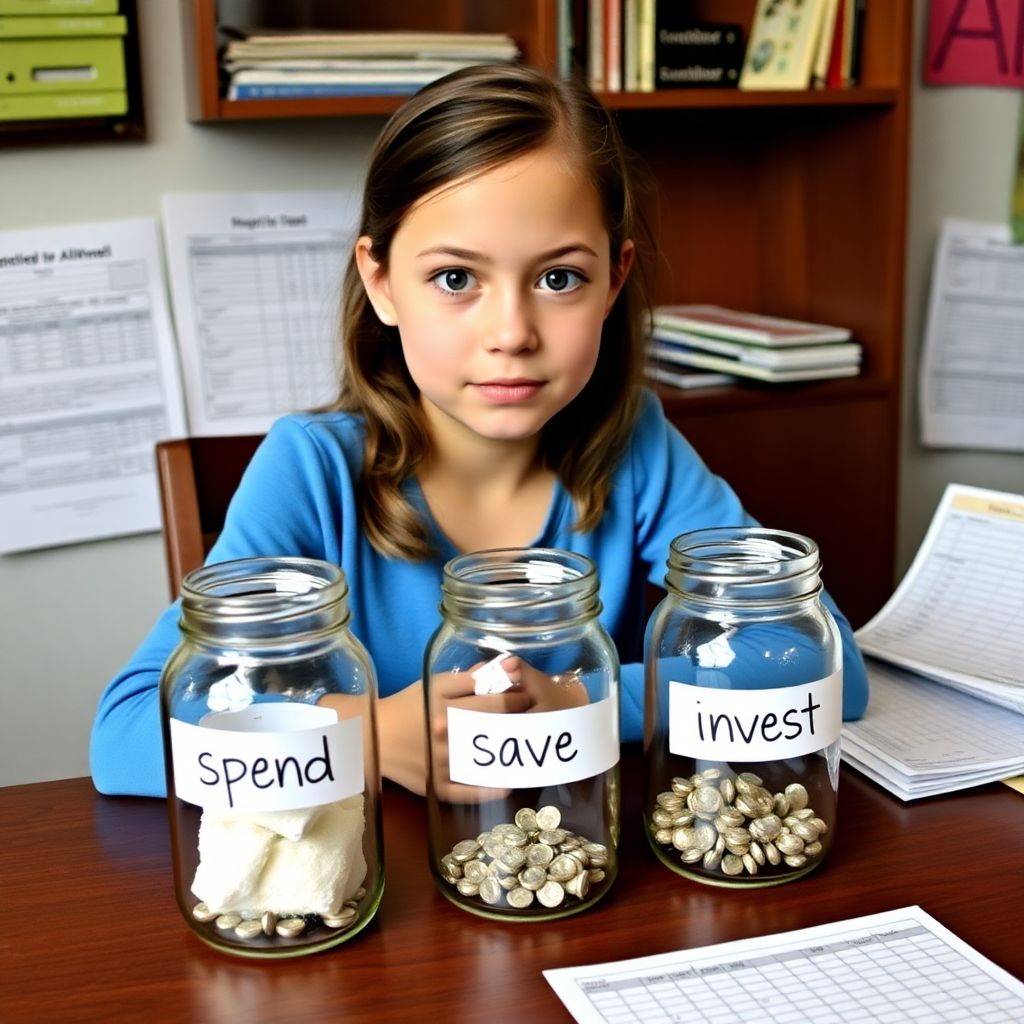
If your 12‑year‑old is already talking about saving and investing, that’s a huge opportunity. At this age, the main goals are:
1. Keep her money safe and accessible for short‑term needs.
2. Introduce real investing so she can see how money grows over years, not weeks.
3. Teach habits and systems, not just open “an account and forget it”.
Below is a structured way to separate her money into “buckets” and specific account types you can consider.
—
1. Start with a clear money system: three (or four) buckets
Before you even pick a bank or platform, help her decide *what* she’s saving for. A simple, kid‑friendly framework:
– Spend now – pocket money, small treats, short‑term wants.
– Save soon – short‑term goals (a gadget, a trip, sports equipment) in the next 6-24 months.
– Grow for later (invest) – long‑term growth (age 18+, college, car, first apartment).
– (Optional) Give – if you want to build a habit of charity or gifts.
Every dollar she gets can be split across these categories in a fixed ratio (for example: 40% spend, 30% save, 30% invest). The accounts you choose should map directly to these buckets.
—
2. Where to keep “accessible” money: day‑to‑day and short‑term savings
For the money she wants to be able to use or may need in the next year or two, focus on *safety* and *easy access* rather than high returns.
a) Youth savings or checking account
Many banks and credit unions offer:
– Youth savings accounts (custodial or joint with a parent).
– Sometimes teen checking accounts with a debit card (often starting at 13-14, but policies vary).
They usually pay very low interest, but they’re:
– Safe (insured).
– Easy to use with a card or ATM.
– A good tool for teaching basics: deposits, withdrawals, keeping a balance, reading a statement.
Use this as her “spend now” and part of her “save soon” money.
b) High‑yield savings account (if available for minors)
Traditional local banks and credit unions often pay almost nothing in interest, as you noticed. If possible, look for:
– A custodial high‑yield savings account or a joint online savings account in your name with her as beneficiary.
– No or low minimum balance; no monthly fees.
This is ideal for “save soon” goals where:
– She might need the money in 6-24 months.
– You want at least *some* interest without risk.
If a dedicated high‑yield option for kids isn’t offered, you can still use a standard savings account and treat it as “her bucket” inside your own system, but clearly track the balance that belongs to her.
—
3. Certificates of Deposit (CDs): when a fixed term makes sense
You already mentioned CDs as an option. They can be useful if:
– She has money she definitely will not need for a period (say, 1-3 years).
– You want a guaranteed, fixed rate, and you’re okay with locking the money.
Pros:
– Usually higher interest than a regular savings at a local bank.
– Very safe and predictable.
Cons:
– Penalties or restrictions if the money is withdrawn early.
– Still not a “high” return compared with long‑term investing in the stock market.
A CD could be a good fit for a specific medium‑term goal: for example, money she wants to use at 16 for a particular purchase, and you both agree it won’t be touched before then.
—
4. Real investing for growth: custodial brokerage account
If she wants to “invest and grow” part of her money, consider a custodial brokerage account (often called UGMA/UTMA in many regions):
– The account is in your name as the custodian.
– The money belongs to her and will eventually become fully hers at a legally specified age.
– You control the investments until she becomes an adult, but you can involve her in every decision.
Inside a custodial brokerage, you can buy:
– Broad‑market index funds (e.g., tracking large stock markets).
– Exchange‑traded funds (ETFs) with diversified holdings.
– Possibly some individual stocks, but for teaching purposes, broad funds are usually better.
Focus on:
– Long time horizon: 5-10+ years.
– Diversification: instead of picking one company she likes, invest in funds that own hundreds or thousands of companies.
– Regular contributions: even small monthly amounts teach consistency.
Make clear that this “invest” bucket is not for spending next year. It’s for when she’s older: college age, first car, first apartment, or even just general adult life expenses.
—
5. Teaching her how investing actually works
The biggest value of starting at 12 isn’t just the interest or returns; it’s the lessons.
You can sit down together and:
– Explain compound growth:
Show how $100 can become much more over many years if it earns a modest annual return and you keep adding to it.
– Compare saving vs. investing:
– Savings = safe, slow growth, good for short‑term.
– Investing = more ups and downs, but better growth over long periods.
– Look at history (in simple terms):
Show that markets sometimes fall for months or years, but over decades they’ve historically trended upward.
– Set rules:
– Money for the next year stays in savings.
– Money for the distant future goes into investments and is “off‑limits” for impulse spending.
Turn it into a project where she helps pick the fund type (for example, a broad stock ETF) and tracks progress a few times a year, not daily.
—
6. Roth IRA (only if she has earned income)
If she earns money from work that actually counts as earned income (babysitting reported to parents with records, part‑time work when older, etc.), you may be able to open a custodial Roth IRA:
– Contributions are made with after‑tax money.
– Growth and qualified withdrawals in retirement are tax‑free.
– It’s a powerful way to show how investing early can dramatically impact retirement savings.
But this only applies if she truly has eligible earned income according to your local tax rules. For now, just be aware it exists as a future tool.
—
7. 529 or other education‑focused plans (if college is a goal)
If you’re thinking ahead to education costs, a dedicated education savings plan might be useful:
– Investment‑based account aimed at future education.
– Potentially tax advantages depending on your country or region.
– Money ideally used for qualified education expenses.
You can involve her by:
– Showing how this account is “college money”.
– Letting her contribute a small portion of gifts or earnings if she’s interested.
– Explaining that this is an investment that grows over many years like her custodial brokerage.
This helps her understand that different goals often have different types of accounts.
—
8. Deciding how much goes where
To make it concrete, you can set up a simple plan for every dollar she gets (allowance, gifts, small earnings). For example:
– 40% to spend now (youth checking/savings).
– 30% to save soon (higher‑yield savings or CD if there’s a clear deadline).
– 30% to invest for later (custodial brokerage with index fund/ETF).
You can adjust the percentages based on her personality:
– If she’s very impatient, maybe give a bit more to “spend now” so she doesn’t feel deprived.
– If she’s highly motivated to build wealth, increase the investment portion.
The key is consistency. Set up automatic transfers where possible so it’s not a negotiation each time.
—
9. Involving her in every step
This is where the real learning happens:
– Open the accounts together. Let her see the forms, explain what each field means (custodian, beneficiary, account type).
– Show her statements. Once a month or once a quarter, review balances together:
– How much did interest add in savings?
– How much did investments go up or down?
– How much did she contribute herself?
– Set specific goals.
For short‑term: “I want $300 in 9 months for X.”
For long‑term: “I want $5,000 by age 18 in my investment account.”
– Celebrate milestones.
When she hits a savings goal, acknowledge the achievement and discuss what she did right.
These habits will matter far more than squeezing an extra 0.5% out of a bank account rate.
—
10. Managing expectations about “interest” vs. “returns”
Many kids (and adults) expect that if they invest, they’ll see quick, big gains. Be very clear about:
– Savings accounts and CDs:
– Almost no risk.
– Very low returns.
– Designed mainly for safety and liquidity.
– Investments in stocks/bonds/funds:
– Can go *down* in the short term.
– Historically stronger growth over long stretches.
– Require patience and a long‑term mindset.
You can even simulate a mini “investment diary”:
– Write down today’s balance.
– Check it in 3, 6, 12 months.
– Talk about what changed and why, without panic when it goes down.
This helps her learn that short‑term dips are normal and not a reason to quit.
—
11. Practical step‑by‑step summary
To put it all together in a simple plan:
1. Open a youth savings (and/or checking) account at a bank or credit union for everyday money.
2. Open or designate a higher‑yield savings or a CD for her short‑to‑medium‑term goals.
3. Open a custodial brokerage account for long‑term investments.
4. Create a clear rule for how every new dollar is split between these accounts.
5. Choose simple, diversified investments inside the brokerage (e.g., a broad market index fund).
6. Review everything with her regularly, focusing on learning, not just the numbers.
7. Adjust as she grows: at 14-16, she might start working, at which point more advanced tools (like a custodial Roth IRA) could come into play.
—
By combining a safe place for her to park money she might need soon with a real investment account for long‑term growth, you’ll give her exactly what she’s asking for: somewhere she can access funds easily, and somewhere else she can watch them grow over time. Just as important, you’ll be giving her a financial education most people don’t get until much later in life.