
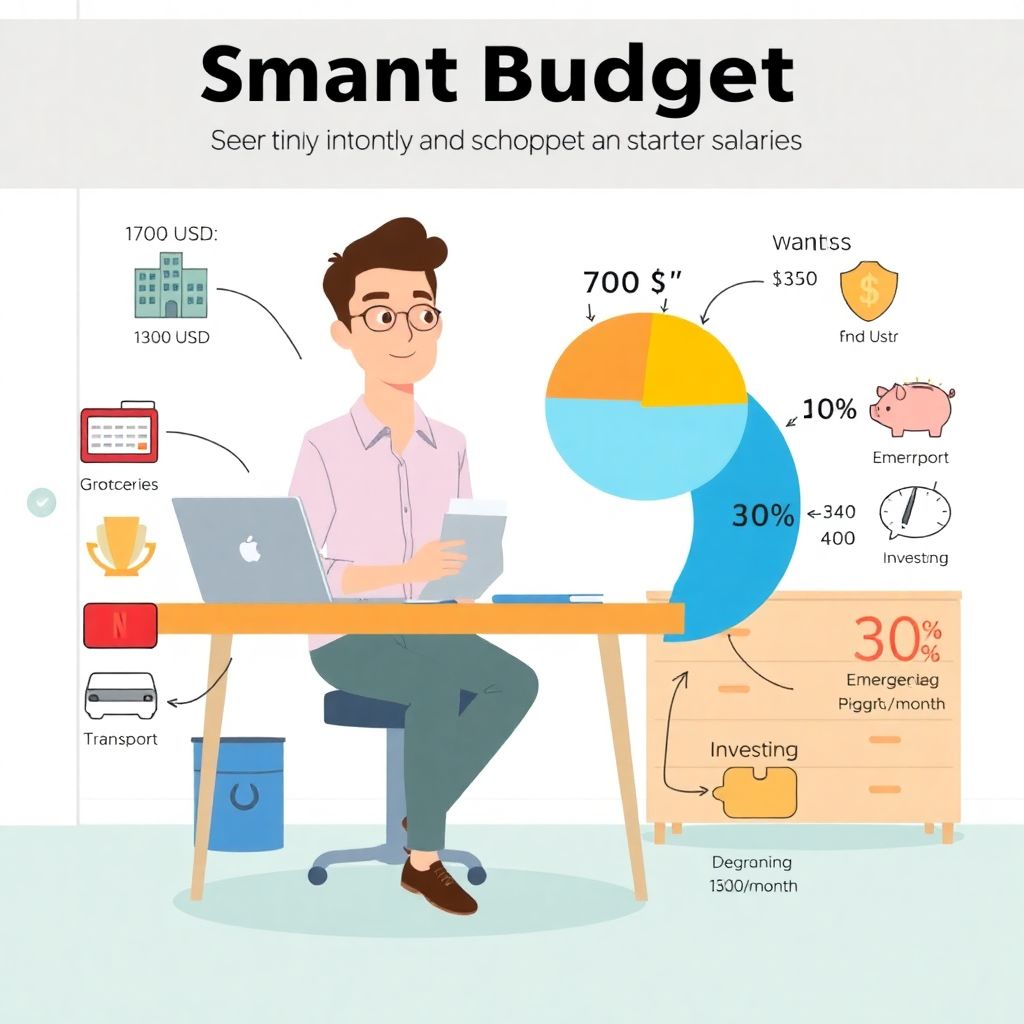
Smart Budget Strategy on a Starter Salary: Is a 70/30 Split a Good Idea?
At 21, starting out in transport management with a monthly income of 1300 USD, you’re already doing something a lot of people don’t: actively thinking about how to manage your money. That alone puts you in a strong position. The challenge is that your fixed costs are high, so you need a plan that’s both realistic and flexible.
Right now, your biggest expense is housing: about 700 USD per month for rent and utilities (dropping to around 600 USD when there’s no heating). After paying for housing, you have roughly 600–700 USD left to cover food, transportation, subscriptions like Netflix and Spotify, your gym membership, and any other day‑to‑day spending.
Your idea is to split your income using a 70/30 approach:
– 70% of your salary for rent, living expenses, and “wants”
– 30% for saving and investing
– About 350 USD toward an emergency fund
– Around 30–35 USD per month into an S&P 500 investment
You’ve also looked at popular frameworks like the 50/30/20 or 60/20/20 rules and are wondering whether your own plan is sensible or too aggressive for your current situation.
How Your Plan Compares to Classic Budget Rules
Common rules of thumb like 50/30/20 suggest:
– 50% for needs (rent, utilities, groceries, transport)
– 30% for wants (entertainment, dining out, subscriptions)
– 20% for savings and debt repayment
With a 1300 USD salary and 700 USD going to housing alone, you’re already over the “ideal” 50% for needs. That doesn’t mean you’re failing; it just means the textbook rules don’t perfectly fit your reality right now. In high-rent situations, many people naturally end up closer to 60–70% on needs.
Your 70/30 plan is actually quite ambitious in a positive way: you’re trying to save 30% of a modest income while paying relatively high rent. That’s not “trying too hard”; it’s aiming high. The key question is: can you stay consistent without feeling so restricted that you give up?
Priority One: Build a Solid Emergency Fund
Committing around 350 USD a month to an emergency fund is a strong move. At your income level, a basic target might be:
– Minimum: 1 month of expenses
– Better: 3 months of expenses
– Ideal over time: 6 months of expenses
If your total monthly spending is around 1000–1100 USD (including rent, food, transport, etc.), then:
– 1 month emergency fund ≈ 1000–1100 USD
– 3 months ≈ 3000–3300 USD
At 350 USD per month, you could reach:
– 1 month of expenses in roughly 3 months
– 3 months of expenses in about 9–10 months
That’s impressive progress for an entry-level salary. Once you hit 3 months of expenses, you can reassess and possibly redirect some of that money from savings toward investments or other goals.
Is Investing 30–35 USD in the S&P 500 Worth It?
Even small investments matter, especially early in your career. Putting 30–35 USD per month into a broad stock index like the S&P 500 is a good way to start building the habit of investing.
However, there’s a practical order of priorities to consider:
1. Cover essential expenses.
2. Build a basic emergency fund.
3. Then invest.
You can still keep that 30–35 USD going each month as long as it doesn’t cause you to dip into high‑interest debt or feel constant financial pressure. Think of it as a “learning investment”: you’re buying both long-term growth and experience. Just be sure you’re not sacrificing critical savings or essentials to keep that investment going.
Tracking Your Real Numbers: Turn Your Plan into a Budget
To see if your 70/30 split is realistic, break your monthly budget into concrete categories. For example:
– Income: 1300 USD
Fixed costs (needs)
– Rent + utilities: 700 USD
– Transport (public transit / fuel): X USD
– Groceries: X USD
– Phone + internet: X USD
Wants
– Netflix / Spotify: X USD
– Gym membership: X USD
– Eating out / entertainment: X USD
Savings & investing
– Emergency fund: 350 USD
– S&P 500: 30–35 USD
Fill in the “X” amounts based on your real spending. Then check:
– Does the math fit under the 70% for rent, expenses, and wants (around 910 USD)?
– Do you still feel like you can live decently, or are you constantly short?
If you find you’re going over that 70% regularly, you might temporarily:
– Reduce some wants (subscriptions, eating out, nonessential purchases).
– Lower the emergency fund contribution slightly (e.g., from 350 to 300 USD) until some costs drop, like when heating season ends or when you move to a cheaper place.
The Big Lever: Reducing Housing Costs After August
You mentioned your rental contract ends in August and you plan to find a cheaper place. That’s one of the smartest medium-term moves you can make, because housing often dominates a young person’s budget.
Some options to consider:
– Roommate / shared flat: Splitting rent and utilities can drastically lower monthly costs.
– Slightly smaller or older apartment: Often much cheaper than modern or central locations.
– Move a bit further from the city center: If the commute cost and time are still reasonable, this can be a huge win financially.
If you manage to cut your rent + utilities from 700 down to, say, 500 USD, suddenly:
– You free up 200 USD every month.
– That extra amount can boost your savings, investments, or simply give you more breathing room.
With lower rent, your budget could shift closer to a classic 50/30/20 or 60/20/20 structure without much pain.
Adjusting the 70/30 Rule as Your Situation Improves
One helpful mindset: treat your 70/30 split as a *starting framework*, not a permanent law. As your income grows or your housing costs fall, update your percentages. For example:
– Right now: 70% expenses / 30% savings + investments
– After rent drops: maybe move toward 65% / 35%
– After a salary raise: aim for 60% / 40% or even better
Over time, your goal can be to increase your savings and investing percentage gradually instead of trying to leap from 0 to perfection in one step.
Don’t Forget Short‑Term and Lifestyle Goals
While building an emergency fund and investing are crucial, it also helps to plan for short-term goals so you don’t feel deprived. Consider creating small sub-buckets within your 30% savings/investing portion:
– Emergency fund
– Future moves (deposits, furniture, relocation costs)
– Small “fun savings” (travel, hobbies, big purchases)
Even putting 20–30 USD a month toward a future goal like a trip or a course for professional development can make the whole budgeting process feel more rewarding.
Practical Ways to Make Your Budget Work on 1300 USD
To help your strategy stick, layer in a few practical habits:
– Automate transfers: On payday, automatically send:
– 350 USD to a separate savings account (emergency fund)
– 30–35 USD to your investment platform
When you never see that money in your main account, you’re less tempted to spend it.
– Use a simple tracking method:
It can be an app, spreadsheet, or even a notebook. Track your monthly totals for:
– Food
– Transport
– Subscriptions
– Entertainment
After 2–3 months, you’ll see clear patterns and where you can painlessly cut back.
– Set an “allowance” for fun:
Decide in advance how much you’ll spend on wants each month. When it’s gone, it’s gone. This avoids guilt and helps you stay within your 70%.
Is Your Plan “Too Much, Too Soon”?
Given your age, income, and high rent, your plan isn’t excessive—it’s ambitious and generally sensible, provided it’s sustainable for you. The risk isn’t that you’re saving “too much”, but that if you feel overly restricted, you might abandon the plan entirely after a few months.
To check if it’s sustainable:
– Can you pay for basic needs (food, transport, essentials) comfortably after rent and savings?
– Do you still have some room for low-cost enjoyment and social life?
– Are you avoiding high-interest debt (credit cards, loans) while following this plan?
If the honest answer to those questions is yes, then your 70/30 split is not just sensible, it’s impressive. If the answer is no, slightly easing off the savings for a few months until your rent drops is a rational adjustment, not a failure.
Long-Term Perspective: Why Starting Now Matters
The best part of your situation is timing. At 21, even modest monthly savings and a small investment in a broad stock index can grow substantially over decades thanks to compounding. Building strong financial habits this early—in tracking expenses, building an emergency fund, and investing consistently—will matter more in the long run than the exact dollar amounts you’re starting with today.
In summary:
– Your 70/30 plan is fundamentally reasonable, especially given your intent to cut housing costs in a few months.
– Prioritize building a solid emergency fund while maintaining a small, steady investment contribution.
– Treat classic rules (50/30/20, 60/20/20) as guidelines, not strict standards—you can adapt them to your reality.
– Review and adjust your budget every few months as your rent, income, and goals change.
You’re not trying too hard; you’re building a solid financial foundation earlier than most people do. The key is to make sure your plan is realistic enough that you can stick with it over the long term.