
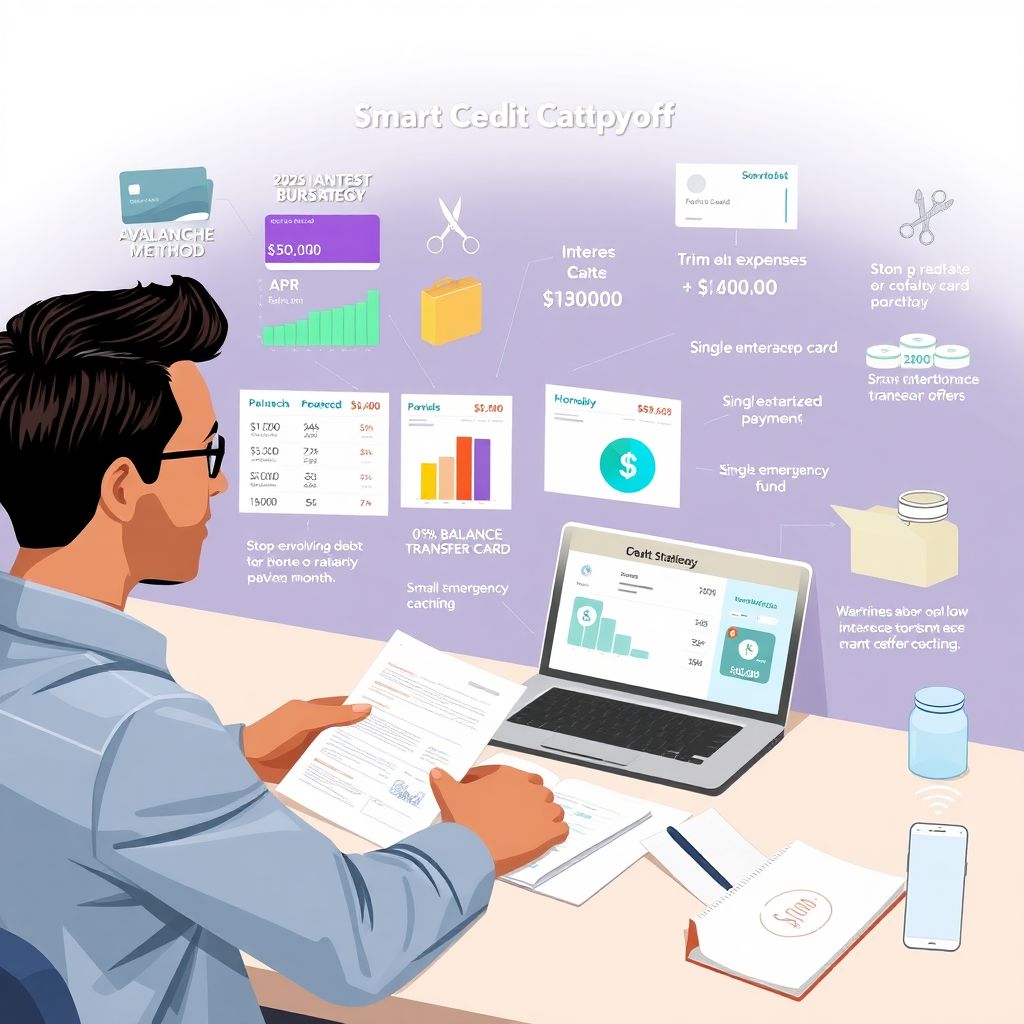
Why Smart Credit Card Debt Strategies Matter More Than Ever
Most people don’t get into credit card debt because they’re reckless; it usually starts with something very mundane: a medical bill, a car repair, a stretch of unemployment, or simply not tracking day‑to‑day spending. The real problem begins later, когда проценты начинают «съедать» доход. With U.S. average credit card APRs hovering around 22–25% in 2025, every $1,000 of revolving balance can easily cost $220–$250 a year in interest alone. That’s why reducing credit card debt isn’t just about “being responsible” — it’s a high‑impact financial strategy that can radically change your cash flow over the next 12–24 months and beyond.
Step 1: Get Brutally Honest With the Numbers
The first smart move is not heroic payments, but clear diagnostics. Most people underestimate how much they owe and how much interest they’re actually paying. Pull your latest statements or log into your accounts and write down, for each card: balance, APR, minimum payment, and due date. It sounds basic, but having everything in one place already puts you ahead of the majority of cardholders who only glance at the minimum due and swipe again. From here, you can see which cards are “bleeding” the most money in interest and which ones are manageable. Think of this as your debt X‑ray before choosing any treatment.
Technical block: How to calculate your “interest burn rate”
To understand how urgent your situation is, calculate how much interest you pay per month:
– Take your APR (say 24%) and divide by 12 → 2% per month.
– Multiply by your current balance. A $5,000 balance at 2% monthly equals roughly $100 in interest every month.
– If your minimum payment is $125 and $100 of that is interest, only $25 actually reduces the debt.
Now imagine you add new purchases; in that case, the principal may barely move. Once people see that only a tiny fraction of their payment reduces the balance, they quickly understand why finding the best ways to pay off credit card debt fast is not about tricks, but about changing the structure of the debt itself.
Step 2: Pick a Payoff Strategy That Matches Your Psychology
There are two classic strategies that really matter in practice: the avalanche and the snowball. Both work, but they work differently on your emotions. In the real world, the “best” method is the one you will actually stick to for 12–24 months, not the mathematically perfect one you drop after three billing cycles.
Avalanche method: Mathematically optimal
With the avalanche method you pay minimums on all cards and throw every extra dollar at the card with the highest APR, regardless of balance size. If one card charges 28% and another 18%, the 28% card gets the attack first. This cuts the most expensive interest early and minimizes total cost. Over a multi‑year horizon, the avalanche can save hundreds or even thousands in interest compared with random payments. However, it can feel slow if the highest‑rate card also has the biggest balance, because it may take many months before you see a zero.
Snowball method: Psychologically powerful
The snowball flips the logic: you pay extra on the card with the smallest balance, ignoring APR for the moment. When that card is gone, you roll its payment into the next smallest, and so on. Mathematically you pay a bit more in interest than with avalanche, but you get early wins. In behavioral finance, those quick victories are often more effective at keeping people engaged than knowing you saved an abstract amount in interest. For many clients of financial coaches, the snowball is the single most realistic way to stay committed through the tedious middle phase of debt repayment.
Real‑life example: Mixed strategy that actually worked
Consider Julia, 34, who in 2024 had three cards:
– $900 at 22% APR
– $3,800 at 19% APR
– $6,500 at 29% APR
Her first impulse was pure snowball: kill the $900 balance to feel relief. After running the numbers, a counselor suggested a hybrid. Julia paid off the $900 card first (snowball win), then immediately shifted to avalanche and attacked the 29% APR card. Result: she cleared all cards in 26 months instead of the 32 months projected with a pure snowball approach, and saved over $1,100 in interest versus her original “just pay what I can when I can” habit.
Step 3: Stop the Bleeding Before You Optimize
Before you look for sophisticated solutions, you need to cap the damage. That usually means two things: no new revolving debt, and carefully trimming nonessential expenses for at least six months. You don’t have to live like a monk, but temporary restraint makes your efforts visible much faster. Push recurring spending (subscriptions, takeout, impulse online buys) under a microscope. Every $50–$100 you free per month can become extra debt payment. The earlier you redirect that money, the fewer months you’ll be stuck in repayment mode.
Practical levers you can pull immediately
– Put all cards on automatic payment at least for the minimum to avoid late fees and extra penalty APRs.
– Switch new purchases to debit or a single card you pay in full each month, so the old balances can only go down.
– Renegotiate bills (phone, internet, insurance) or downgrade plans for a 6–12 month “debt sprint” period.
In many cases, just pausing lifestyle creep and capturing an extra $200 a month turns a 7‑year payoff horizon into something closer to 2–3 years. That’s a huge psychological difference: a “project” that has a visible end date instead of an endless drain.
Step 4: Use Balance Transfers Smartly, Not Blindly
One of the more powerful tools for reducing interest is using low interest balance transfer credit cards. In 2025, many issuers still offer 0% introductory APR on transfers for 12–21 months, often with a 3–5% transfer fee. Used well, these offers can compress the payoff timeline significantly; used poorly, they simply rearrange the deck chairs while the ship keeps taking on water.
Technical block: When a balance transfer actually saves money

Suppose you have $6,000 at 24% APR. Without a transfer, interest is about $1,440 per year if the balance stayed constant. You find a 0% intro offer for 18 months with a 4% transfer fee:
– Fee: 4% of $6,000 = $240, paid up front or capitalized into the balance.
– If you pay $350 monthly, 18 months × $350 = $6,300, enough to clear the balance before the promo ends.
– Net effect: you pay $240 in fees instead of roughly $1,800+ in interest over the same period.
However, this only works if you stop using the old card, pay on time to keep the 0% rate, and set up a payment schedule that fully clears the balance before the promotional window closes.
Common mistakes with balance transfers
People often treat a transfer as “problem solved” and free credit as spending power. Two typical traps: using the old card again once it’s at zero, and not computing how much per month is required to finish within the promo period. A smart move is to segment your thinking: the transfer card becomes a “debt bucket” with a fixed monthly withdrawal plan, while everyday spending moves to either a separate card paid in full or directly to debit. When handled this way, balance transfers can be one of the best ways to pay off credit card debt fast without resorting to more drastic measures.
Step 5: Consider Professional Help — But Know the Trade‑Offs
If your total unsecured debt is overwhelming (for example, more than half your annual take‑home pay) or you’re already missing payments, DIY strategies may not be enough. That’s where structured credit card debt consolidation programs and counseling come into play. The industry around debt help is massive and mixed in quality, so the key is to understand the categories before signing anything.
Credit counseling and DMPs: The “coached” route
When you hire credit counselor to reduce credit card debt, you’re usually working with a nonprofit agency that reviews your finances and may set up a Debt Management Plan (DMP). Under a DMP, they negotiate reduced interest rates with your creditors (often down to 6–10% instead of 20–30%) and bundle everything into a single monthly payment. You pay the agency, and they distribute the money to your card issuers.
This can significantly lower your interest and provide structure, but it comes with rules: you typically must close or suspend the cards included in the plan, you commit to a 3–5 year payoff schedule, and missing payments can break the arrangement. Still, for people who need discipline and lower rates, a DMP can be a realistic middle ground between doing it alone and going into more drastic forms of debt relief.
Debt relief vs. consolidation vs. bankruptcy
The term credit card debt relief services near me covers everything from legitimate counseling agencies to aggressive settlement firms. Settlement companies try to negotiate lump‑sum reductions of what you owe (for instance, paying $7,000 to wipe out $12,000), often after asking you to stop paying your cards and build up a fund instead. This can seriously damage your credit for years, may trigger collection actions, and can create taxable “forgiven” income. It is a last‑resort tool, not a routine optimization strategy.
Classic consolidation, on the other hand, involves taking a personal loan, HELOC, or other structured product to pay off multiple cards, converting revolving debt into a fixed‑term loan with (hopefully) lower interest. The math can work nicely if the rate is truly lower and you don’t rack up new card balances on top. Bankruptcy is the nuclear option and can discharge many card debts but has the longest‑lasting impact on your credit profile and often on your emotional well‑being as well. The correct choice depends on income stability, total debt, and your tolerance for long‑term credit damage.
Step 6: Build a Mini‑Safety Net to Avoid the Relapse Cycle
One underappreciated “strategy” for reducing credit card debt is actually building a small emergency fund early in the process. It sounds counterintuitive: why save when you’re in debt at 24% APR? But in practice, people without any cash cushion often slide right back into borrowing after the first unexpected bill. A $500–$1,000 buffer won’t protect you from everything, but it will keep a flat tire, a co‑pay, or a sudden work trip from undoing months of progress.
A pragmatic approach is to split your surplus in the first few months: for example, direct 80% to debt payoff and 20% to an emergency fund until you have at least a week or two of expenses stashed away. Once that’s set, you can redirect everything to repayment. In behavioral terms, the mini‑fund acts like a seat belt; it doesn’t speed the car up, but it dramatically reduces the damage from inevitable bumps.
Behavioral Tactics That Make the Math Stick
Raw numbers rarely change behavior by themselves. The people who successfully exit credit card debt in 12–36 months usually introduce some form of environmental design: they make the right move the default one, not a heroic act of willpower. This can be as simple as scheduling automatic extra payments for the day after payday, or keeping only one lower‑limit card on you and storing others out of reach.
Useful behavioral tweaks include setting a clear “debt‑free date” based on your payment plan, tracking your total balance monthly (not daily), and celebrating concrete milestones like “under $5,000” or “second card closed.” For some, it’s also valuable to share the plan with a friend or partner who can provide light accountability. The goal is to shift from feeling like you’re being punished to treating this as a time‑bound project with visible progress markers.
Looking Ahead: How Credit Card Debt Will Change by 2030
By 2025, several trends are already reshaping the landscape of consumer credit, and they will affect how people deal with card debt over the next five years. First, regulation is tightening: more jurisdictions are pushing for clearer disclosures, caps on certain junk fees, and stricter marketing rules for high‑APR products. This won’t make interest cheap — risk‑based pricing isn’t going away — but it should reduce the most opaque and predatory practices, giving consumers slightly more transparent choices when choosing or restructuring credit.
Second, artificial intelligence and open banking tools are making real‑time cash‑flow management much more accessible. Budgeting apps already connect to your accounts, predict upcoming bills, and flag when you’re trending toward carrying a balance. Expect these systems to evolve into proactive “co‑pilots” that suggest targeted actions: they may highlight personalized opportunities like an optimal low interest balance transfer credit card, warn you before a payment pattern triggers a penalty APR, or auto‑simulate the impact of a higher payment on your payoff date. For many households, this will turn planning from a once‑a‑year spreadsheet into a continuous, gentle course correction.
Third, employers and fintechs are expanding workplace financial well‑being programs. It’s becoming more common for HR departments to offer direct access to vetted credit card debt consolidation programs, on‑demand credit education, and even subsidized sessions with a financial coach. Over time, this could shift the stigma around debt from a “personal failure” narrative to a more pragmatic “common challenge with structured solutions” view, which tends to encourage earlier intervention.
At the same time, frictionless digital payments, buy now–pay later options, and instant credit approvals mean the temptation to over‑leverage won’t disappear. If anything, the risk will move from classic credit cards to a mix of card, BNPL, and subscription‑like credit products. The people who will fare best by 2030 are those who treat debt literacy as an ongoing skill, not a one‑off fix — they’ll understand their true cost of borrowing across all channels and deliberately choose when and how to use it.
Bottom Line: A Strategy, Not a Miracle
Reducing credit card debt is less about discovering a secret hack and more about applying a coherent, realistic plan: map your balances and APRs, choose a repayment strategy (avalanche, snowball, or a hybrid), stop adding new revolving debt, and use tools like balance transfers, consolidation, or counseling only when they clearly improve the math and your behavior. Layer on a small emergency buffer and some simple behavioral tactics, and you create a system that quietly works in your favor month after month.
In 2025 and beyond, the tools, apps, and programs around debt will keep getting smarter, but they’re still scaffolding around the same core actions: spend a bit less than you earn, direct the difference strategically, and protect yourself from predictable shocks. If you align today’s habits with that logic, the “debt problem” gradually shrinks from a source of constant stress to a finite project with a clear end date — and that’s the real, durable form of credit card debt relief.