
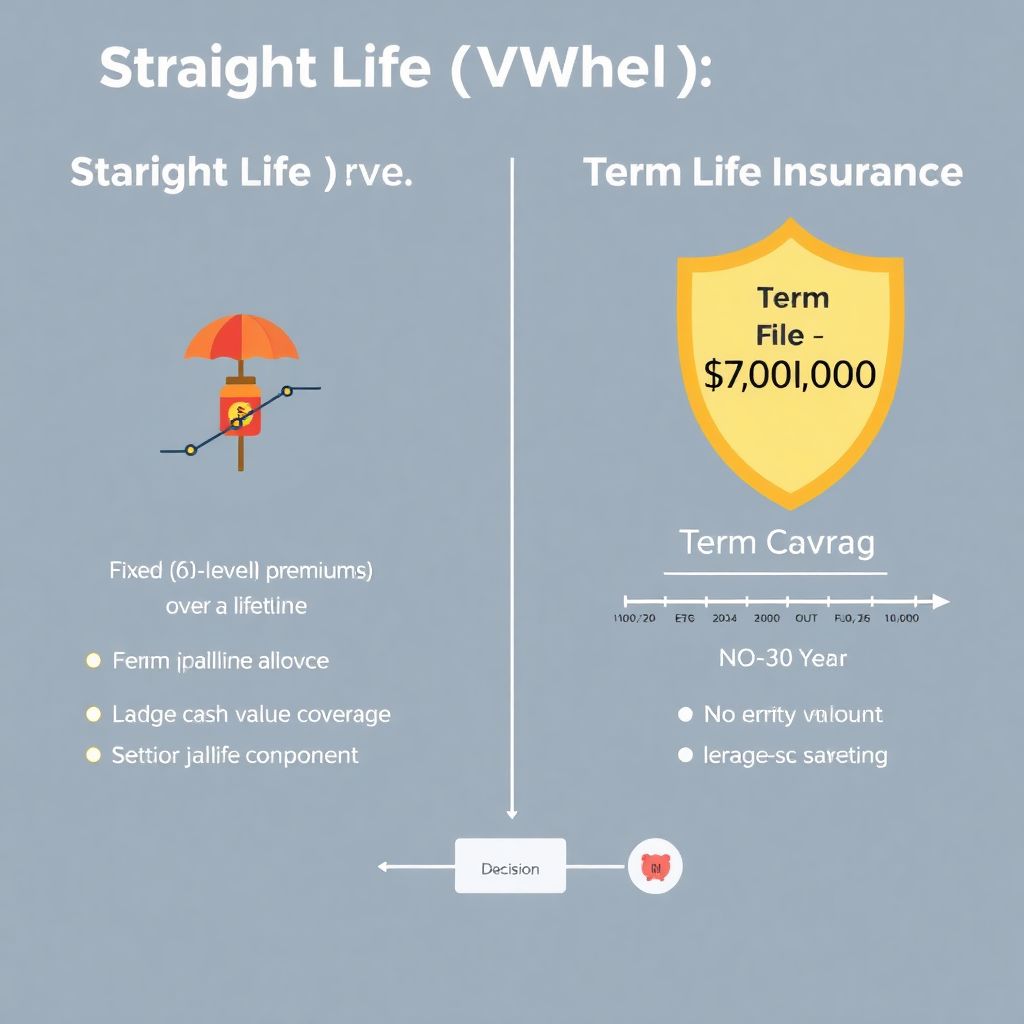
“Straight life” and “whole life” are usually just two names for the same type of permanent life insurance. In most traditional insurance language, a *straight life* policy is a form of *whole life* insurance where you pay fixed premiums for your entire life (or to a certain age, like 100), and the coverage stays in force as long as you keep paying.
So in practical terms: if your parents bought you a $50,000 straight life policy more than 20 years ago, the odds are very high that it is, in fact, a standard whole life policy.
Below is what that actually means for you, how it compares to term life, and how to think about whether to keep it now that you’re married and thinking about proper coverage.
—
What is “straight life” insurance?
“Straight life” typically refers to:
– Level (fixed) premiums: You pay the same amount every month or year, and that amount does not increase with age.
– Lifetime coverage: The policy is designed to last your entire life, not just a set number of years.
– Cash value: Part of your premium builds up a savings-like component inside the policy. This is the cash value, which can grow over time and can often be borrowed against or surrendered.
That description is essentially the textbook definition of whole life insurance. Insurers and agents sometimes use “straight life,” “ordinary life,” or “continuous premium whole life” interchangeably.
There *are* variations within whole life (limited-pay, single-premium, etc.), but what you describe — a long-standing policy with a fixed face amount of $50,000 — is almost certainly a standard straight whole life policy.
—
Why whole life (straight life) is often criticized
Whole life policies get a lot of pushback in personal finance discussions, mainly for these reasons:
1. They are expensive for the amount of coverage you get
For the same premium, a term life policy will usually give you many times more death benefit than a whole life policy.
2. Investment component is usually not very attractive
The cash value grows slowly, with returns that often lag what you could get from investing in broad-market index funds over the long term.
3. Complexity and fees
Whole life contracts are more complex, with internal costs that are hard to see. Many people end up not fully understanding what they bought.
That doesn’t mean whole life is *always* bad; it means it’s often not the best tool for the main job most people need life insurance to do: protect income for dependents in case of premature death.
—
What about your existing $50,000 straight life policy?
You’re in a unique situation compared to someone being *sold* a new whole life policy today:
– The policy has been in force for over 20 years.
– Your parents locked it in when there were health concerns, so your insurability was uncertain.
– By now, it likely has some cash value.
A few important points:
1. You’ve already paid the “front-loaded” costs
Whole life has higher fees and costs in the early years. Those are largely behind you. From this point forward, the economics of keeping the policy can actually look better than starting a new one.
2. The policy may be relatively cheap compared to starting fresh
Because it was purchased when you were a child, the premium might be quite low for lifetime coverage at current age and health status.
3. $50,000 is not enough as primary family protection
For a married adult, especially if you have or plan to have children, $50,000 is typically far below what’s needed to replace income, pay off debts, or cover long-term needs. Think of this policy more as a supplemental piece, not your main safety net.
—
How to think about term life insurance now
Now that you’re married, your first priority is making sure your spouse (and any future children) would be financially secure if you died unexpectedly in the next 10–30 years. That’s exactly the kind of risk term life insurance is designed for.
Key features of term life:
– Coverage for a fixed period (e.g., 20 or 30 years).
– Much larger death benefit for the same premium compared with whole life.
– No cash value; if you outlive the term, the policy ends and you get nothing back.
Typical coverage guidelines suggest:
– An amount roughly 10–15 times your annual income, adjusted for debts, kids, and whether your spouse has significant income.
– A term length that covers your highest-risk years — often until:
– Your mortgage is substantially paid off,
– Kids are grown and financially independent, and
– You have substantial retirement savings.
For example, someone earning $70,000 per year might look at a $700,000–$1,000,000 20- or 30-year term policy, depending on their situation. The cost for that level of term coverage can still be quite modest if you’re relatively young and healthy.
—
Should you keep the straight life policy *and* buy term?
In many cases, the best combination is:
– Buy a new term policy for adequate coverage, and
– Keep the old whole/straight life policy, especially if the premium is low and your health history is complicated.
Here’s why you might keep it:
1. Guaranteed lifelong coverage
If something happens to your health later and you become uninsurable or very expensive to insure, that $50,000 benefit will still be there as long as you pay the premium.
2. Small but certain inheritance or final-expense coverage
Even when you are old and no longer need a large death benefit, $50,000 can cover funeral costs and leave a modest legacy.
3. Existing cash value
The policy likely has accumulated some cash value. If you surrender the policy, that’s what you would get back (minus any taxes if applicable). Compare that to the long-term benefit of keeping it in force.
You might consider surrendering or reducing the policy only if:
– The premium is *painfully* high relative to your budget.
– You need cash urgently for a critical goal (e.g., debt payoff with high interest, emergency fund).
– You can secure robust term coverage at a good rate and you are confident about your long-term insurability and savings discipline.
—
Practical steps to evaluate your current policy
Before making a decision, it’s worth getting concrete details instead of guessing. Request the following information directly from the insurer:
1. Policy type and features
Ask them to confirm in writing whether it is a whole life (straight life) policy, and whether there are any riders or special conditions.
2. Current cash value
Find out how much cash value has built up and the surrender value (what you’d receive if you cancel now).
3. Premium details
– Current premium amount and frequency
– Whether premiums are level for life
– How long premiums must be paid (some policies become “paid up” at a certain point)
4. Projected values
Request an illustration showing:
– Projected cash value and death benefit at future ages (e.g., 50, 60, 70).
– Any point where the policy becomes self-sustaining (i.e., dividends or internal values can cover the premium).
When you see the numbers on paper, it’s much easier to weigh the trade-offs.
—
How to decide if it’s “worth it” to maintain the policy
Ask yourself a few key questions:
1. Is the premium affordable without sacrificing your main goals?
If the payment is small enough that it doesn’t hinder:
– Building an emergency fund,
– Paying off high-interest debt,
– Contributing to retirement accounts,
then keeping the policy is often reasonable.
2. What would you do with the surrender value if you canceled?
If surrendering gives you a few thousand dollars:
– Would it be used to pay down high-interest debt?
– Would it fund a crucial financial safety net?
– Or would it just sit in a low-yield account?
The more *productive* the alternative use, the stronger the case for surrendering.
3. How is your current health?
If your childhood health issues are completely resolved and you’re now in excellent health, you may have great access to affordable term coverage. If your health is borderline or uncertain, that lifetime coverage becomes more valuable.
4. Do you value guaranteed long-term coverage beyond term?
Some people like knowing they will always have at least a small policy in place, no matter how long they live. If that peace of mind matters to you, it’s a point in favor of keeping the straight life policy.
—
A sample strategy for someone in your position
While everyone’s finances are different, a common, sensible approach for someone in your situation might look like this:
1. Keep the existing straight life policy (assuming the premium is manageable and you don’t urgently need the cash).
2. Buy a new level term life policy that:
– Covers 10–15 times your income (or an amount shown by a more precise needs analysis).
– Lasts 20–30 years, depending on your age and family plans.
3. Review your coverage every few years
As your income, savings, mortgage, and family situation change, you might adjust term coverage down the road.
4. Use investments, not whole life, for growth
Focus your long-term savings and investing in retirement accounts and diversified investments, rather than trying to use life insurance as an investment vehicle.
—
Long-term view: what happens decades from now?
If you keep the straight/whole life policy:
– It can act as a small permanent layer of coverage that outlives your term policy.
– By retirement, your financial risk should ideally be much lower: mortgage largely paid off, children independent, assets accumulated. At that stage, a $50,000 policy isn’t about income replacement; it’s about final expenses and small legacy planning.
– You may even be able to stop paying premiums later if the policy reaches a “paid-up” status or if you use dividends/cash value to cover premiums, depending on the contract.
If you surrender it and rely solely on term:
– You likely get more coverage now for the same or lower total premiums.
– But once the term expires, if you still want or need coverage, you would have to buy it at an older age, potentially with worse health and higher cost, or go without.
—
Bottom line
– Yes, “straight life” is effectively a kind of whole life insurance: permanent coverage with fixed premiums and a cash value component.
– Your existing $50,000 policy is almost certainly that type of whole life.
– It is not enough as a primary safety net for a married person; you should strongly consider adding a substantial term life policy to protect your spouse and any future children.
– Whether you keep the existing straight life policy depends on its cost, your health, your other financial priorities, and how much you value having a permanent, guaranteed benefit.
The most balanced approach for many people in your shoes is to keep the old straight life policy as a small permanent layer and add a large, affordable term policy for the years when your family depends heavily on your income.