
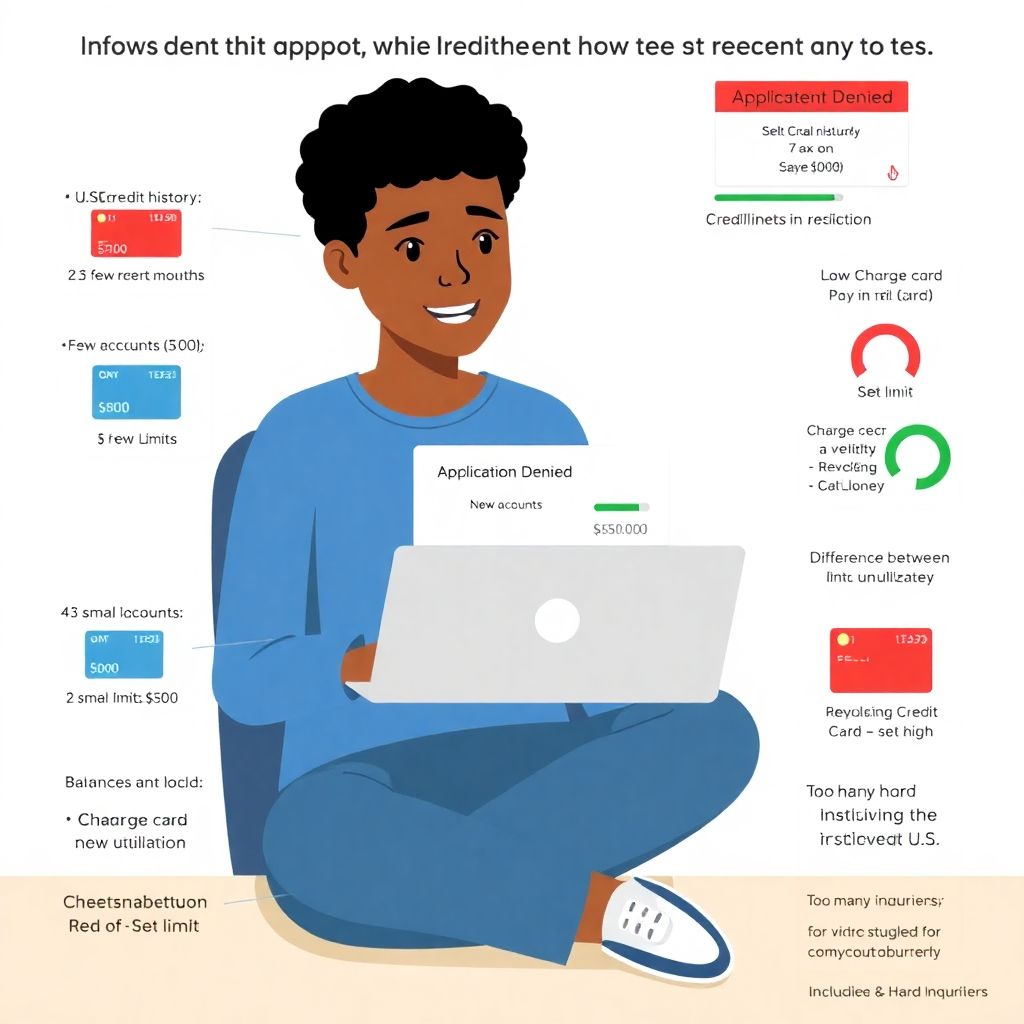
Struggling to Get Approved for a Regular Credit Card in the U.S.? Here’s What’s Going On
Moving from another country and trying to build credit in the United States can be frustrating, especially when you’re doing everything “right” and still getting denied. If you’ve already managed to get one or two cards but keep getting turned down for others, you’re dealing with a very common situation: a thin or young credit profile that lenders don’t fully trust yet.
Below is a clear breakdown of why this happens, how long you should wait before applying again, what kind of credit score and history banks like to see, and what you can do right now to improve your chances.
—
Why You’re Getting Denied Even Though You Already Have Cards
You’ve already done something many new arrivals can’t: you leveraged your Canadian credit history to get a U.S. American Express charge card and a couple of low-limit credit cards. That’s a solid start. But from a typical U.S. lender’s perspective, your profile still has several “risk flags”:
1. Short U.S. credit history
Even if you had a strong record in Canada, most U.S. banks primarily care about what they can see on your American credit reports. If your first U.S. card only dates back to May and another to August, your credit history is still less than a year old. Many issuers prefer to see at least 6–12 months of *domestic* history, and some want 1–2 years for their more attractive cards.
2. Limited number of accounts
Two or three open accounts is good for a start, but it doesn’t give lenders much data. They can’t yet see how you handle multiple lines of credit over time, especially revolving credit lines (traditional credit cards, not charge cards).
3. Low total available credit
With limits around $500 per card, your total available credit is modest. That means any small balance you carry can make your utilization ratio look high. High utilization—even temporarily—can pull your scores down and make you seem riskier.
4. Charge card vs. credit card confusion
A card like Amex Gold is often a “charge” product: you’re expected to pay in full every month. While it can contribute to your U.S. credit history, many banks put more weight on how you manage traditional revolving credit cards with set limits.
5. Too many recent applications (inquiries)
If you’ve applied for several cards across different banks in a short period, you’ve likely accumulated multiple hard inquiries. A cluster of recent applications can look like you’re desperate for credit, which raises risk in lenders’ scoring models.
—
How Long Should You Wait Before Applying Again?
There isn’t a single magic number, but there are some good rules of thumb:
– Wait at least 3–6 months after your last denial before applying for another new card, especially with the same bank.
– Many people see meaningful improvement after 12 months of consistent on-time payments and low utilization.
– For the “better” cards (higher limits, more perks), some issuers prefer to see 1–2 years of clean U.S. credit history.
Instead of applying frequently, focus on making your current accounts as strong as possible. Time is one of the biggest ingredients in a healthy credit profile.
—
Is There a Specific Credit Score You Should Aim For?
Banks don’t publish strict minimums, and each card has its own internal criteria. But general guidelines:
– Below 670 (FICO): Considered fair or below; approvals will be harder, and limits may be low.
– 670–739: Good credit; some mainstream cards become realistic, especially if your history isn’t extremely short.
– 740+: Very good to excellent; opens the door to many premium products, provided your file isn’t too thin or extremely new.
However, remember that score alone is not enough. A 720 score with 3 months of history is less attractive to some banks than a 690 score with 3–5 years of history and multiple well-managed accounts.
—
How to Strengthen Your Profile Before Applying Again
Instead of chasing approvals right now, use the next several months to build a rock-solid record with the cards you already have.
1. Perfect payment history
– Pay every bill on time, every single month.
– Set up automatic payments for at least the statement balance if you can.
– One late payment can hurt much more when your history is short.
2. Keep utilization low
– Aim to use under 30% of your total available credit at all times if possible.
– For even better optics, many people try to stay under 10% when a statement closes.
– With a $500 limit, try not to let your reported balance exceed about $50–$150 when the statement cuts.
3. Use your cards regularly but responsibly
– Put normal weekly or monthly expenses (groceries, gas, subscriptions) on your cards.
– Pay them off in full to avoid interest and show consistent, responsible usage.
4. Avoid a burst of new applications
– Each hard inquiry can shave a few points off your score for a short time.
– Multiple inquiries in a short period can reduce your approval odds, even if your score looks okay.
—
When to Consider Applying for Another Card
You’ll typically improve your chances if you can check most of the boxes below:
– You’ve had your oldest U.S. card for at least 9–12 months.
– You’ve had no late payments at all.
– Your average utilization has been consistently low (ideally under 30%, better under 10%).
– You haven’t had a new inquiry in the last 3–6 months.
– Your credit score has been stable or rising, not bouncing around due to high balances.
If those conditions hold, you can try applying for a mid-tier card that’s known to be friendly to newer credit profiles, preferably with a bank that often works with people who are early in their journey.
—
Should You Aim for Specific Banks or Types of Cards?
With a thin or young U.S. file, some strategies are more realistic than others:
– Stick with issuers that have already approved you
If Capital One or Fidelity has given you a chance, consider whether they offer product upgrades or additional cards with better terms after some time. Sometimes, internal history with a bank counts more than your score.
– Give Amex time with you
Since you already have an Amex charge card, consistent, responsible use can improve your standing with them. After 6–12 months of good history, their internal systems may be more open to offering you a regular credit card.
– Avoid jumping straight to premium, high-end cards
Cards with big bonuses, luxury perks, or very high limits usually expect a deeper credit profile. Applying too early can lead to unnecessary denials.
—
Strategies to Grow Your Credit Limits Over Time
Higher limits help lower your utilization and can improve your score, which in turn boosts approval odds elsewhere.
– Request a credit limit increase (CLI)
After about 6 months of on-time payments, many issuers will consider raising your limit.
– Some do “soft pulls” that don’t affect your score.
– If they warn of a “hard pull,” weigh whether it’s worth it at your stage.
– Let your income information stay updated
Higher reported income (accurately reported) can support higher limits. Make sure your card issuers have your current income on file.
– Avoid maxing out your cards
Regularly hitting your limit, even if you pay it off, can look risky. Smaller, frequent payments throughout the month can help.
—
How Non-U.S. History Helps – and Where It Doesn’t
Your Canadian credit history helped you get a foot in the door. Some global banks have systems that translate foreign history into U.S. approvals, which is likely how you got your first American Express card. However:
– Most U.S. issuers do not directly factor in foreign credit reports once you’re applying in the U.S. system.
– Over time, your U.S. track record becomes the main story. Treat your existing U.S. cards as your foundation and build from there.
In other words, your international history gave you a head start, but now you’re being evaluated primarily on how you manage credit within the U.S. framework.
—
What to Do If You Keep Getting Denials
Every time you’re denied, you’re entitled to an adverse action notice that explains the main reasons for the rejection. Pay attention to recurring themes like:
– “Too few accounts with sufficient history”
– “Too many recent inquiries”
– “High utilization on revolving accounts”
– “Length of credit history is too short”
Use that feedback to guide your next steps. If multiple banks are saying your history is too new, that’s a sign you need to wait and let time work for you rather than applying again immediately.
—
A Practical Timeline for the Next 12 Months
Here’s a realistic roadmap given your situation:
Next 3 months
– Use your existing cards regularly for everyday expenses.
– Pay in full and before the due date.
– Keep reported utilization low.
– Do not apply for any new credit.
Months 4–6
– Check your credit scores and reports to confirm that:
– No negative marks have appeared.
– Your accounts are aging and utilization is improving.
– If your income, usage, and history look solid, request credit limit increases on your existing cards.
Months 7–12
– With roughly a year of U.S. history, reconsider applying for one carefully chosen new card that matches your profile.
– Apply only once or twice, not for several cards at once.
– If approved, continue the same discipline: low utilization, on-time payments, and controlled applications.
—
The Bottom Line
You don’t necessarily need to hit a very specific credit score before you apply again; you need a combination of decent score, longer history, lower utilization, and fewer recent inquiries. For someone in your situation—new to the U.S., a couple of low-limit cards, and multiple denials—the best move is usually to pause applications for several months, let your accounts age, keep balances low, and possibly grow your limits where you already have relationships.
Consistency over the next 6–12 months will matter far more than trying to find the “perfect” moment or card. Build slowly and deliberately, and approvals for regular, higher-limit credit cards will become much more attainable.