
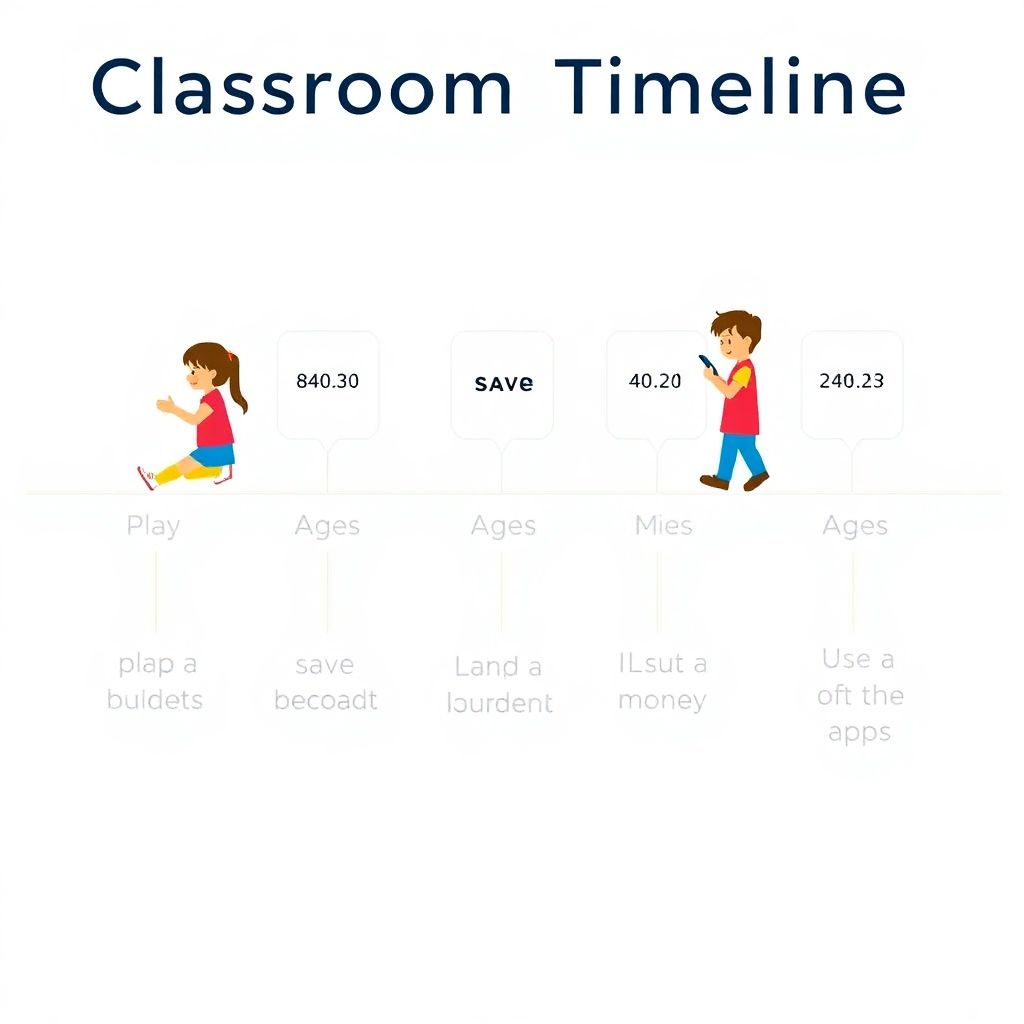
Teaching kids about money works best as a simple, age-by-age sequence: name and play with money in preschool, introduce saving and tiny budgets in early primary, add earning and goals in upper primary, then move into apps, banking, and credit in the teen years. Short, regular, real-life activities beat long lectures.
Core principles for teaching money by age
- Start early with concrete play and language, then gradually add numbers, choices, and responsibility.
- Use small, real amounts of money and repeat the same habits weekly to build routines.
- Connect every lesson to real life: snacks, toys, apps, outings, and later jobs and banking.
- Make mistakes safe and cheap in childhood so teens can learn before real financial risks appear.
- Scale complexity, not pressure: more decisions and tools, but always within clear family boundaries.
- Tailor financial education for kids and teenagers to your values, culture, and comfort with risk.
Preschool foundations (3-5): naming, counting and play-based value
This stage is for most children aged 3-5 who can count a little, follow simple rules, and enjoy pretend play. Avoid structured money lessons if your child is highly anxious around numbers, shows strong delay or overwhelm with basic counting, or if money is currently a major family conflict.
Focus on teaching kids about money as a language and a set of objects, not as stress or pressure. Use play and stories as your main tools.
| Goal | Key activities | Typical time per week | Simple success metric |
|---|---|---|---|
| Name coins and notes | Sort coins by size/color; match play money to real coins; name each one aloud. | 10-15 minutes | Can correctly name most common coins without help. |
| Count small amounts | Count 3-5 coins together while putting them into a jar; simple board games with spaces as “money”. | 10 minutes | Can count up to at least 5 objects and say the final total. |
| Understand basic trade | Pretend shop: child “buys” snacks or toys with play money and hands it over. | 10-20 minutes | Understands that you give something (money) to get something (item). |
Keep it light: at this age, money lessons for kids preschool to teens start with touch, sight, and short conversations like “We give the store money to take home bananas.” No need for amounts, budgets, or rules yet.
Early primary (6-8): saving habits, simple budgets and allowance basics
For ages 6-8, children can handle rules, short-term goals, and tiny numbers. This is where how to teach children about money by age becomes more structured but still very approachable.
You will need a few simple tools and boundaries:
- Three clear containers for spend, save, and give. Transparent jars or labeled envelopes are ideal.
- A small, predictable money source such as a weekly allowance or regular rewards for agreed household contributions, with written rules.
- Visual goal trackers like charts or printed pictures of a target toy with progress bars.
- Consistent money day (for example, every Saturday morning) to review jars, update goals, and talk about choices.
- Spending boundaries (what is always family-paid, what is child-paid, and what is off-limits regardless of money).
| Goal | Key activities | Typical time per week | Simple success metric |
|---|---|---|---|
| Recognize earning vs. gifts | Label money as “gift from grandma” or “earned for helping” when it appears. | 5-10 minutes | Can say whether money was a gift or earned in 3-4 examples. |
| Start saving habit | Split all new money between jars; discuss how “save” grows over time. | 10-15 minutes | Puts something into the save jar most weeks. |
| Make tiny budgets | Plan spending up to a small limit for a snack or outing; compare two low-cost options. | 10-20 minutes | Stays within the agreed budget once you set it together. |
Upper primary (9-11): earning, spending choices and goal-setting
This is the core training ground for best ways to teach kids financial responsibility: children can compare options, wait for bigger rewards, and start earning small amounts. Turn this into a structured mini-curriculum with clear steps and measurable outcomes.
-
Define money roles in your family
Explain what parents always pay for (needs), what kids may pay for (wants), and what is shared. Write this down in a short, visible family money agreement.
- Keep the list short: 5-10 bullet points at most.
- Review it every 3-6 months as your child matures.
-
Set up an earning system that is not tied to basic chores
Keep regular chores as expected family contributions; add optional paid “extra jobs” like washing the car or deep-cleaning the playroom.
- Post a job list with tasks and pay rates.
- Limit jobs to those that are safe and age-appropriate.
-
Create one short-term and one medium-term savings goal
Help your child choose a goal they can reach in weeks, and one in a few months, and write the target amount and target date.
- Print or draw the items and place near their money storage.
- Track progress weekly by coloring in boxes or filling a bar.
-
Introduce a simple written or digital spending log
Use a small notebook, spreadsheet, or basic app (with your supervision) to record money earned and spent.
- Log date, source/where spent, and amount.
- Review the log together once a week for patterns.
-
Practice value-based choices
Use real decisions to ask, “Is this how you want to use your money? What will you not be able to buy if you choose this now?”
- Compare at least two options, not just yes/no.
- Let them feel small consequences without rescue, when safe.
-
Debrief purchases and earning experiences
After each significant buy or earning project, ask what they liked, disliked, and would change next time.
- Keep the tone curious, not judging.
- Capture one concrete change for next time.
Fast-track mode: 3-step overview
If you are short on time, compress this stage into three repeating weekly habits:
- Weekly money meeting: pay for extra jobs, update goals, and review the spending log in 15-20 minutes.
- One intentional spending choice: child decides between two wants, with you narrating trade-offs.
- Quick reflection: one-minute talk: “What did you learn about money this week?”
| Goal | Key activities | Typical time per week | Simple success metric |
|---|---|---|---|
| Understand earning | Offer paid extra jobs with clear rates and payment day. | 30-40 minutes | Can explain which tasks earn money and which do not. |
| Track money flow | Maintain a basic log of income and spending; review together weekly. | 15-20 minutes | Most entries recorded; child can state current balance. |
| Achieve savings goals | Set and monitor goals with visuals and progress updates. | 10-15 minutes | Reaches at least one planned goal within the target time. |
Early teens (12-14): budgeting apps, part-time work prep and digital money
Money lessons for kids preschool to teens now shift into more independent practice and digital tools. Early teens are ready for structured experiments with small risks under your supervision.
Use this checklist to see if your early teen is on track and to guide financial education for kids and teenagers at this stage:
- Can explain the difference between cash, debit cards, and stored-value gift cards in their own words.
- Uses a simple budgeting app or spreadsheet to track allowance, gift money, and any earnings at least once a week.
- Understands that “in-app currency” and game tokens still cost real money and can name who pays.
- Checks prices and compares at least two options before most non-essential purchases.
- Can describe one or two safe ways to earn money at their age (for example, pet sitting, yard work, tutoring younger kids).
- Knows basic online safety: never sharing card details, passwords, or sending money to strangers.
- Can stick to a simple monthly budget for at least one category, such as snacks or entertainment.
- Talks about at least one longer-term goal (for example, a trip or device) and has a rough plan to save for it.
| Goal | Key activities | Typical time per week | Simple success metric |
|---|---|---|---|
| Use digital money tools safely | Practice with a supervised budgeting app or family banking app. | 20-30 minutes | Opens the app unprompted and records activity most weeks. |
| Prepare for part-time work | Discuss legal age, safe job types, and role-play asking for work. | 20 minutes | Can list two or three realistic first-job ideas. |
| Strengthen online safety | Review scams, phishing examples, and safe payment rules. | 10-15 minutes | Can explain what they would do if someone online asks for money. |
Mid to late teens (15-17): credit, banking, taxes and real-world practice
At this age, teaching kids about money must include banks, taxes, and credit. Teens are close to independent life, so focus on practical, reversible experiences and clear boundaries. Watch for these common pitfalls and address them directly.
- Relying on parents as a backup for every financial mistake, which removes natural consequences and weakens learning.
- Getting access to a credit card (even as an authorized user) before they can track spending accurately and pay on time.
- Using buy-now-pay-later or subscription services without understanding total cost, renewal dates, and cancellation rules.
- Ignoring small, regular expenses like snacks and app subscriptions that quietly drain accounts over time.
- Not reading basic terms on bank accounts, overdraft rules, or mobile payment apps they already use.
- Confusing tax withholding with total tax owed, or assuming any refund is “free money” to spend immediately.
- Sharing cards or account logins with friends or partners instead of using trusted, individual methods.
- Taking on paid work that disrupts sleep, school, or health, undermining the purpose of earning.
- Skipping simple record-keeping for income and expenses, making it hard to file basic tax forms or track goals.
| Goal | Key activities | Typical time per week | Simple success metric |
|---|---|---|---|
| Manage a bank account | Open a youth account together; review statements and alerts. | 20-30 minutes | Balances account monthly and resolves any issues with guidance. |
| Understand credit basics | Explain interest, minimum payments, and responsible card use. | 15-20 minutes | Can describe how missed payments affect their future. |
| Prepare for taxes | Walk through a sample pay stub and simple tax scenario. | 20-30 minutes (seasonal) | Can identify gross pay, net pay, and basic withholdings. |
Designing a progressive, measurable family money curriculum

Here is how to teach children about money by age without overwhelming yourself. Choose a structure that fits your time, comfort, and family values, and adjust as you go.
Option 1: Weekly micro-lessons (slow and steady)
Ideal if you have limited free time but want consistent exposure.
- Pick one 15-20 minute slot per week per child or sibling group.
- Rotate focus: earning, saving, spending, giving, digital safety.
- Use real events from the week as examples to keep it relevant.
Option 2: Project-based money themes (vacations, birthdays, big buys)
Use upcoming events as anchors for money lessons.
- Let kids help plan a budget for a party, trip, or large purchase.
- Give them a portion of the budget to manage with clear constraints.
- Debrief afterward: what went well, what they would change, and what they learned.
Option 3: Six-week accelerated family money plan
Use this fast-track for a focused season, then shift to maintenance:
- Week 1-2: Set up jars or basic accounts, explain family money rules, and start a simple log for upper primary and older.
- Week 3-4: Add earning opportunities, one savings goal per child, and one weekly family money meeting.
- Week 5-6: Introduce a budgeting app for teens, run one small project (like a planned outing), and reflect together on what each child learned.
| Age band | Main focus | Primary tools | Key progress indicator |
|---|---|---|---|
| 3-5 | Recognize money and simple trade | Play cash register, coins, pretend shop | Names coins and understands paying to get items |
| 6-8 | Saving habit and tiny budgets | Jars, allowance rules, picture goals | Saves regularly and keeps to agreed small budgets |
| 9-11 | Earning and goals | Job list, spending log, goal charts | Tracks money and reaches set goals |
| 12-14 | Digital money and early work | Budgeting app, gift cards, guidance on gigs | Uses app, compares prices, knows safe work options |
| 15-17 | Banking, credit, and taxes | Youth account, sample statements, pay stubs | Manages account, explains credit impact and basic taxes |
Parents’ recurring concerns with concise solutions
How much allowance should I give at each age?
There is no single correct amount because incomes and costs differ by family. Choose a sum small enough that mistakes are affordable but large enough that kids can practice saving and spending; then review yearly and adjust with your budget and their responsibilities.
Should kids be paid for regular chores?
Paying for every basic chore can blur the line between being part of a family and working. Many families separate non-negotiable chores from optional, extra paid jobs, so children learn both contribution and earning without endless negotiation.
What if my child spends all their money on junk?
As long as it is safe and within your family rules, allow some regrettable purchases. Use them as low-stakes lessons by asking afterwards what they might do differently next time, instead of rescuing or quietly topping up their funds.
How do I handle different rules for siblings of different ages?
Explain that older children get more money and freedom because they also carry more responsibility and expectations. Write age-based privileges and duties down, and review them at birthdays so changes feel fair and predictable, not random.
Is it too late to start financial education with my teenager?
It is never too late. Start with what they already care about: phones, transport, outings, and upcoming work. Offer gradual control over parts of the budget alongside clear limits, and use banking apps and statements as concrete teaching tools.
How can I teach money values without oversharing adult financial stress?
Share the principles behind your decisions (such as avoiding debt for wants) without giving exact numbers if that feels uncomfortable. Use simple examples and explain trade-offs in age-appropriate language rather than discussing every bill in detail.
What if I do not feel confident with my own money skills?
Learn alongside your children using beginner-friendly books, videos, and tools. Be honest that you are improving too, and keep activities small and simple; modeling curiosity, humility, and progress is itself a powerful money lesson.