
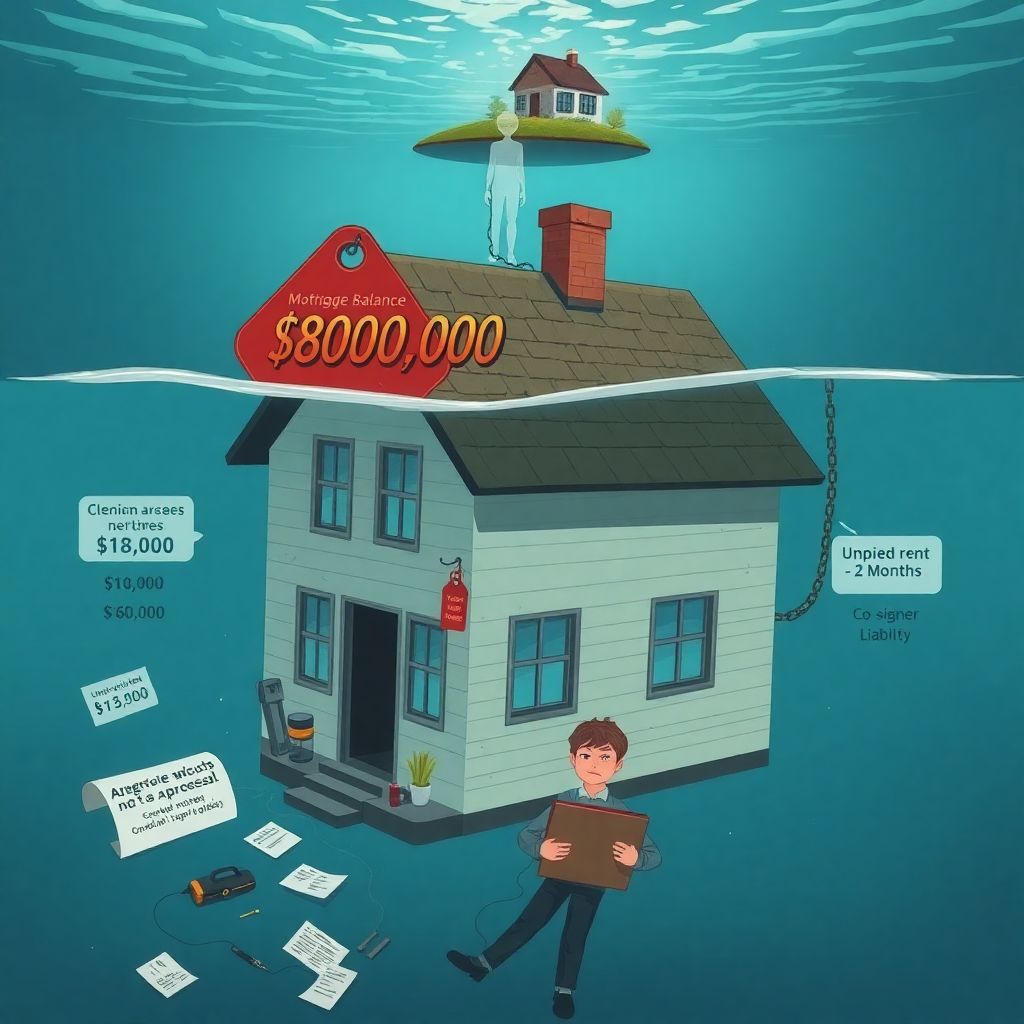
Underwater mortgage with co‑signer and renewal approaching: what now?
I bought a house in 2022 with a co‑signer. Looking back, that decision – and the purchase itself – was a major financial mistake for me. I’m not trying to dodge responsibility: I understand these are consequences of my own choices, and I’m actively trying to find a realistic way forward.
How I ended up underwater
After buying the property, I went back to school, which meant my income dropped significantly. To cover the mortgage, I decided to rent the house out. That’s where things went badly wrong.
I ended up with a terrible tenant who stopped paying rent and caused serious damage. At this point:
– The tenant owes me about $18,000 in unpaid rent
– The damage to the property will cost around $18,000 to repair
Because of the reduced income and the rental disaster, I fell behind on the mortgage. Right now I’m about two months in arrears.
Refinancing attempt and underwater value
I tried to refinance the mortgage to get some breathing room. The bank refused. The reason is simple: the property is underwater.
– Mortgage balance: about $800,000
– Current appraised value: about $600,000 (and that’s before doing repairs)
So I owe roughly $200,000 more than the house is worth. From the bank’s perspective, there’s no equity to support a refinance.
The co‑signer’s position and the communication gap
I bought the house with a co‑signer, which at the time felt like the only way to qualify. In hindsight, it tied someone else’s financial future to my risk, and that’s been weighing on me.
I initially did not tell the co‑signer about the mortgage arrears or the full scale of the financial trouble. She did know there were problems with the tenant, but not that I was behind on payments or how bad things had become.
That lack of transparency has now created even more tension and mistrust.
Talking to an LIT and the surrender option
I consulted a Licensed Insolvency Trustee (LIT) to explore formal debt solutions. One of the options they suggested was a surrender of the property under a Division I proposal (this is a Canadian insolvency route, generally used when debts are very high or when a consumer proposal isn’t suitable).
In simple terms, this would mean:
– I would hand the property back and walk away from it as part of a formal insolvency process
– The shortfall (the difference between mortgage balance and sale price) would be dealt with in that proposal
– My co‑signer, however, could still be pursued by the lender for any remaining amount not covered by me in the proposal, unless the bank agreed otherwise
I then informed the co‑signer about what the LIT had suggested. She asked for time to research it, which was fair. Instead of discussing it directly with me, she contacted my parents and set up a meeting with them.
In that meeting, she made it clear she would not agree to me surrendering the house because of the high risk that the bank would pursue her for the full shortfall. From her viewpoint, that’s absolutely understandable: she’s on the hook too.
Family support and the renewal deadline
My parents, after learning the full situation, are now willing to help:
– They’re prepared to cover the arrears
– They’re also willing to pay for the repairs (around $18,000) so the house can be rented out again
The mortgage is a 5‑year term, and it comes up for renewal next year. The co‑signer wants to be released at renewal. That’s her line in the sand.
This leaves me stuck:
– Financially, the property doesn’t make sense. I’m deeply underwater with a massive mortgage on a house worth significantly less than the debt.
– Morally and legally, I don’t want to walk away in a way that leaves the co‑signer exposed to aggressive collection on the shortfall.
Key constraints in this situation
Here are the main constraints I’m dealing with:
– Location: Canada (so Canadian mortgage and insolvency rules apply)
– Term: 5‑year mortgage term, renewal next year
– Rate: 3.85% interest (relatively low compared to recent market hikes)
– Balance vs value: Owe ~$800,000, current value ~$600,000 without repairs
– Arrears: 2 months behind, but parents can help bring that current
– Co‑signer: Wants out at renewal and does not accept surrender/insolvency risk
Possible ways forward
This is not a situation with a perfect solution, but there are several paths to examine carefully. Each comes with trade‑offs.
1. Stabilize the mortgage in the short term
If your parents are willing and able:
– Use their help to clear the arrears immediately
– Complete the necessary repairs so the property is rentable at a market rate
– Document everything: costs, payments, and any informal “loans” from parents
This at least stops the immediate threat of foreclosure and protects the co‑signer in the short term. It also gives you time to think strategically before renewal.
2. Re‑rent the property – but only with stronger safeguards
If you choose to rent again, do it in a far more controlled way:
– Use strict tenant screening: credit checks, references, proof of income
– Consider using a reputable property management company, even though it costs money; they often prevent far more expensive problems
– Require damage deposit (where allowed) and clear clauses about repairs and inspections
– Schedule regular inspections to catch issues early
Your goal is to turn the house into a stable, income‑producing asset, or at least something that reduces your monthly loss, while you wait for renewal or a better exit opportunity.
3. Plan for the mortgage renewal now
With renewal coming next year, you need a strategy well in advance:
– Talk to your current lender early and ask what they would require to renew without the co‑signer
– Ask if they would allow a name change or release of the co‑signer if you meet certain conditions (income, debt ratios, payment history over the next 12 months)
– If they won’t, consider whether any other lenders might take you on at renewal – although being underwater and having arrears history makes this difficult
Be realistic: if your income is still low due to school, it may be hard to qualify on your own for an $800,000 mortgage. That means the co‑signer’s demand for a release at renewal could be very hard to satisfy in practice.
4. Consider a structured agreement with your co‑signer
The relationship with your co‑signer is under stress, and understandably so. To reduce conflict and uncertainty:
– Sit down and have a transparent, written discussion about:
– Who is paying what (mortgage, repairs, insurance, taxes)
– What happens at renewal if you cannot refinance without her
– How you will keep her updated on payments and any issues
– Consider drafting a formal agreement (with legal advice) stating:
– That you assume responsibility for shortfalls
– How you will handle any default or forced sale
– How you’ll compensate her if she ends up paying because of bank action
While this doesn’t eliminate her legal risk with the lender, it may give her reassurance about your commitment and clarify expectations.
5. Evaluate the hard choice: sell at a loss vs hold and hope
You’re massively underwater. Two broad strategic options:
A. Sell now (or after repairs), accept a large shortfall
– The property might sell around $600,000 after it’s repaired
– You’d owe the lender the $200,000+ shortfall, plus costs
– That shortfall becomes unsecured debt, which may be negotiable or addressed through a proposal or insolvency process
– The co‑signer remains liable for that shortfall, but if you enter a formal proposal and make payments, it may reduce eventual exposure
B. Hold the property and hope for market recovery
– You keep making payments, supported by rental income and parental help
– You gamble that in a few years, the market value climbs closer to or above the mortgage balance
– You live with ongoing financial strain, risk of vacancies or more tenant issues, and the stress of being stuck in a bad investment
Neither option is attractive. Selling may crystallize the loss but could give you a path to rebuild. Holding can preserve credit and avoid immediate damage but locks you into a highly leveraged, negative‑equity position.
6. Revisit the insolvency / Division I proposal option with full legal advice
You’ve already talked to an LIT, which is a smart step. Given the co‑signer’s involvement, it’s worth:
– Getting independent legal advice (not just from the LIT) about how a Division I proposal or bankruptcy would affect:
– You
– The co‑signer
– The lender’s right to pursue her for any shortfall
– Asking specifically:
– If you surrender the house and include the shortfall in a proposal, what is the likely amount still collectible from the co‑signer?
– Are there any negotiation strategies with the lender to limit action against her if you follow through on a proposal?
This won’t magically make the risk disappear, but it will replace assumptions and fears with concrete information.
Emotional and ethical dimension
This situation isn’t only about numbers:
– You feel guilt for involving a co‑signer in a purchase you now regret
– You’re under intense stress from debt, school, and family dynamics
– The co‑signer feels blindsided by the arrears and potential surrender
Recognizing all of that matters. Clear communication, admitting past mistakes openly, and demonstrating a credible plan are as important as any technical financial step. It will be easier to gain cooperation from your co‑signer and your parents if they see you’re informed, proactive, and not hiding information anymore.
Practical next steps you can take this month
1. Stop the bleeding
– With your parents’ help, bring the mortgage current.
– Begin or schedule essential repairs so the house can be rented at a proper rate.
2. Document your cash flow
– List your current income, expenses, and projected rental income after repairs.
– See if the property will still run at a loss and by how much.
3. Meet again with the LIT and a lawyer
– Ask very direct questions about worst‑case scenarios and co‑signer liability.
– Get clarity on what a Division I proposal or other formal process would look like.
4. Have a structured talk with your co‑signer
– Share updated information: arrears resolved, repair plan, rental strategy.
– Discuss realistic expectations for renewal and what happens if you can’t refinance her off.
5. Set a decision deadline before renewal
– For example, decide that six months before renewal, you will either:
– Commit to keeping the property and apply for renewal, or
– List it for sale and tackle the shortfall through negotiation or a proposal
The bottom line
You’re in a tough, high‑stress financial mess, but not a hopeless one. The house is underwater, you’re tied to a large mortgage with a co‑signer, and renewal is approaching. There isn’t a pain‑free solution, but there are structured ways to reduce damage:
– Stabilize the mortgage now
– Turn the property into a manageable rental if possible
– Be transparent with your co‑signer and family
– Use professional advice from an LIT and a lawyer to understand all consequences
– Decide, before renewal, whether you’re going to hold and manage the risk or sell and confront the loss head‑on
Every choice involves trade‑offs, but taking organized, informed steps now will give you far more control than waiting for the bank or the market to decide your fate.