
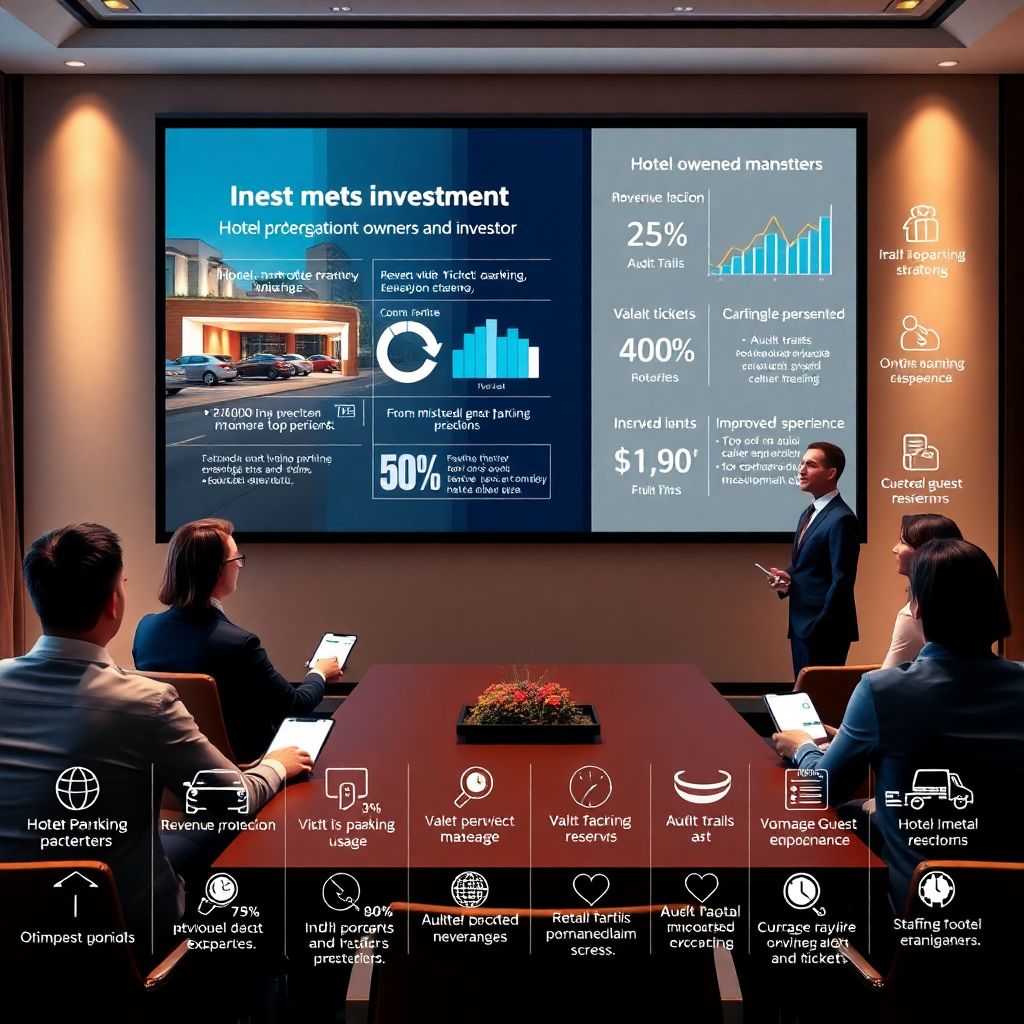
How to Justify Valet System Investments to Hotel Ownership
Convincing ownership to spend on a valet management system can be tricky, especially when the price tag looks significant and the return isn’t as obvious as room revenue or F&B sales. A typical system costing around 10,000 a year may seem modest in the context of total hotel expenses, but leadership will still ask a fair question: “What do we get back for this?”
To make a compelling case, you need to move beyond vague promises of “better service” and translate the impact of valet into numbers, risk reduction, and strategic value.
1. Frame It as a Revenue Protection and Optimization Tool
Valet rarely shows up as a direct line of new revenue, but it strongly influences how much revenue you keep and how much you can grow. Ownership thinks in terms of:
– How does this protect existing revenue?
– How does this help us capture more revenue from the same asset?
Make these links explicit:
– Parking revenue integrity: A digital valet system tracks every vehicle, every ticket, every charge. That reduces undercharging, missed tickets, “friends & family” freebies, and basic human error. Estimate how many tickets might be slipping through now. Even a 2–5% leakage on parking fees can add up to thousands of dollars annually.
– Improved upsell opportunities: With guest data and patterns, your team can promote premium parking options (preferred spots, overnight packages, event parking) more consistently. A structured system makes it easier to standardize and monitor these upsells.
– Better use of limited space: If your parking capacity is tight, a valet system can help optimize every spot, allowing you to serve more cars at peak times (events, weekends, holidays). More cars parked = more revenue, especially in urban or resort locations.
Instead of saying “it improves efficiency,” show a projected range:
– If average lost or mis-billed parking is currently estimated at just 1–2 cars a day, multiplied by your rate and 365 days, you can demonstrate how quickly that 10k investment pays for itself.
2. Emphasize Risk Reduction and Liability Control
Ownership is highly sensitive to anything that could create a big, unexpected hit to the P&L. Valet operations are inherently risk-heavy: vehicle damage, lost keys, guest disputes, and potential legal exposure. A structured valet system reduces these risks and provides documentation when issues arise.
Key arguments:
– Clear audit trail: Digital time stamps of check-in and check-out, driver identity, photos on arrival, and condition reports create a verifiable record. This can drastically reduce fraudulent claims and shorten dispute resolution.
– Lower damage and claim costs: Even if claims are infrequent, one major payout can exceed the annual cost of the system. Highlight that ownership is not just paying for software, but for a form of insurance against poor documentation and mismanaged incidents.
– Consistency in procedures: A system-enforced workflow ensures staff follow standard steps: inspections, ticket scanning, proper key handling. That reduces human error and careless mistakes that lead to costly problems.
If you have any historical data on damage claims or guest disputes, estimate how much a more controlled system might have saved you over the past 1–3 years. Ownership responds well to, “In the last two years we paid X in claims. If a system could have prevented even 30–40% of that, it would already be paying for itself.”
3. Connect to Guest Experience and Reputation Metrics
Guest experience may sound soft, but its impact shows up directly in:
– Review scores
– Repeat business
– Group and corporate decisions
– Rate tolerance (how much you can charge)
Valet is often the first and last touchpoint of the stay. If the arrival is chaotic, parking is slow, or cars are misplaced at checkout, you’re starting and ending the guest journey with friction.
Explain it in ownership language:
– Better arrivals = better reviews: Guests rarely separate “parking” from the overall hotel experience. A seamless valet process reduces wait times and confusion at the curb during peak hours, which helps keep overall satisfaction scores high.
– Impact on ADR and occupancy: Higher review scores and smoother arrival experiences support higher pricing power and make it easier to win group and corporate RFPs. No, the valet system alone won’t raise ADR by 10%, but it contributes to the total experience that allows you to maintain or grow rate.
– Managing peak pressure points: Busy check-in/check-out periods are when problems cluster: traffic jams at the entrance, upset guests, safety issues, and stressed staff. A system that coordinates arrivals, departures, and ticket handling reduces chaos and visible guest frustration.
Translate this into a realistic scenario: if improved arrival and departure experiences lead to even a small bump in review scores or fewer negative comments about parking, that contributes to your overall brand positioning and future revenue.
4. Highlight Operational Efficiency and Labor Optimization
From an ownership perspective, labor is one of the biggest controllable costs. A valet system can either allow you to run with slightly leaner staffing or make your existing team more productive. Both have value.
Consider these operational points:
– Reduced manual errors: No more illegible paper tickets, lost stubs, or confusion about which car belongs to whom. This reduces time spent resolving mistakes and searching for cars.
– Faster car retrieval: Real-time tracking allows attendants to stage cars in advance during peak times. Shorter waits mean higher throughput with the same staff count.
– Data-driven scheduling: Systems often provide reports on arrival/departure peaks. That helps you schedule valet staff more precisely rather than overstaffing “just in case.” Ownership appreciates decisions backed by data rather than guesswork.
Where possible, convert these into numbers: how many staff hours could be saved per week by reducing time spent sorting out issues, searching for keys, or dealing with misplaced cars? Those hours have a direct cost.
5. Show Competitive Positioning and Brand Alignment
Ownership typically cares about how your property compares to the competition and how well operations support the brand promise.
Position the valet system as part of a larger strategy:
– Keeping pace with comparable hotels: If similar properties in your market use professional valet systems, not having one can make you look behind the curve.
– Brand standards and expectations: For upscale and full-service properties, a smooth, tech-enabled valet operation aligns with guest expectations of a modern, professional hotel.
– Corporate and group clients: Planners evaluating venues pay attention to arrival logistics, especially for large groups, VIPs, and events. A reliable valet system makes you easier to sell for conferences, weddings, and high-end functions.
You can frame it as: “This is not just a parking tool; it’s part of how we present ourselves as a modern, competitive, well-run property.”
6. Build a Simple, Concrete ROI Story
Ownership doesn’t need a perfect forecast, but they do need a structured, plausible one. Create a basic ROI model that combines several factors:
– Recovered revenue and leak prevention
– Example: If you estimate that the system prevents the loss of just 2–3 unpaid tickets a day at an average of X per ticket, the annual recovered revenue could approach or exceed the system cost.
– Risk and claim reduction
– Estimate average annual spend on vehicle damage claims and guest compensation tied to valet or parking. Then apply a conservative reduction rate (e.g., 20–30%) to show possible savings.
– Labor and efficiency gains
– Even if you don’t cut headcount, quantify time saved per shift (less searching, fewer disputes, faster handovers). Translate that into labor cost savings or the value of staff being able to assist guests instead of fixing mistakes.
Present these as ranges:
– Worst case: The system mostly pays for itself via reduced leakage and risk.
– Expected case: The system pays for itself and adds a modest net financial gain annually.
– Best case: The system supports measurable improvements in reviews, parking revenue, and group business, making the return significantly higher.
7. Address Ownership Objections Proactively
Think ahead to the questions ownership will likely raise and answer them before they ask:
– “Is this just a nice-to-have luxury?”
Position it as an operational control tool and risk management measure, not a vanity purchase. Show the specific financial and legal vulnerabilities it addresses.
– “Can we just improve procedures without buying software?”
Acknowledge that procedures matter, but stress that consistency and accountability are far easier to maintain with a system that tracks every action automatically. Human memory and paper systems break down under pressure; digital tools don’t.
– “What if staff turnover is high?”
Highlight that a standardized system makes training faster and reduces the risk posed by new or inexperienced staff. The system itself becomes part of your institutional memory.
8. Use Pilot Programs and Milestones to Reduce Perceived Risk
If ownership is hesitant, suggest a staged approach rather than an all-or-nothing decision:
– Pilot period: Propose a 6–12 month trial with clear metrics: reduction in disputes, improved ticket capture, average wait times, and guest feedback.
– Defined KPIs: Agree on what success looks like before implementation:
– Percentage reduction in lost tickets
– Fewer guest complaints specifically related to parking/valet
– Increased parking revenue compared to the same period last year
– Review checkpoints: Commit to presenting data after 3 and 6 months so ownership can see early trends rather than waiting a full year.
This lowers the psychological barrier to approval: they’re not committing “forever,” they’re authorizing a structured test with measurable outcomes.
9. Integrate Valet Data With Broader Hotel Strategy
One way to elevate the conversation is to show how valet data can serve the bigger picture:
– Peak arrival insights: Align staffing at the front desk, bell, and concierge with valet patterns. That can reduce lines in the lobby and improve guest satisfaction more broadly.
– Event planning: Use historical valet data to forecast parking needs and staffing for events, providing more accurate proposals and smoother execution.
– Guest behavior patterns: Over time, you may learn when drive-in traffic spikes, how locals versus hotel guests use parking, and which packages perform best. This can inform marketing and pricing decisions beyond valet alone.
When ownership sees that this is not an isolated tool but a data source that supports overall hotel performance, the investment appears more strategic and less tactical.
10. Translate “Better Guest Experience” Into Tangible Outcomes
Finally, don’t drop vague statements like “It improves guest experience” and stop there. Translate that into things owners understand:
– More positive mentions of smooth arrival and departure in reviews.
– Fewer complaints that require compensation, upgrades, or discounts.
– Stronger first and last impressions that support loyalty, word-of-mouth, and repeat stays.
You might not be able to quantify every element precisely, but you can explain the logic chain clearly: smooth valet → less stress at check-in/out → happier guests → better scores and loyalty → better long-term revenue.
—
When you present the valet system to ownership, build your argument around three pillars:
1. Financial protection and optimization (reduced leakage, better use of space, potential upsell).
2. Risk and liability management (fewer and cheaper disputes, better documentation).
3. Strategic value to guest experience and brand (reviews, competitiveness, and long-term positioning).
Wrap these in a simple, conservative ROI model, propose a test period with clear KPIs, and you shift the conversation from “Why should we spend 10k on this?” to “Can we afford not to have proper control and visibility over such a visible, high-risk part of the guest journey?”