
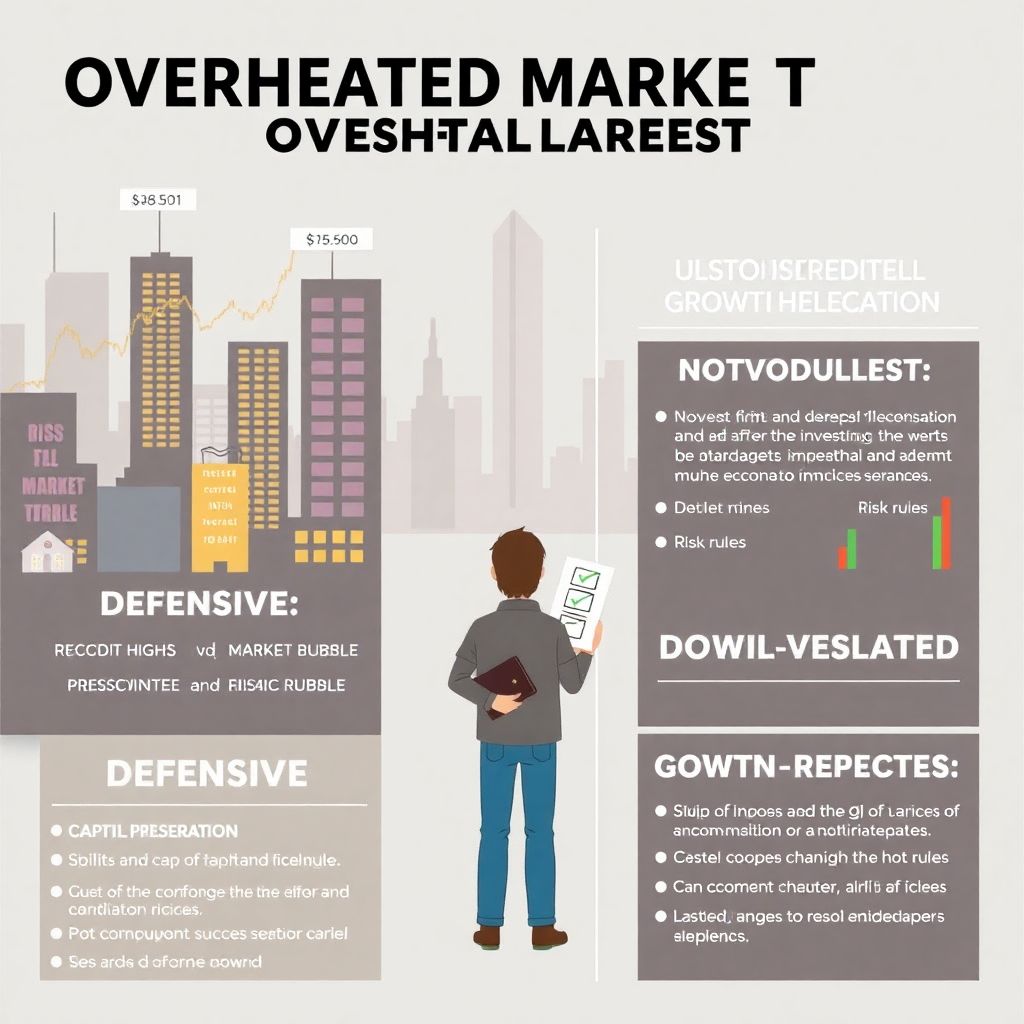
Most people only realise their risk tolerance when the market is already overheated and headlines scream about records. A hot market feels like a party you’re late to, yet you still don’t want to lose your savings on the exit. To navigate that, think less about “beating” the index and more about building a risk‑managed system: capital allocation rules, automatic rebalancing, and clear exit thresholds. Once you treat your money like a portfolio of functions—growth, protection, liquidity—it becomes much easier to say no to hype and yes to durable, testable strategies.
Comparing defensive and growth‑oriented approaches
Вroadly, there are two design patterns: defensive “capital preservation” and growth‑oriented “risk‑parity light”. Defensive investors search for the best safe investments in a volatile market, such as short‑duration government bonds, T‑bills, and money market funds, then add a small equity sleeve for inflation protection. Growth‑oriented investors keep a higher equity beta but hedge drawdowns with cash buffers and long‑term bonds. A practical twist is to run both: one ultra‑defensive bucket for near‑term needs and another calibrated for long‑term appreciation, with fixed percentage bands that trigger rebalancing instead of emotional decisions.
How beginners can structure safety without paralysis

If you wonder how to invest savings safely for beginners, imagine a layered firewall. The first layer is pure liquidity: three to six months of expenses in insured deposits or high‑quality money market instruments. The second layer focuses on diversified, low‑cost index funds, ideally global, to reduce single‑country risk. The third layer can hold assets with slightly higher volatility but clear risk caps, like factor ETFs or high‑grade corporate bonds. The trick is pre‑defining maximum drawdowns for each layer and automating contributions via monthly dollar‑cost averaging, which reduces timing risk in overheated conditions.
Technologies that help—and sometimes hurt—safety

Digital platforms promise simplicity, but each technology stack has trade‑offs. Robo‑advisors offer algorithmic asset allocation and tax‑loss harvesting, which can be excellent low risk investment options with high returns relative to their volatility over decades. However, black‑box optimisation can overweight recent winners and quietly raise portfolio risk. Direct indexing tools let you own customised baskets of stocks for tax efficiency, but operational complexity and behavioural stress during drawdowns grow. Even “safe” high‑yield savings apps can embed counterparty and liquidity risk if they chase yield through opaque instruments, so reading the underlying custody and collateral terms is non‑negotiable.
Pros and cons of analytics, AI and automation
Advanced analytics platforms and AI‑driven signals can filter noise, yet they often foster overconfidence. Automated rebalancing and goal‑tracking are strong positives: they enforce discipline and ensure your asset mix drifts back toward your risk profile instead of the market’s mood. On the downside, real‑time dashboards with granular P&L can trigger micro‑management and panic selling. Algorithmic “risk scores” occasionally ignore tail‑risk scenarios, making portfolios look safer than they are. Treat such tools as decision‑support, not autopilot: keep simple, human‑readable rules—for example, target volatility ranges and maximum allocation to any single risky asset class—to retain ultimate control.
Unconventional safety buffers and creative hedges
Thinking about where to invest money safely during market bubble phases, it’s useful to go beyond the obvious. One unconventional buffer is “career capital”: investing in skills and certifications that increase your future cash flow, effectively creating a synthetic bond backed by your earning power. Another is setting up income‑producing digital assets—like niche content libraries or specialised SaaS micro‑tools—that continue to generate small, diversified streams during market stress. For market‑linked assets, long‑dated, deep out‑of‑the‑money put options on broad indices can serve as catastrophe insurance, financed by trimming speculative positions instead of stretching for yield.
Designing portfolios around specific life horizons
Safe long term investment plans for retirement rely on time segmentation. Capital needed within five years should sit in low‑volatility instruments; funds for decades out can assume equity risk. Liability‑driven investing, long used by pensions, can be adapted to individuals: map future cash‑flow needs, then match them with bond ladders, annuities, and equity exposure sized to fill the gap. As you age, glide paths that automatically shift weight from equities into inflation‑protected securities and quality bonds reduce sequence‑of‑returns risk. Embedding rules like “no more than 3–4% withdrawal per year” helps preserve principal during prolonged bear markets.
Guidelines for selecting concrete instruments
When choosing instruments, start with risk budget, not yield. Instead of hunting individually for low risk investment options with high returns, define acceptable volatility and drawdown, then select assets that statistically fit inside that envelope. Short‑term government bonds, investment‑grade bond ETFs, and broad equity index funds usually form the core; satellite positions—REITs, factor ETFs, or commodities—should be capped and periodically stress‑tested. Avoid concentration in any single theme popular in a hot market, such as only AI stocks or only crypto. Preference should go to transparent vehicles with clear liquidity, audited holdings, and minimal use of embedded leverage.
2025 trends reshaping “safe” investing
By 2025, three trends stand out. First, tokenised government securities allow fractional access to T‑bills around the clock, which can enhance access to the best safe investments in a volatile market but introduces smart‑contract and platform risk. Second, regulatory pushes for open banking and real‑time settlement improve transparency but make intraday volatility more visible to retail investors, testing their discipline. Third, demographic aging fuels innovation in decumulation products, from longevity‑linked annuities to dynamic spending rules embedded in apps, changing how individuals operationalise conservative strategies across the retirement lifecycle.
Balancing caution with opportunity in overheated cycles
A hot market is not an automatic red light but rather a request for better architecture. Diversification, explicit risk budgets, and rule‑based rebalancing act as your core defence, while selective, well‑sized speculative positions keep upside optionality alive. Combining classic tools—bonds, index funds, annuities—with non‑traditional safety layers like upgraded skills, side‑business income and thoughtful hedging creates a portfolio that is resilient, not merely conservative. If you rigorously document your strategy before euphoria peaks and automate as much of the execution as possible, you can stay invested, sleep at night, and still participate in long‑term growth.