
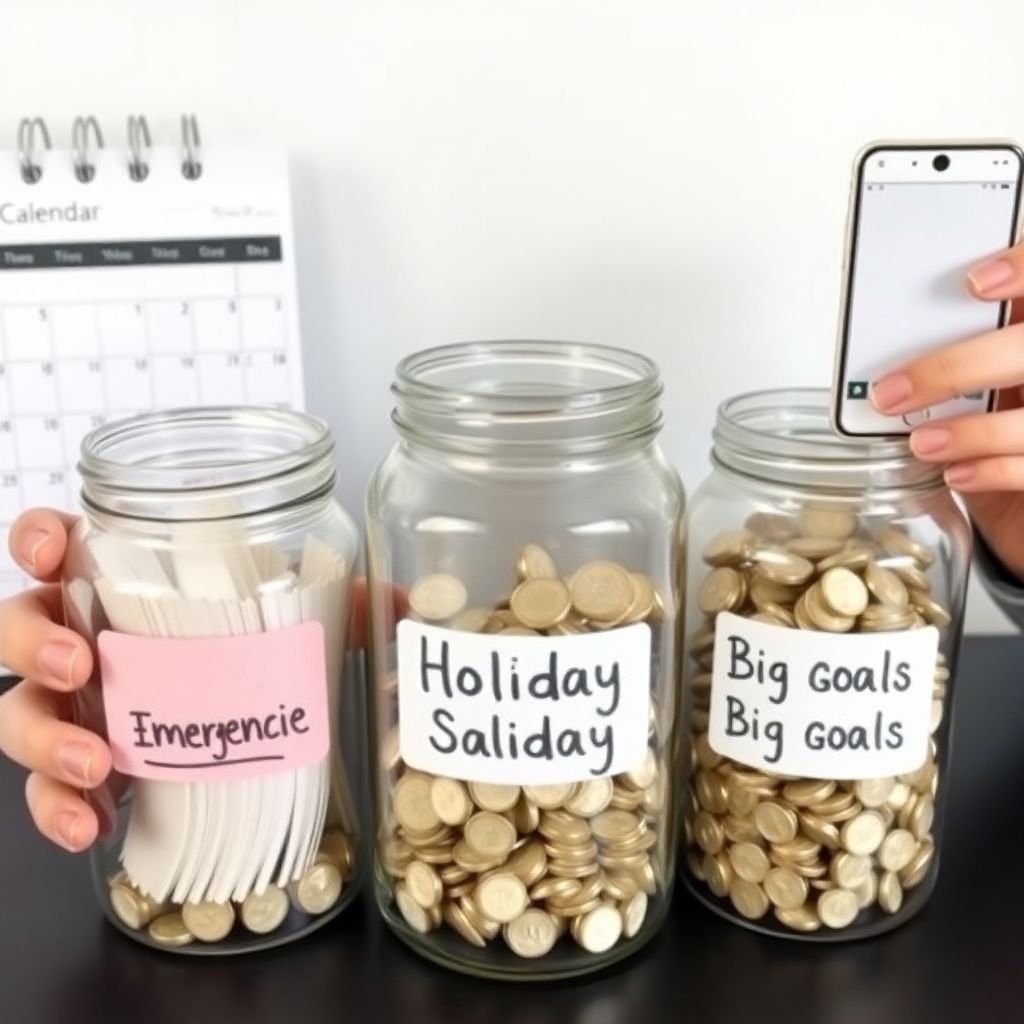
A simple savings plan channels your income into three buckets: emergencies, holidays, and big goals, using separate accounts, automatic transfers, and realistic timelines. You’ll first map cashflow, then set specific targets, pick safe savings accounts, automate contributions, and review monthly so your plan stays aligned with real-life changes and priorities.
Core Rules for an Actionable Savings Plan
- Separate money for emergencies, holidays, and big goals into different accounts to avoid mixing short-term spending with safety reserves.
- Automate transfers right after payday so saving happens before you feel the temptation to spend.
- Use only safe, FDIC/NCUA-insured savings accounts for emergency and near-term goals, not investments that can drop in value.
- Make each goal specific: exact amount, deadline, and monthly contribution needed, then adjust your budget to fit.
- Review once a month: rebalance contributions between buckets instead of constantly changing or pausing the plan.
- Increase savings whenever your income rises or a recurring expense ends, locking in lifestyle before it creeps upward.
Next action: Open or label three separate savings buckets today: Emergency, Holidays/Travel, and Big Goals.
Assess Your Baseline: Cashflow, Fixed Costs, and Risk Exposure
This method fits you if you have any regular income and want predictable progress without complex investing. It is not ideal if you cannot reliably cover essentials each month or if you are in deep high-interest debt; in those cases, stabilizing income and reducing expensive debt must come first.
- List your reliable income (after tax). Include salary, regular side gigs, and benefits that offset expenses (like housing support). Example: you take home $3,500 per month.
- Identify fixed and essential costs: rent/mortgage, utilities, groceries, minimum debt payments, transport, insurance, childcare. Sum them. Example: essentials total $2,600.
- Estimate variable and lifestyle spending: eating out, subscriptions, hobbies, non-essential shopping. Example: you currently spend about $600 here.
- Calculate current free cashflow: Income − Essentials − Lifestyle. With the examples: $3,500 − $2,600 − $600 = $300 currently available for saving or debt payoff.
- Check your risk exposure: Do you have unstable income? Are you the main earner? Any big predictable costs (repairs, medical, tuition) in the next year? High risk means prioritizing a larger emergency buffer before aggressive goal saving.
Example baseline conclusion: If you can reliably save $200-$300 per month after covering essentials, you can build an emergency fund while still putting something toward holidays and a big goal.
Next action: Write down your monthly take-home, essentials, lifestyle spending, and remaining amount so you know exactly how much can go into your savings plan.
Set Specific Targets: Emergency, Holiday, and Major-Goal Benchmarks
To turn vague intentions into a working savings plan, you need clear targets and simple tools: basic access to online banking, a spreadsheet or note app, and possibly automatic savings apps for goals and emergencies that let you set rules and track progress visually.
- Define your emergency fund benchmark: Pick a realistic first target (for example, one month of bare-bones expenses), then a longer-term target (such as multiple months). If bare-bones costs are $2,000, your first goal might be $2,000, longer-term $6,000.
- Outline holiday and travel plans: Decide how to start a savings plan for vacation and travel by picking one or two concrete trips within the next year and estimating their cost. Example: winter trip $1,000, summer trip $1,500, total $2,500.
- Clarify one or two big goals: These might include a car, home down payment, or education. Use separate savings accounts for long-term goals and big purchases so you can track them independently. Example: save $10,000 for a car in three years.
- Translate goals into monthly numbers: Divide each goal amount by months until the deadline. Example: $2,500 holidays ÷ 12 months ≈ $210/month; $10,000 car ÷ 36 months ≈ $280/month.
- Compare to your free cashflow: If your goals require $600 per month but you only have $300 available, lower amounts or lengthen timelines until the total fits your real budget.
Example target set: $2,000 emergency (12 months), $2,500 holidays (12 months), $10,000 car (48 months) might mean about $170/month emergency, $210/month holidays, $210/month car if your cashflow allows.
Next action: Write three clear targets with amounts and dates: Emergency, Holidays/Travel, and one Big Goal, plus the monthly contribution required for each.
Allocate Money Efficiently: Buckets, Percentages, and Trade-offs
-
Choose and label your savings buckets
Open or repurpose three separate accounts:- One high-yield savings for emergencies
- One savings for holidays and travel
- One savings for your main big goal
When you compare online banks for emergency and holiday savings, focus on no monthly fees, easy transfers, and a competitive rate.
-
Pick a safe home for your emergency bucket
Look for the best high-yield savings account for emergency fund needs that is FDIC- or NCUA-insured, offers same- or next-day transfers, and no withdrawal penalties. Safety and quick access matter more than squeezing out every last bit of interest. -
Decide on percentage splits across buckets
Based on your risk and deadlines, assign simple percentages of your monthly savings amount. Example for $300/month to save:- 60% ($180) to Emergency until it hits the first benchmark
- 25% ($75) to Holidays/Travel
- 15% ($45) to Big Goal
After the emergency fund reaches the initial target, you can redirect some of its percentage to holidays or the big goal.
-
Automate transfers right after payday
Set recurring automatic transfers on your main payday: from checking into each savings bucket based on the percentages above. Many banks and automatic savings apps for goals and emergencies let you schedule these rules so the money moves before you see it as spendable. -
Pre-plan trade-offs if money gets tight
Decide in advance what you will reduce first when something unexpected happens. For example:- Temporarily cut Big Goal contributions to protect Emergency and basic Holiday savings.
- Pause Holiday savings for one month before touching Emergency funds.
- Restore normal percentages as soon as the issue passes.
Example split: With $400/month to save and high risk (unstable job), you might do 70% Emergency ($280), 20% Holidays ($80), 10% Big Goal ($40) until your first emergency target is reached.
Fast-Track Version: 15-Minute Setup
- Open or label three savings accounts: Emergency, Holidays/Travel, Big Goal.
- Decide how much you can save each month (for example, $150, $250, or $400).
- Assign simple percentages: 60% Emergency, 25% Holidays, 15% Big Goal (adjust later if needed).
- Set three automatic transfers on payday for those exact amounts.
- Put a 15-minute calendar reminder one month from now to review and tweak percentages.
Next action: Set up automatic transfers from your checking account into at least two buckets (Emergency and Holidays/Travel) before your next paycheck arrives.
Emergency Fund Blueprint: Size, Liquidity, and Where to Park It
- Your emergency fund sits in a separate, clearly named account (not mixed with checking or goal savings).
- The account is a straightforward savings or money market account, not invested in stocks or anything that can drop in value.
- You can access the money within a couple of days without penalties or complex steps.
- The bank or credit union is government-insured (FDIC or NCUA) and has no monthly maintenance fee.
- You have a written first target (for example, one month of essentials) and a longer-term target (several months) documented somewhere.
- Your current balance and how many months of essentials it covers are easy to see at a glance.
- You make automatic contributions every month, even if small, and only pause them for true financial emergencies.
- You withdraw from this fund only for genuine emergencies (job loss, essential car repair, urgent medical), not for holidays or gadgets.
- When you do use it, you create a simple plan to refill it before ramping up other goals again.
Example checkpoint: If your essentials are $2,200 and your emergency fund is $1,100, you know you are at roughly half of a one-month target and can plan contributions to reach the full month in the next few months.
Next action: Confirm that your emergency savings are in a separate, insured account and decide your next emergency balance milestone in writing.
Speed-Up Techniques for Holidays and Big Goals Without Sacrificing Safety

- Relying on credit cards to pay for holidays instead of building the holiday bucket in advance, which quietly adds interest costs and stress.
- Investing short-term holiday or travel money in volatile assets that might drop right before you need to book, forcing you to delay or take on debt.
- Using one blended savings account for both urgent emergencies and vacations, which makes it tempting to raid your safety buffer for trips.
- Overcommitting to big goals and underfunding emergencies, leaving you exposed if you lose income or face a large unexpected bill.
- Ignoring windfalls (tax refunds, bonuses) instead of directing a planned percentage to holidays and your main big goal.
- Letting small lifestyle creep (subscriptions, food delivery, impulse buys) quietly eat the exact money that could shorten your savings timelines.
- Switching banks or accounts too often chasing tiny interest differences, rather than focusing on consistent contributions and simple rules.
Example speed-up move: If you receive a $600 bonus, you might send 50% ($300) to Emergency, 30% ($180) to Holidays, and 20% ($120) to your Big Goal instead of absorbing it into everyday spending.
Next action: Pick one upcoming windfall or expense cut and pre-decide what fraction will go to Holidays and your main Big Goal.
Maintain and Iterate: Automation, Tracking, and Monthly Rebalancing
Once the plan is running, you have several safe options for keeping it aligned with your life without constant micromanagement.
- Automation-first, manual tweaks monthly: Keep your automatic transfers fixed through the month, then adjust only during a scheduled review. This works best if your income is stable and you prefer a set-and-check-later approach.
- Percentage-based rules for variable income: If your income fluctuates, choose percentages of each paycheck (for example, 10% Emergency, 5% Holidays, 5% Big Goal) and adjust the actual amounts each time you get paid.
- Milestone rebalancing across buckets: When your emergency fund hits a milestone, slightly reduce its percentage and increase contributions to holidays or big goals, while still keeping emergencies growing slowly.
- Simple visual tracking: Use a spreadsheet, a note, or your banking app to list each goal, target, and current balance once a month. The visual progress keeps you motivated and shows where rebalancing might help.
Example rebalancing: After your emergency fund reaches the first target, you might shift from 60% Emergency / 25% Holidays / 15% Big Goal to 40% / 30% / 30% without increasing total savings.
Next action: Schedule a recurring 20-minute calendar event once a month to review balances, percentages, and whether your timelines still feel realistic.
Practical Concerns and Quick Clarifications
How many separate savings accounts do I really need?
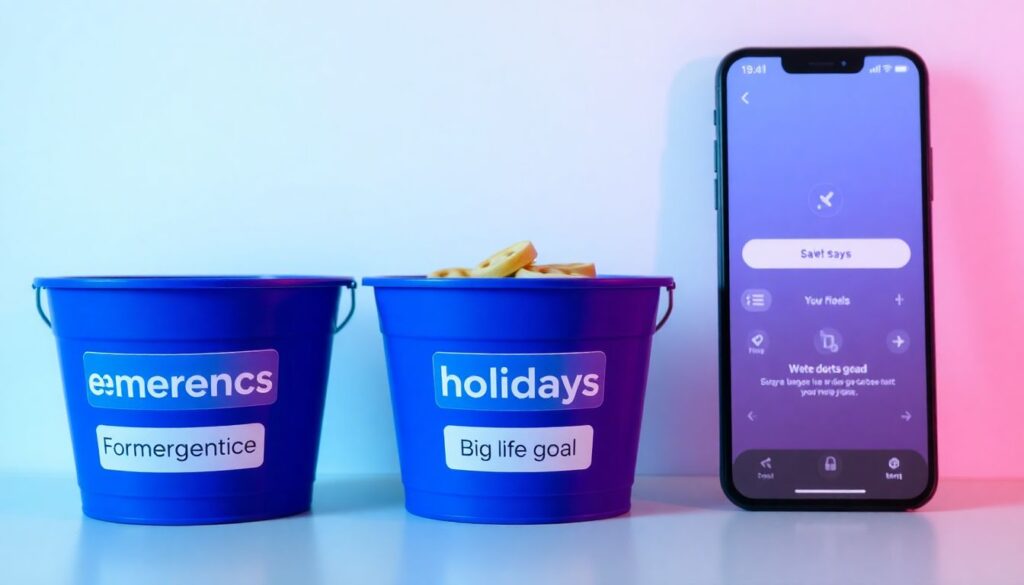
Three buckets usually work well: one for emergencies, one for holidays and travel, and one for your main big goal. If your bank lets you create labeled sub-accounts, that is often enough; otherwise, use separate accounts at the same or another reputable bank.
Should I pay off debt or build an emergency fund first?
Cover essential bills and minimum payments first, then start a small emergency fund while paying extra toward any high-interest debt. Once you have a basic buffer, you can balance additional debt payoff with growing your emergency and goal savings.
Is it safe to use apps that move money automatically?
Automatic savings apps for goals and emergencies are generally safe when they use reputable banks and strong security practices. Always enable two-factor authentication and start with small amounts until you are confident the app behaves exactly as you expect.
Where should I keep long-term goal savings?
For big purchases within a few years, savings accounts for long-term goals and big purchases at banks or credit unions are safer than volatile investments. If your timeline is very long and your risk tolerance is higher, investment accounts may be appropriate, but only after your emergency fund is solid.
What if I can only save a very small amount right now?
Start with the smallest consistent amount you can manage, even $10-$20 per month. Focus first on a tiny emergency cushion, then add holiday and big-goal contributions as income rises or you reduce expenses. Consistency builds the habit that lets you increase amounts later.
How often should I change my savings percentages?
For most people, monthly or quarterly adjustments are enough. Change percentages when your income shifts, a goal is reached, or your emergency fund hits a milestone, rather than reacting to every small spending surprise.
Is it worth switching banks for a better interest rate?
If another bank offers a clearly better experience and you can easily move your automatic transfers, switching can help, especially if you compare online banks for emergency and holiday savings regularly. However, the interest difference rarely matters more than steady contributions and simple, low-friction systems.